
All In: How Jewish Day Schools Create a Sense of Belonging
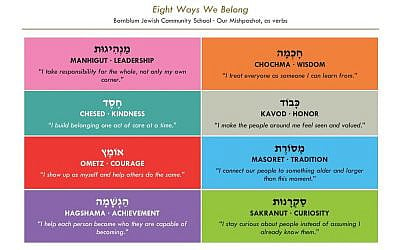
How do Jewish Day Schools create a sense of belonging? At Bornblum, we don’t sort our students into tribes or houses (like Harry Potter). Instead, we sort them into families. We call them Mishpachot, and each one carries a name that is also an aspiration: Manhigut, leadership; Chochma, wisdom; Chesed, kindness; Kavod, honor; Ometz, courage; Masoret, tradition; Sakranut, curiosity; and Hagshama, achievement. These eight families, eight middot (values-based characteristics), and a great deal of colored poster board and ink (I have developed opinions about which shade of grey reads best from across a gym; I did not have these opinions before we started the program in 2019).
Here is what I keep coming back to as we start our school year. The names on those posters are not adjectives. They are verbs.
We tend to talk about character as though it were a possession. She has patience. He has courage. That child is kind. It sounds like a compliment, and it is, but it quietly teaches something I don’t actually believe: that a middah is a trait you either received or you didn’t, like brown eyes or a good singing voice. Chesed is not something you have; chesed is something you do, this morning, for the kid whose morning is going worse than yours. Ometz is not a temperament; it is the specific, unglamorous act of raising your hand when you would rather disappear into your chair. The grammar matters more than it sounds. When we make middot into verbs, character stops being a report card of who you already are and becomes an invitation to who you might become today.
This brings me to a conversation we had this week during staff orientation, before a single student walked through the door. We were talking, of all things, about the difference between fitting in and belonging. I was inspired by the explanation that staff members gave of times when they felt they belonged and when they struggled to fit in. I was surprised by the teacher who said that fitting in takes more effort as an adult. And we were reminded that it is something that genuinely happens in every school for every student.
Fitting in is quiet work, and most of us are very good at it. It is the art of reading a room and then editing yourself to match it, sanding down the parts that might stick out (perhaps in a design lab space), laughing a half-second late so you are sure you are laughing at the right thing. Fitting in feels like acceptance, but it costs you a small piece of yourself every time, and the price is easy to miss because it is paid in loose change.
Belonging is different and is actually harder. Brené Brown puts it about as well as anyone: you belong somewhere only when you can show up as yourself, without trading in a smaller version of you for approval. Belonging does not ask you to shrink. It asks you to bring the whole, unsanded, occasionally inconvenient you, and it promises there will still be a non-judgmental seat for you. We strive for Bornblum to be a school with open seats, where every child and family feels a strong sense of belonging.
This summer, our whole staff took the CliftonStrengths assessment, and it turned out to be a quiet argument for the same thing. Your strengths, the assessment insists, are largely yours to keep; you can shore up the areas that come less naturally, but the ranking is unlikely to reorder itself. At first, that sounds like the opposite of what I’ve just said about verbs. It isn’t. Your strengths are the raw material you were handed; what you do with them, and around them, is still the verb. A team comes together not when everyone is strong at everything, but when each person shows up fully as themselves and trusts the others to cover the rest, or when each person knows where there might be holes that need overcompensation. That is belonging by another name: you contribute as who you actually are, not as a more complete version you think the room wants.
Here is where the two ideas meet, and where the phrase I can’t shake comes from. A school that treats its values as verbs is asking its students to be all in, to actually act with courage and kindness and curiosity rather than wear them as labels. And you cannot ask a child to be all in on who they are becoming unless they first believe they belong exactly as they are. The two are really a single move. Doing chesed requires the nerve to be seen doing it. Practicing ometz requires a room where being wrong out loud will not cost you your place. All in only works when a person feels safe enough to put all of themselves on the table.
Of course, there is a balancing thought here, and I don’t want to skip past it. Belonging is not the absence of boundaries; it is what makes healthy boundaries possible. (Prentis Hemphill’s line, that “boundaries are the distance at which I can love you and me simultaneously,” has been rattling around my head all summer.) A child who belongs can say no, without fearing exile. A child who is only fitting in can never really say no, because for them, every “no” expressed is a risk to their seat. So belonging and boundaries are not opposites; they are two sides of the same coin. You can only draw a line and stay in the room when you are sure the room is actually yours.
I am, I’ll admit, better at describing this than at living it; ask anyone who has watched me walk into a meeting late (doesn’t happen often, as I am one of those arrive early kind of people) and immediately try to blend into the wallpaper. But I get to spend my days around five-year-olds and thirteen-year-olds (and maybe even some adults) who have not yet learned to be anyone but themselves, and my job, as I understand it, is mostly to keep them that way. To build a place where the middot on the wall are things we do together, and where doing them all in never requires anyone to first become someone else.
That is the year I am hoping for. Eight families, a great many verbs, and a building full of children and staff who are all in, precisely because they already know they belong.