Gratitude | Purpose | Renewal
America 250 | Essay 3: Patriots of the Covenant
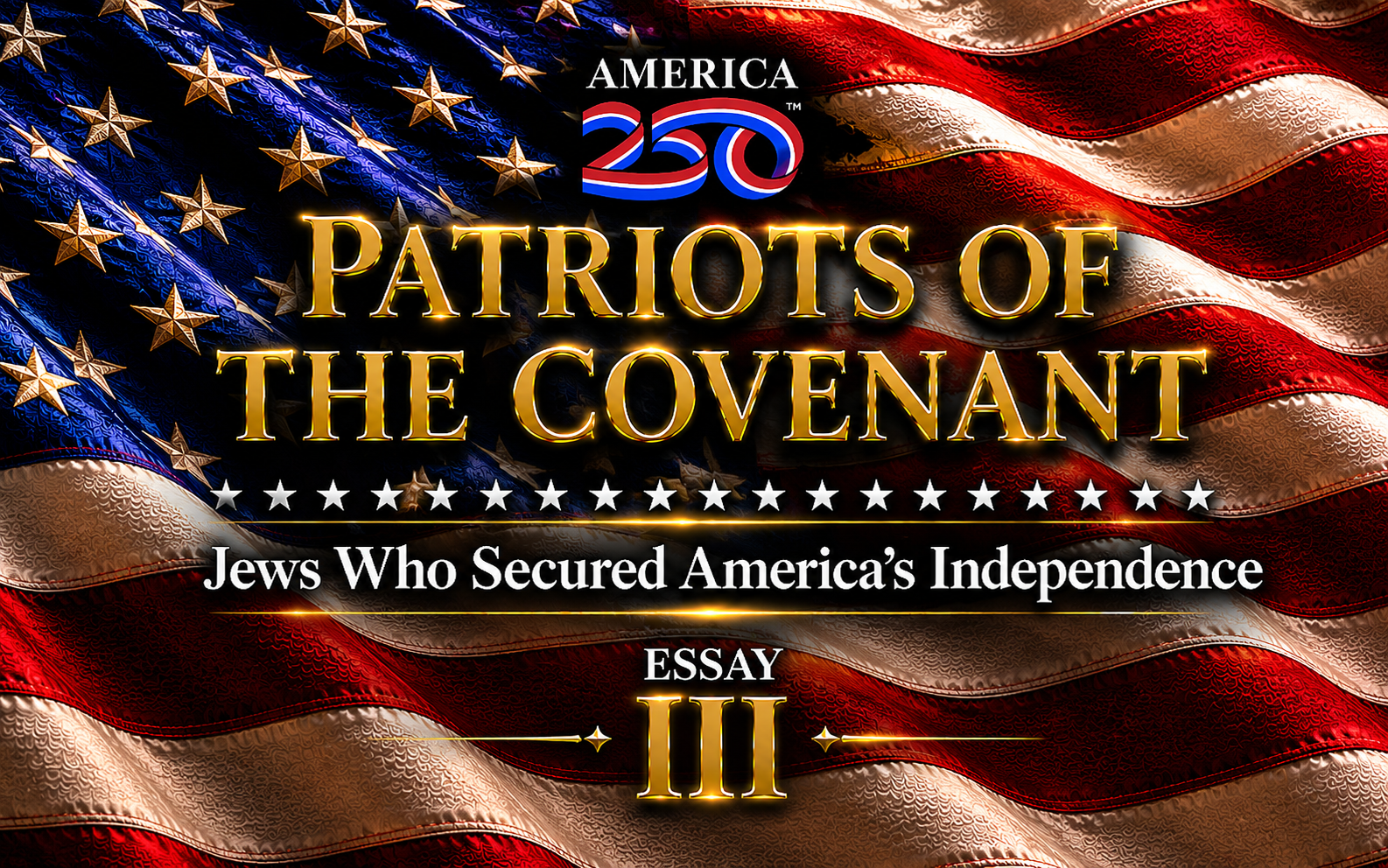
AI Generated Illustration
From financiers and soldiers to rabbis, women, and entire congregations, Jewish patriots stood at the heart of America’s fight for independence, shaping not only the nation’s birth but its enduring commitment to liberty.
A Covenant of Patriots
The American Revolution was a crucible in which a new political identity was forged; one grounded not in monarchy or bloodline, but in liberty, conscience, and the rights of individuals. For Jews in the colonies, this was more than a political upheaval. It was a covenantal moment: the first time in modern history that Jews could fight openly as equal citizens for a nation that promised freedom not as a favor, but as a right.
The Torah had long articulated a vision of political freedom. When Moses confronted Pharaoh with the words, “Let My people go, that they may serve Me” (Exodus 9:1), he introduced the world to the idea that liberation is not merely escape from tyranny, but the foundation of a moral society. Jewish patriots of the Revolution recognized in America’s struggle a modern echo of that ancient call.
This essay turns from symbols and scripture to action. Here, Jewish patriots step directly into the center of the Revolution; not as observers, but as indispensable participants in the struggle for independence.
Haym Salomon: The Financier of Freedom
Among the Jewish patriots of the Revolution, none stands taller than Haym Salomon. Born in Poland to a Sephardic family, he arrived in America in 1775 and immediately joined the Sons of Liberty. His revolutionary activity led to two arrests by the British, but he escaped and turned his talents to finance; a decision that would alter the course of the war.
Salomon became the Continental Congress’s most important financial broker. He converted French loans into usable currency, kept the government solvent when its coffers were empty, and provided the funds that enabled Washington’s decisive Yorktown campaign in 1781. When the government could not pay its own officials, Salomon quietly covered their salaries. When Congress needed liquidity, he found it. When Washington needed resources, Salomon delivered. By the war’s end, Salomon had committed over $600,000 of his own fortune to the Revolution; a sum worth tens of millions today. He died penniless, never repaid by the government he helped create. His patriotism reflected a deeper Jewish ethic; the Torah’s insistence that a just society must be built through human responsibility and sacrifice.
Jewish Soldiers in Washington’s Army
Jewish contributions to the Revolution were not limited to ledgers and loans. Jews fought; and died, for American independence. Francis Salvador, a Sephardic immigrant in South Carolina, became the first Jewish patriot killed in the war. Isaac Franks served directly under Washington. Jewish militiamen from Newport, Charleston, New York, and Philadelphia took up arms alongside their Christian neighbors, fighting in battles from the Carolinas to the Mid‑Atlantic.
Their motivation was rooted in a biblical principle older than any republic: “There shall be one law for the citizen and for the stranger who dwells among you” (Exodus 12:49). For the first time in centuries, Jews saw the possibility of living in a nation where equality under law was not theoretical, but attainable. Fighting for America meant fighting for a future in which Jews could live not as tolerated outsiders, but as full members of a free republic.
David Salisbury Franks: Loyalty Tested, Loyalty Proven
One of the most remarkable Jewish soldiers of the Revolution was David Salisbury Franks, a Philadelphian who rose to become one of the highest‑ranking Jewish officers in the Continental Army. He served as aide‑de‑camp to Benedict Arnold before Arnold’s treason, a connection that cast suspicion on him through no fault of his own. Franks was investigated twice. Franks was cleared twice.
His perseverance evokes the biblical charge to Joshua: “Be strong and resolute; do not fear or be dismayed” (Joshua 1:9). Washington and Congress continued to entrust him with sensitive diplomatic missions, a testament to his integrity and patriotism. His story reflects a deeper truth: Jewish loyalty in the Revolution was not assumed; it was proven, often under pressure, and ultimately honored.
Other Patriots of the Covenant: Unsung Jewish Heroes of the Revolution
While Salomon and Franks stand out, they were part of a broader constellation of Jewish patriots whose service shaped the Revolution in ways both visible and quiet. Gershom Mendes Seixas, the “Patriot Rabbi” refused to pray for King George III, carried his congregation’s Torah scrolls out of British‑occupied New York, and later participated in Washington’s inauguration; a symbol of Jewish belonging in the new republic. Mordecai Sheftall of Georgia, the highest‑ranking Jewish officer in the Revolutionary forces, endured imprisonment on a British prison ship while refusing to violate Jewish dietary laws.
Solomon Bush, severely wounded in battle, became the highest‑ranking Jewish officer in the Pennsylvania Line. Benjamin Nones, a French‑Jewish volunteer, fought in the Carolina campaigns and later defended Jewish civic equality in the early republic. The Gratz family, merchants and community builders, supplied the Continental Army and helped shape the emerging Jewish communal infrastructure of the new nation.
Jewish women, though fewer in number, also sustained the patriot cause. In Charleston, Jewish women organized fundraising drives and gathered provisions that kept Patriot soldiers supplied during the most uncertain phases of the war. In Philadelphia, women worked to preserve Jewish communal life amid occupation and displacement, ensuring that worship, charity, and education continued even as the city shifted between British and American control. Their efforts made Jewish patriotism not only a matter of battlefield valor, but of safeguarding community, dignity, and faith. Together, these women remind us that Jewish participation in the Revolution was broad, diverse, and rooted in a covenantal belief in liberty.
Mikveh Israel: The Synagogue of the American Revolution
If Salomon was the financier of freedom, Mikveh Israel was its spiritual home. Philadelphia’s historic synagogue became a hub of Jewish patriot activity. Its members donated funds, supplied goods, and supported the Continental Army. Salomon’s own manuscript shows he personally financed the synagogue’s construction and mediated internal disputes; a reminder that Jewish patriotism was both communal and national.
Mikveh Israel was not alone. Jewish communities in Newport, New York, and Charleston also played vital roles, providing material support and moral leadership throughout the war. Their synagogues became centers of civic engagement, where prayers for the Continental Congress mingled with the practical work of sustaining a revolution.
Washington and the Jews of Newport
The Revolution’s Jewish story reaches a turning point in 1790, when the Hebrew Congregation of Newport wrote to President George Washington. Their letter was not ceremonial. It was a plea for reassurance. For centuries, Jews in Europe had lived under regimes where “tolerance” was fragile; granted by rulers, revoked at whim, and always conditional.
It was Moses Mendes Seixas, the warden of Congregation Yeshuat Israel in Newport, Rhode Island, who presented this letter to Washington on behalf of the community. The Jews of Newport wanted to know whether the new American republic would be different. Would they be citizens or merely tolerated outsiders? Would the promises of the Revolution apply to them? Washington’s reply would become one of the most important documents in the history of religious liberty.
To Bigotry No Sanction: America’s Covenant of Equality
Washington’s response was unprecedented. He rejected the very idea of tolerance as a political framework. Tolerance implies that one group grants permission to another. The United States, by contrast, was founded on the principle that rights are inherent; not bestowed by the majority. He declared that the new nation “gives to bigotry no sanction, to persecution no assistance” grounding Jewish equality not in goodwill but in the Constitution itself.
For Jewish patriots who had financed, fought, and sacrificed for independence, this was the covenant made explicit. Washington’s words echoed the prophetic calling of Isaiah: “I have made you a covenant people, a light to the nations” – (Isaiah 42:6). In affirming Jewish equality, Washington was recognizing the Jewish role in the moral architecture of the republic.
The Jewish Place in America’s Founding
The American Revolution was not a Christian or Deist struggle alone. It was also a Jewish story; a story of financiers, soldiers, rabbis, women, and communities who believed in the promise of liberty and labored to make it real.
Their contributions are not a footnote to American history. They are one of its foundations; a testament to the enduring Jewish belief that freedom is both a gift and a responsibility, and that a just society is built by those willing to stand for it.
–––––––––––––––––––––––––––––––
About America 250: A Jewish Lens on the American Story
This five‑part series explores how Jewish ideas, values, and experiences helped shape the American experiment from its earliest symbols to its evolving identity. As the nation marks its 250th year, it invites readers to recognize how deeply Jewish thought, resilience, and moral imagination run through America’s past, present, and future. Essay 4 turns to the great wave of Jewish immigration that reshaped the 19th and 20th centuries, when the Jewish story became inseparable from the American story. From Ellis Island to the Lower East Side, it explores how Jewish resilience, education, and communal responsibility helped define modern American identity and fueled Jewish leadership in labor and civil‑rights movements.
Related Topics