Articles Crafted for Action
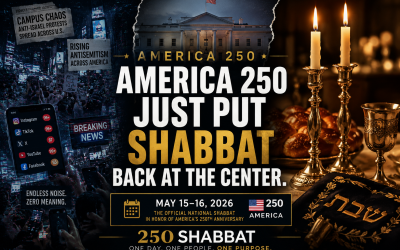
America 250 Just Put Shabbat Back at the Center
#250Shabbat #America250 #Shabbat #JewishUnity #JewishAmericanHeritageMonth
Everyone Reported Trump’s Shabbat Proclamation. Few Are Grasping What It Actually Means.
When President Donald Trump issued an official White House proclamation encouraging Jewish Americans to observe a national Sabbath in honor of America’s 250th anniversary, Jewish media covered it immediately.
The headlines appeared everywhere.
The Jerusalem Post.
JNS.
Jewish Insider.
The Times of Israel.
Chabad.
Community chats.
Social media feeds.
People noticed it.
But I am not sure people are fully grasping it.
Because beneath the headlines and political reactions, something much deeper happened here, something culturally and spiritually significant that many people seem to be skimming past too quickly.
For the first time in American history, a sitting president publicly called upon Jews to honor Shabbat as part of a national celebration of America itself.
Not merely to celebrate Jewish heritage.
Not merely to condemn antisemitism.
Not merely to acknowledge Israel.
Shabbat.
That matters more than people realize.
The official proclamation stated:
“In special honor of 250 glorious years of American independence and on the weekend of Rededicate 250 — a national jubilee of prayer, praise, and thanksgiving — Jewish Americans are encouraged to observe a national Sabbath.”
Read that carefully.
At a moment when modern culture increasingly pushes constant consumption, endless stimulation, social fragmentation, algorithmic addiction, and the erosion of family structure, the highest office in the United States publicly elevated one of the oldest spiritual institutions in human civilization:
a weekly day of rest, reflection, family, gratitude, prayer, and disconnection from the chaos of the world.
That is not insignificant.
Especially now.
Especially after October 7.
Since the massacre in Israel and the explosion of antisemitism that followed globally, Jews have largely existed in survival mode. Every day feels like another battle. Another attack. Another headline. Another protest. Another social media war.
And understandably, much of the Jewish conversation has become reactive.
Defense.
Fear.
Politics.
Messaging.
Damage control.
Necessary conversations, yes.
But exhausting ones.
What struck me so strongly about this proclamation was that suddenly the public conversation shifted away from Jewish victimhood and toward Jewish contribution.
Toward something timeless.
Toward Shabbat.
Not because Shabbat is trendy.
Not because it polls well.
Not because it is politically useful.
But because deep down, even many secular people instinctively understand that something about modern life is no longer sustainable.
People are spiritually exhausted.
Families barely sit together anymore.
Children are growing up inside screens.
Human beings cannot go five minutes without checking notifications.
Silence has become uncomfortable.
Rest feels almost illegal.
People brag about burnout as though exhaustion itself has become a status symbol.
And meanwhile, Judaism has carried within it for thousands of years an institution specifically designed to protect human dignity from exactly this kind of societal collapse.
Shabbat.
One day where productivity does not define human worth.
One day where family becomes central again.
One day where people stop chasing and simply exist.
One day where technology loses its control over us.
One day where holiness enters time itself.
Ironically, modern secular culture now spends billions trying to recreate fragments of what Shabbat already perfected centuries ago.
Digital detoxes.
Mindfulness apps.
Wellness retreats.
Slow living movements.
Mental health resets.
Judaism already built the original framework.
And perhaps that is why this proclamation hit me differently than it hit others.
Because I did not read it merely as a political statement.
I read it almost as a cultural signal flare.
A reminder that perhaps the Jewish people do not need to endlessly reinvent themselves to survive modernity. Perhaps some of the very things people dismissed as “outdated” are actually the antidote to many of the problems modernity itself created.
That realization is what pushed me to launch a grassroots initiative called “250 Shabbat,” a growing movement encouraging Jews across America to strengthen their connection to Shabbat in whatever way they can as part of the America 250 celebration.
Not through pressure.
Not through shame.
Not through politics.
Through invitation.
Since launching it, I have watched people from communities all across the country begin stepping forward wanting to help spread the message into Jewish chats and networks. Five Towns. Miami. Houston. Arizona. Los Angeles. Baltimore. Chicago. Lakewood. Montreal. Deal.
And what struck me most was not only the response itself, but the emotional tone of the response.
People seem hungry for this.
Hungry for something grounding.
Something unifying.
Something deeper than another outrage cycle.
Because outrage may energize people temporarily, but it cannot sustain civilization.
Shabbat can.
America is approaching its 250th birthday.
The Jewish people have survived for thousands of years not merely because we fought enemies successfully, but because we protected institutions that preserved our spiritual identity across generations.
Shabbat was one of them.
And maybe that is why this moment feels bigger than people realize.
Not because a president mentioned Jews.
But because in one of the loudest and most overstimulated eras in human history, the conversation unexpectedly returned to stillness.
To family.
To holiness.
To rest.
To gratitude.
To Shabbat.
And perhaps many more people are ready for that conversation than we think.
To join or help spread the 250 Shabbat movement:
https://chat.whatsapp.com/D2pfJc22Pd807PX8GOcsiA?mode=gi_t
Related Topics
Related Posts