
Israeli-American attorney and Chairman of Republicans Overseas Israel
Featured Post
America must help protect Syria’s Druze
The US lifted sanctions against Syria to help ensure a stable nation that protects its minorities. The Druze plight is a litmus test for those commitments
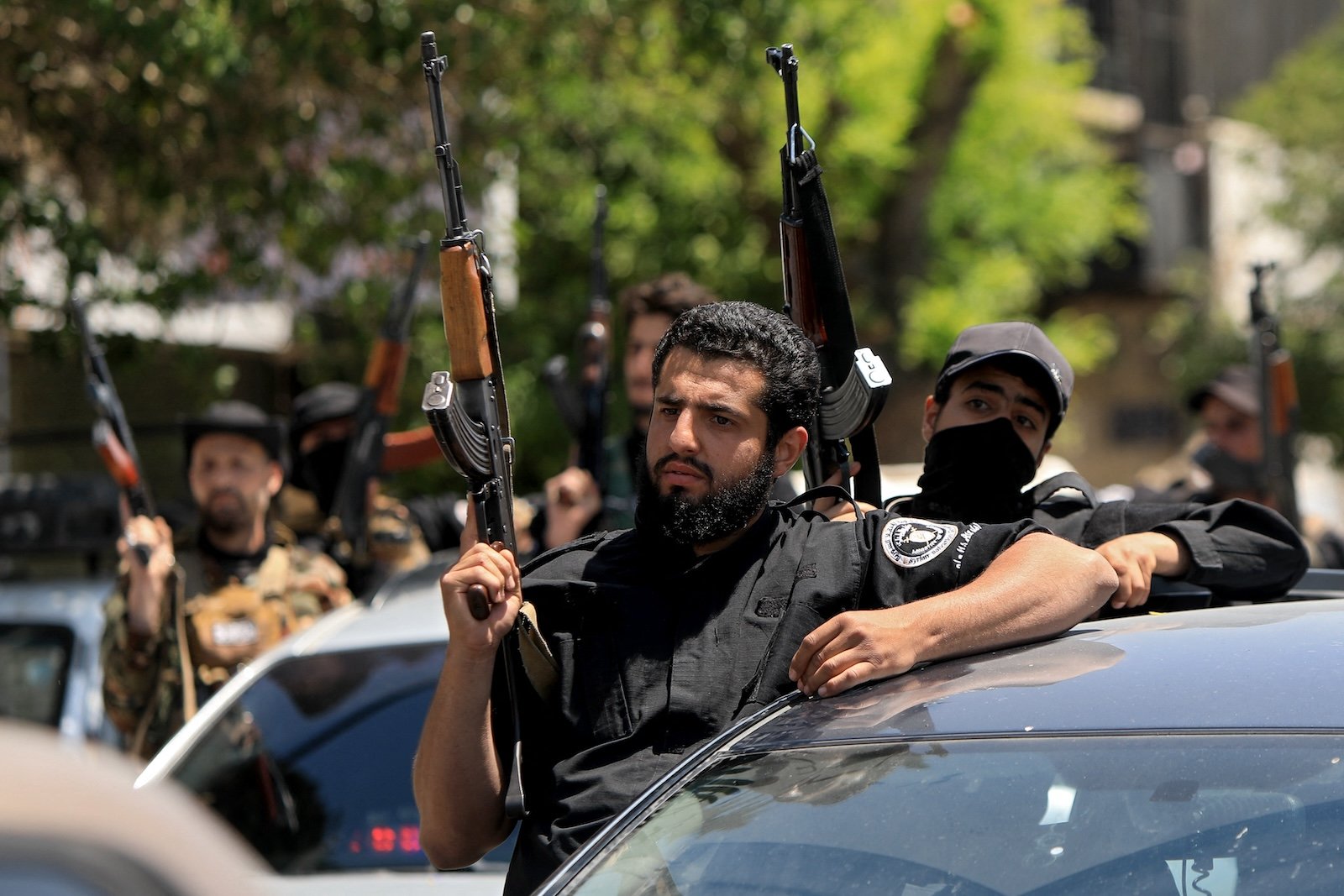
Members of Syria's security forces stand guard next to their vehicles in the capital Damascus on April 29, 2025, following overnight sectarian clashes that left nine people including six Druze fighters dead. (Bakr ALKASEM / AFP)
Following the collapse of Assad’s regime, Syria’s 700,000-strong Druze minority finds itself increasingly vulnerable to sectarian violence and government neglect. Recent deadly clashes in Sweida province, where Bedouin attackers humiliated elderly Druze merchants in scenes reminiscent of Nazi tactics, have escalated to such a degree that Israel was compelled to conduct airstrikes against Syrian forces to protect the Druze community — underscoring an urgent humanitarian crisis that demands immediate US intervention to prevent further destabilization.
* * *
Following the collapse of Assad’s regime, Syria’s 700,000-strong Druze minority finds itself increasingly vulnerable to sectarian violence and government neglect. Recent deadly clashes in Sweida province, where Bedouin attackers humiliated elderly Druze merchants in scenes reminiscent of Nazi tactics, have escalated to such a degree that Israel was compelled to conduct airstrikes against Syrian forces to protect the Druze community, underscoring an urgent humanitarian crisis that demands immediate US intervention to prevent further destabilization.
Syria’s Druze community, concentrated in Sweida province in southern Syria, represents a religious minority whose monotheistic faith derived from the Ismaili branch of Shia Islam. Despite their efforts to remain neutral in Syria’s civil war and take arms only to defend their towns and villages, the Druze have increasingly become targets of political neglect, economic suffocation, and violent repression.
Following Assad’s regime collapse in December 2024, power shifted to Ahmad al-Sharaa (Abu Mohammad al-Julani), leader of Hay’at Tahrir al-Sham (HTS), a former al-Qaeda affiliate. Under his rule, Druze concerns have intensified, as HTS forces previously targeted non-aligned minority groups through violent crackdowns, arbitrary detentions, and extrajudicial killings.
The Druze community’s apprehensions are rooted in painful history with al-Qaeda affiliates. In June 2015, al-Nusra Front fighters executed at least 20 Druze villagers in Qalb Lozeh, just weeks after al-Julani publicly claimed his group upheld a tolerant stance toward the Druze. Nearly a decade later, that same individual now occupies Syria’s presidency, fueling doubts about entrusting Druze safety to a former jihadist.
This pattern of violence continued in July 2018, when ISIS militants launched coordinated assaults across Sweida province, claiming over 250 civilian lives and abducting dozens of women and children in one of the civil war’s deadliest single-day atrocities.
The Syrian government’s persistent failure to protect the Druze has created a humanitarian crisis demanding immediate international attention. This neglect has destabilized the region, as evidenced by violent clashes beginning July 13, 2025, between Bedouin tribes and local Druze fighters in Sweida.
According to the Syrian Observatory for Human Rights, the conflict has claimed 99 lives, including 60 Druze fighters and civilians, 18 Bedouin, 14 security personnel, and seven unidentified individuals. The violence began when Arab Bedouins abducted an elderly Druze merchant and attempted to shave off his mustache — reminiscent of Nazi tactics against bearded Jews in 1939 Poland. These clashes closed the Damascus-Sweida highway, disrupting vital connectivity and commerce.
The situation deteriorated to such an extent that Israeli forces conducted airstrikes against Syrian government forces moving toward Sweida. Prime Minister Netanyahu stated that Israel is “committed to preventing harm to the Druze in Syria due to the deep brotherly alliance with our Druze citizens.” Israeli officials described the strikes as “exceptionally large-scale,” targeting tanks, armored personnel carriers, and access routes.
This systemic neglect has trapped the Druze in a cycle of violence and deprivation. The community faces killings, dire poverty, and critical lack of medical care and basic infrastructure. Without adequate protection or justice, the Druze are left to fend for themselves in escalating lawlessness.
This crisis stands in stark contrast to principles outlined in the recent lifting of certain US sanctions on Syria, which reaffirmed commitment to fostering a stable, unified nation that safeguards minorities and denies safe haven to terrorists. The Druze plight represents a litmus test for these commitments.
For the United States, addressing this crisis is not merely a moral obligation but a strategic imperative to prevent further regional destabilization. The Executive Order rescinding Syrian sanctions provides that persons committing human rights abuses after July 1, 2025, will remain subject to sanctions. By addressing this crisis, the United States, Israel and the broader international community can reaffirm their commitment to a stable Syria that upholds the rights and security of all its people.
Related Topics