
Rabbi • Jewish & Israel Educator • Community Builder
America, the Other Jewish Homeland
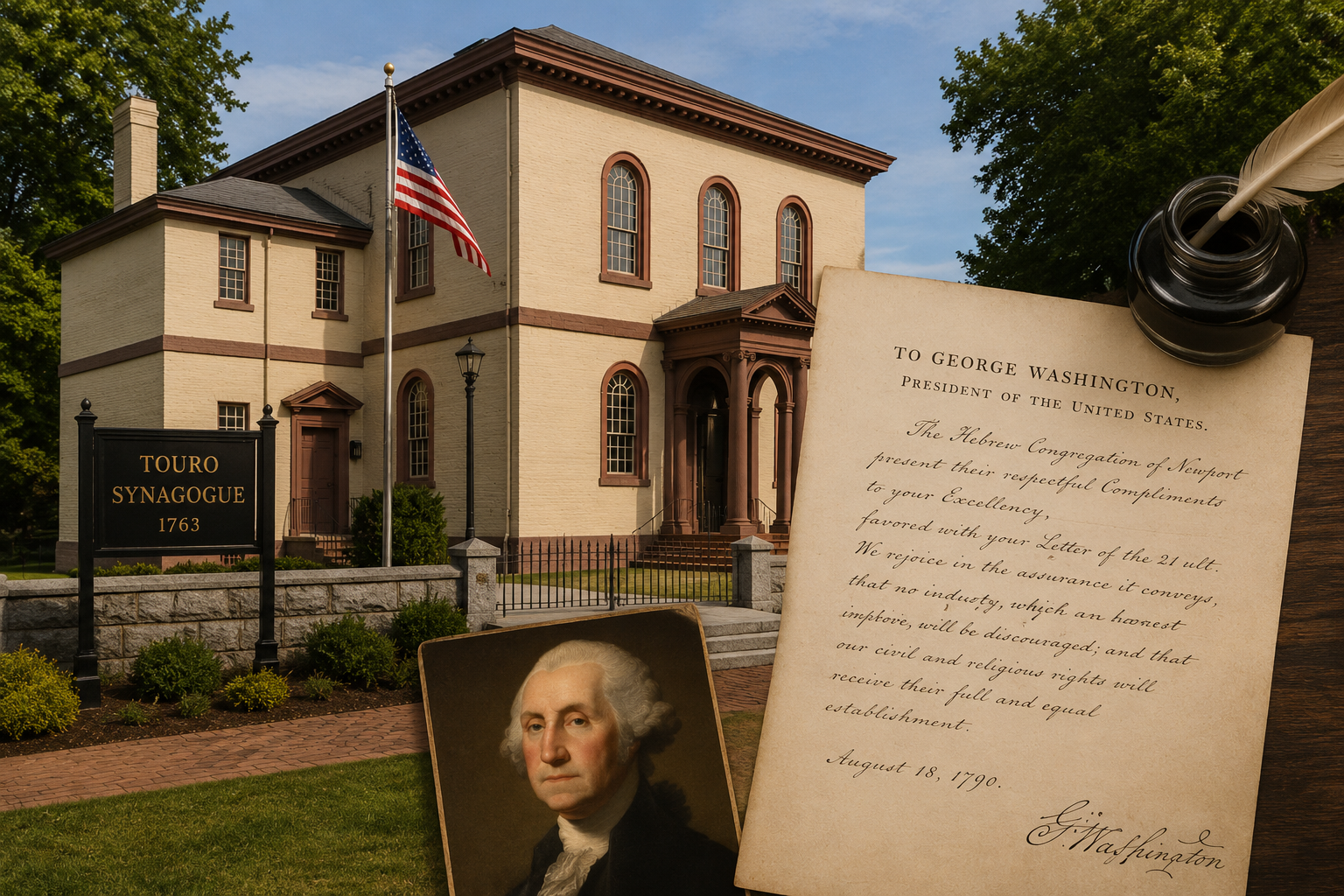
Touro Synagogue in Newport, Rhode Island, America's oldest synagogue. In 1790, President George Washington wrote to the congregation that the United States would give "to bigotry no sanction, to persecution no assistance." Photo by Kenneth C. Zirkel via Wikimedia Commons (CC BY-SA 4.0).
As Americans celebrate Independence Day this weekend, millions of people will gather for barbecues, parades, fireworks, and backyard parties. In Chicago, where I live, many of those celebrations will include a local tradition: the Chicago-style hot dog. It is hard to imagine a more American scene, and it is also hard to imagine a more Jewish one.
The story of the American hot dog runs through German Jewish immigrants, Chicago’s Jewish neighborhoods, kosher butchers, and companies like Vienna Beef, founded by Jewish immigrants who helped shape the city’s culinary identity. Like so many quintessentially American traditions, the hot dog tells a story of newcomers becoming Americans while remaining themselves.
This year feels different. America is not merely celebrating another Fourth of July; the United States is entering its 250th year. A quarter of a millennium after the signing of the Declaration of Independence, Americans are asking what the nation has achieved, where it has fallen short, and what its future might hold. American Jews should be asking a related question: what has America meant for the Jewish people?
The standard answer is that America became the greatest Diaspora community in Jewish history. There is certainly truth in that, as American Jewry grew to become the largest, wealthiest, and most influential Jewish community ever to exist outside the Land of Israel. But as America’s 250th anniversary approaches, I wonder whether that description is no longer sufficient. What if America is not simply the greatest Diaspora in Jewish history, but something fundamentally new?
For nearly two thousand years, Jews lived as minorities scattered throughout the world. Some societies tolerated Jews, others welcomed them for a time, and many persecuted them. Nearly all shared one assumption: Jews could remain Jews, or they could fully belong, but doing both at the same time was extraordinarily difficult.
In medieval Europe, Jews possessed communal autonomy but not equality. After the French Revolution, Jews increasingly received legal equality, but often only as individuals. As the French statesman Clermont-Tonnerre famously declared during the debates over Jewish emancipation, society should grant “everything to the Jews as individuals, and nothing to the Jews as a nation.” The message was clear: you may become citizens, but your Jewishness must ultimately become private.
America offered something different. The Constitution prohibited religious tests for public office, and the First Amendment protected the free exercise of religion. Most remarkably, the American experiment developed a model of citizenship that did not require Jews to stop being Jews.
In 1790, when the Hebrew Congregation of Newport wrote to President George Washington expressing hope that the new nation would reject Europe’s long history of religious persecution, Washington responded with words that have become famous: “To bigotry no sanction, to persecution no assistance.” Those words deserve their place in American history, but what has always struck me is something even more profound. Washington did not answer Jews as individuals who happened to practice a different religion; he answered a Jewish community and acknowledged Jews collectively as participants in the American project.
For perhaps the first time in Jewish history, a major nation was saying not merely, “We will tolerate you,” but “You belong here.” Of course, American history has never been perfect. The United States has struggled with discrimination, prejudice, exclusion, and failures to live up to its founding ideals, and Jews themselves have experienced antisemitism throughout American history. The promise of America has often exceeded the reality.
Yet when measured against the broader sweep of Jewish history, something extraordinary happened here. American Jews built synagogues, schools, camps, charities, newspapers, universities, advocacy organizations, and cultural institutions. They entered public life, served in government, shaped commerce, influenced culture, and helped write the American story, doing so not by abandoning Judaism but while openly embracing it.
This distinction matters because it helps explain one of the great puzzles of modern Jewish life. Classical Zionism emerged in response to societies that repeatedly demonstrated the fragility of Jewish belonging. The founders of Zionism believed that no matter how successful Jews became, they would eventually discover that they remained outsiders. Looking at Europe, they were right; looking at much of the Middle East and North Africa, they were right; and looking at the twentieth century as a whole, they were tragically right.
But America complicated the story. For generations, American Jews embraced Zionism passionately while simultaneously building a future in the United States. They loved Israel, supported Israel, visited Israel, prayed for Israel, and sent their children to Israel, yet most remained here. They did so not because they lacked commitment to the Jewish people or loved Israel less, but because America had succeeded in ways few societies ever had.
Israel answered the Jewish question of sovereignty, while America answered the Jewish question of citizenship. One became the homeland of Jewish self-government, and the other became the homeland of Jewish belonging.
As America turns 250, this may be the most important conversation American Jews need to have. The relationship between American Jews and Israel is often framed as a story of growing distance, misunderstanding, or decline, and there is some truth in those concerns. But perhaps we are asking the wrong question. Perhaps the real story is not a failure, but the unprecedented success of two extraordinary experiments: the rebirth of Jewish sovereignty in Israel and the flourishing of Jewish life in the United States.
For two thousand years, Jews dreamed of returning home, and in the modern era, something remarkable happened. They returned home, and they built another one.
This essay is the first in a multi-part series marking America’s 250th anniversary and exploring the relationship between American Jewish life, Zionism, citizenship, and belonging.
Related Topics
Related Posts