
CEO of Time to Stand Up for Israel
American Jews, Wake Up!
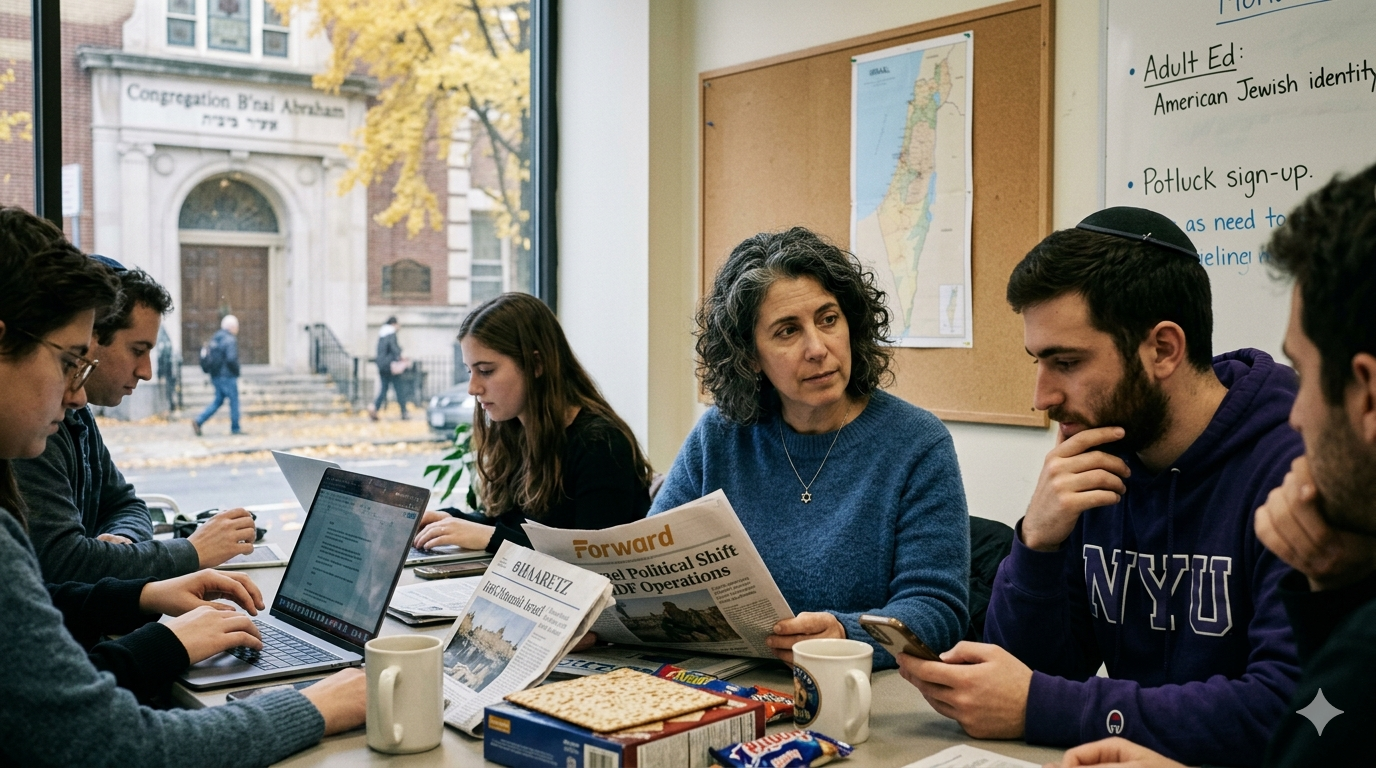
Photo Credits: Sabine Sterk (AI)
Why So Many American Jews No Longer Understand Israel
I still remember the day I met an American Jew in a hostel in Israel.
He was from Texas, if I recall correctly. He was participating in one of the well known Jewish heritage tours through Israel. What struck me immediately was not that he was visiting Israel. It was the fact that he had hidden it from almost everyone in his life.
He had not told his family.
He had not told his coworkers.
He had not told his friends.
Instead, he had invented an entirely different story about where he was going.
Why?
Because in his social environment, being openly enthusiastic about visiting Israel was apparently something that was frowned upon.
That alone was remarkable. But what came next was even more astonishing.
As we sat together, he began telling me what he believed about Israel.
According to him, Arabs were not welcome in shopping malls.
Arabs were routinely beaten by Israelis.
Israelis spat on Arabs in the streets.
The so called West Bank was supposedly an area where Arabs were not allowed to live freely and where discrimination was the norm.
He spoke about checkpoints as if they existed purely to oppress people.
The more he talked, the more I realized that almost everything he believed about Israel was either grossly exaggerated, completely detached from reality, or simply false.
So I began explaining.
I spoke about Judea and Samaria, not merely as disputed territory but as the historical heartland of the Jewish people.
I explained why checkpoints exist in the first place.
They were not created because Israelis enjoy inconveniencing others. They were established after years of suicide bombings, terrorist attacks, shootings, and murder campaigns that claimed the lives of countless innocent civilians.
I explained that Israelis themselves often pass through security checks.
Tourists pass through them as well.
Security procedures are a reality in a region where terrorism has been a constant threat for decades.
We talked for three hours.
The next morning, I saw him again during breakfast.
He was crying.
His entire perception of Israel had been shaken.
He admitted something that I have never forgotten.
“I just didn’t know.”
Think about that for a moment.
A Jewish man visiting Israel for the first time.
A man connected by ancestry, history, and identity to the Jewish people.
And yet he knew almost nothing about the reality of the country.
His understanding had been built almost entirely on narratives, headlines, social media posts, and second hand opinions.
For several days we continued talking.
We discussed Jewish history.
The Arab Israeli conflict.
The security situation.
The miracles of Israel’s survival.
The rescue of Ethiopian Jews.
The constant threat posed by Hamas, Hezbollah, and Iran.
By the end of his trip, he had become a member of Time To Stand Up For Israel. He even donated to support soldiers serving at security checkpoints.
For a brief moment, I thought he had discovered something important.
Then he returned to America.
Two months later, he disappeared.
The old narratives returned.
The old environment reclaimed him.
And that experience taught me something profound.
Many American Jews are living in a completely different reality from Israelis.
Of course, this is not true of everyone. There are countless proud Zionists in the United States. Many support Israel passionately and stand by the Jewish state through good times and bad.
But it is impossible to ignore the growing disconnect that exists between large parts of American Jewry and the reality of life in Israel.
Part of the explanation lies in the American educational system.
The United States is a vast country. Educational standards vary dramatically between states and districts. International history and geopolitics often receive less attention than domestic issues.
Americans live in a continent sized nation. A person can travel thousands of kilometers and still remain inside the same country. By contrast, Europeans are constantly exposed to different languages, cultures, and perspectives.
The result is that many Americans naturally focus on America first.
Another factor is historical experience.
Israeli Jews live in a region where military service is common, where security concerns are part of daily life, and where the consequences of war are never far away.
American Jews generally grow up in one of the safest and most prosperous democracies on earth.
Their Jewish identity is often centered around religion, culture, family, and social values rather than national survival.
Neither experience is inherently wrong.
But they are fundamentally different.
A third factor is distance.
It is easy to have opinions about terrorism when rockets are not falling near your home.
It is easy to speak abstractly about security when your children are not serving in the military.
It is easy to criticize checkpoints when you have never experienced the aftermath of a suicide bombing.
Distance changes perspective.
Perhaps most importantly, younger generations of American Jews often encounter Israel through university campuses, social media platforms, activist movements, and highly politicized debates.
Many first learn about Israel through accusations rather than history.
They hear about occupation before they hear about the Six Day War.
They hear about settlements before they hear about centuries of Jewish connection to the land.
They hear about Palestinian grievances before they hear about Jewish refugees expelled from Arab countries.
Context disappears.
Reality becomes distorted.
This should concern every Jew, whether living in Jerusalem, New York, Tel Aviv, Los Angeles, Haifa, or Miami.
The Jewish people have survived for thousands of years because they understood that they were one family.
Different opinions are natural.
Disagreement is healthy.
Ignorance is dangerous.
Israel is not perfect.
No country is.
But the survival of the Jewish state remains one of the greatest achievements in Jewish history.
If future generations are to understand that achievement, they must experience Israel directly.
They must walk its streets.
Meet its people.
Hear its stories.
Understand its challenges.
Programs that bring American Jews closer to Israeli society are not luxuries. They are necessities.
The future of Jewish unity depends on it.
Because if there is one lesson I learned from that young man from Texas, it is this:
People cannot defend what they do not understand.
And they cannot love what they have never truly known.
The Jewish people face enough challenges from outside. We cannot afford to lose connection with one another from within.
More than ever, Jews must stand together.
Related Topics