
America’s Return on Its Ongoing Investment in Israel
America’s Return on Its Ongoing Investment in Israel
Let’s clear up a general misunderstanding:
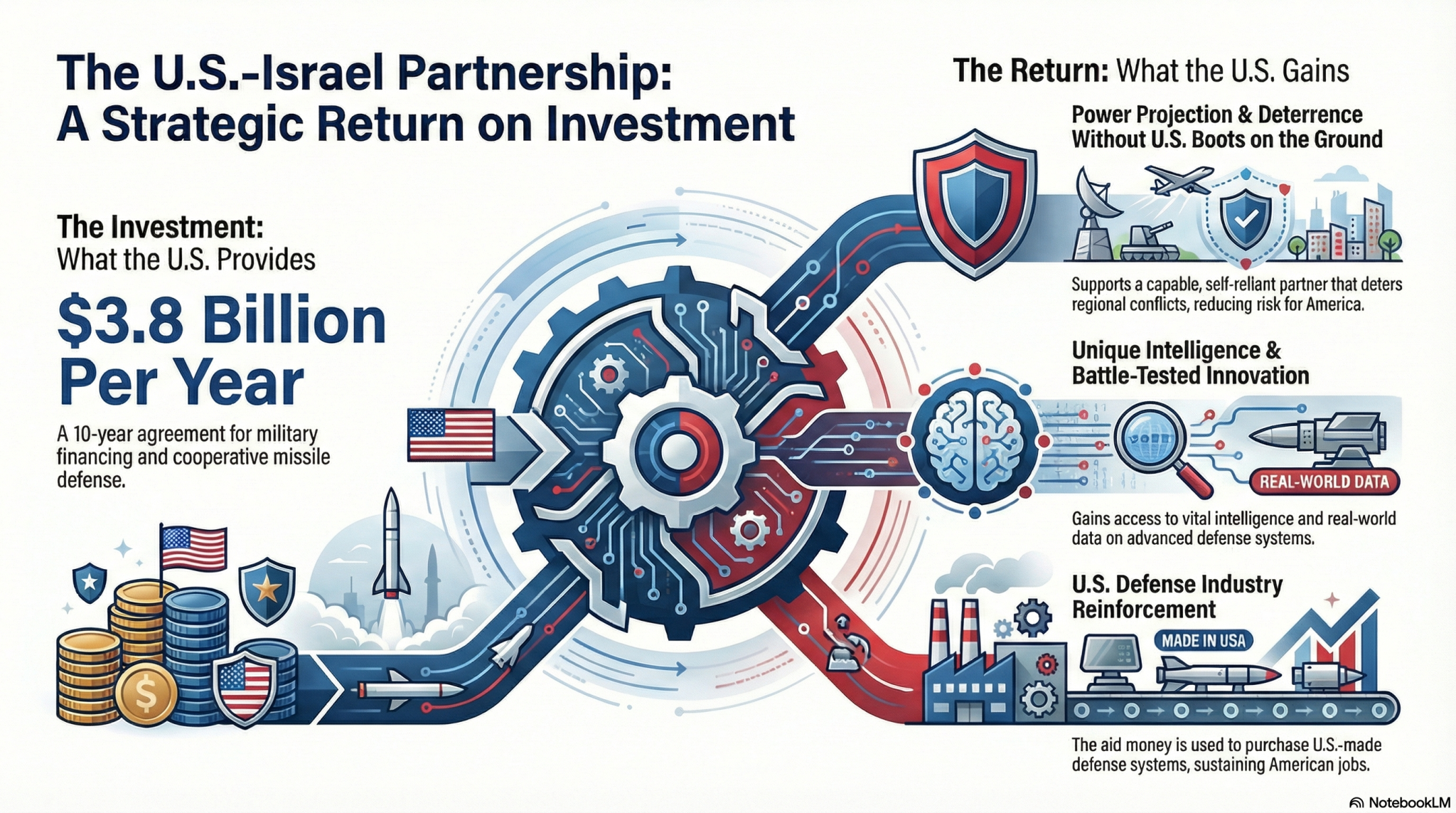
For a few cents on the foreign-aid dollar, the United States buys a security-and-technology partnership it cannot cheaply replicate anywhere else. It does not send money to Israel but finances the purchase of material made in the US.
Israel did not become strong because America helped. America helps because Israel is strong.
That distinction matters—especially now, when US foreign aid is under louder scrutiny, and when even Israel’s prime minister is publicly floating a long-term ambition to “taper” Israel off US military aid in the next decade.
If aid is going to be debated honestly, it should be described honestly. US aid to Israel is not charity, and it is not a nostalgia project. It is a strategic instrument Washington uses to purchase something real: a security-and-technology partnership that returns value to the United States across deterrence, intelligence, defense innovation, and regional leverage.
And yes, in a federal ledger the size of America’s, it is remarkably small. Under the current Memorandum of Understanding (FY2019–FY2028), US assistance totals $38 billion over 10 years—$3.3 billion annually in Foreign Military Financing plus $500 million annually for cooperative missile defense, subject to Congressional appropriations.
Depending on how you define “foreign aid” in a given year (obligations, disbursements, or broader “international affairs” spending), Israel’s share lands anywhere from a few percent to the mid-single digits.
So what does the United States get for it?
1) Power projection without US boots on the ground
Israel is a rare kind of ally: militarily capable, technologically sophisticated, and—crucially—self-reliant. The United States gains a forward strategic partner in the Middle East without having to station large US ground forces to keep the alliance meaningful.
In a region where American entanglement is politically toxic and operationally costly, that is not a talking point. It is a strategic bargain.
2) Intelligence the US can’t replicate at the same depth
Israel sits on the fault lines of Iran, Hezbollah, Hamas, jihadist networks, weapons trafficking, and cyber conflict. Its intelligence services operate with regional access, language fluency, and human networks that the US cannot simply purchase or duplicate on demand.
This is not romance. It’s geography, capability, and proximity—turned into actionable insight. Washington values that, quietly, because it reduces uncertainty and improves decisions in crises.
3) A “battle lab” for the systems America is going to need
The aid package is structured around interoperability and co-development, especially in missile defense. The US and Israel jointly fund and refine layered air and missile defense under real-world conditions—conditions that test systems in ways Pentagon simulations can’t fully reproduce.
America learns from Israeli operational realities: drones, rockets, precision-guided threats, urban terrain, command-and-control under saturation. Those lessons feed US doctrine and procurement at a time when the US is preparing for drone-heavy, missile-heavy battlefields across multiple theaters.
4) A defense-industrial cycle that flows back to the US
A common misunderstanding is that US aid is money “sent overseas.” Much of it is FMF (Foreign Military Financing)—assistance that is used to purchase US-made defense systems, sustaining American production lines, suppliers, and skilled labor.
Washington is not merely “helping Israel buy weapons.” It is also underwriting demand for its own defense base while keeping a key partner interoperable with US forces.
5) Deterrence that can prevent bigger—and more expensive—wars
A strong Israel forces adversaries to calculate. When the regional balance is clear, escalation is harder. When Israel appears weak or isolated, escalation becomes tempting.
From Washington’s view, aid is partly preventive spending: bolstering the partner most willing and able to impose costs on Iran’s proxy strategy—thereby reducing the likelihood of a wider war that might eventually drag Americans in at far higher cost.
6) A reliable ally in a neighborhood of fragile partnerships
The Middle East is full of transactional relationships, regime instability, and sudden policy swings. Israel’s advantage, for Washington, is not that it is always easy—but that it is predictable. It does not collapse, flip, or require regime-rescue interventions to remain a functioning partner.
That stability is strategic value in itself.
7) Technology spillover beyond the battlefield
Israel’s edge in cyber defense, intelligence software, and dual-use innovation is not an abstract “startup nation” slogan. Close security ties accelerate cooperation that strengthens both countries’ resilience—especially as cyber threats, disinformation, and AI-enabled attacks become central to national security.
8) Influence, not dependency
Aid does not mean the US “controls” Israel. But it does preserve alignment—shared standards, coordinated planning, interoperability, and an institutional relationship that outlasts political friction.
Cutting aid does not make Israel disappear as a regional actor. It mostly reduces US leverage in moments when Washington wants coordination most.
The honest framing
US aid to Israel is best understood as what it is: a strategic partnership agreement expressed in dollars, weapons, and joint programs—one the US has formalized through the MOU framework.
Americans can still argue about oversight, conditions, and policy disagreements. Israelis can still argue about sovereignty and the long-term wisdom of relying on any external patron. But neither side should pretend the relationship is a one-way humanitarian donation.
A win-win, if we treat it like one
For Israel, American aid helps preserve qualitative military edge and buys strategic breathing room in a hostile region—without substituting for Israel’s duty to defend itself.
For the United States, the return is measurable: deterrence without deployments, intelligence depth, real-world defense innovation, industrial reinforcement, and a stable, capable partner in a region where stability is scarce.