At the beginning of the Holocaust, Lithuanian locals began murdering Jews prior to the arrival of Nazis. Lithuania had the highest murder rate of Jews in all of Europe. The participation of locals in the persecution and slaughter of Jews was simply massive.
In the 8 months after Germany’s June 1941 invasion of Lithuania, a Lithuanian Jew’s best chance of survival was to flee to Nazi-occupied areas to the south of Lithuania.
Let me reiterate – it was safer for a Jew to be among Nazis than to be among their Lithuanian neighbors.
This is noted in accounts in the memorial books for Eišiškės and Valkininkai.
The are two reasons for this:
Nazi Germany had no policy of mass-murder in 1941; and
In June 1941 the Germans restored ethnic Lithuanians to the civilian and police positions that they had held immediately prior to the June 1940 Soviet takeover of Lithuania.
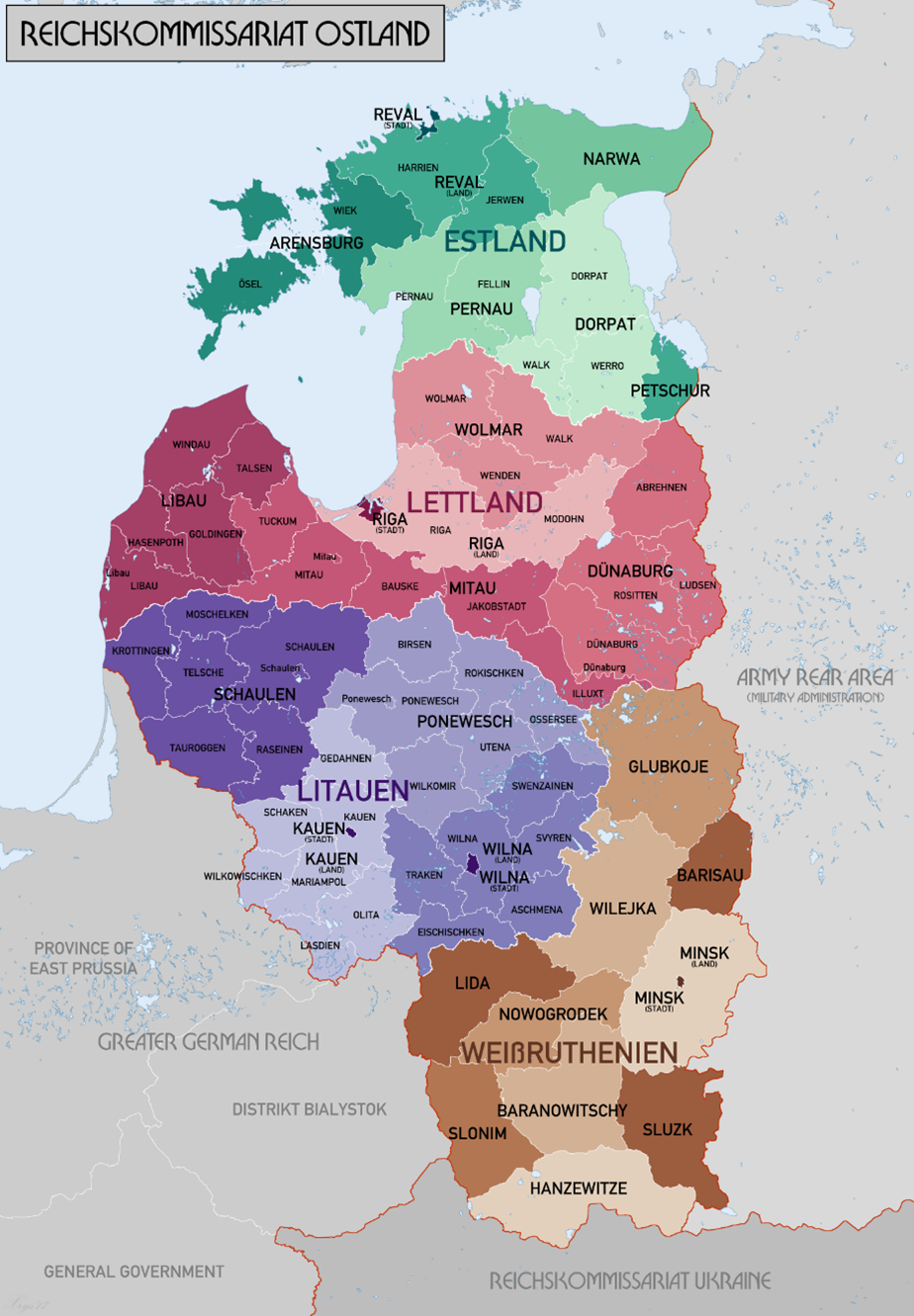
In the second half of 1941, ethnic Lithuanians had day-to-day control in the purple-shaded area, Generalbezirk Litauen (General District of Lithuania). Nearly all Jews in this area were murdered well before December 1941.
In the second half of 1941, ethnic Lithuanians had day-to-day control in the purple-shaded area, Generalbezirk Litauen (General District of Lithuania). Nearly all Jews in this area were murdered well before December 1941. Source: https://en.wikipedia.org/wiki/Reichskommissariat_Ostland#/media/File:Reichskommissariat_Ostland_Administrative.png
Most of the mass murders in the brown-shaded area, Generalbezirk Weissruthenien, occurred between mid-May and the end of July 1942, several weeks after Nazi Germany’s January 20, 1942, Wannsee Conference. By then, Jews had heard reports of the massacres in the towns in Lithuania and some were fortunately able to make plans to evade round-ups and escape to the forests.
The current government of Lithuania chooses to focus exclusively on the 0.04% of Lithuanians who are “Righteous Among the Nations” rescuers of Jews. They ignore and negate the other 99.96% of Lithuanians who are not “Righteous Among the Nations”. The relentless focus on the 0.04% is the Government’s ploy to use the rescuers as an alibi for the whole nation. It does not take a statistician to understand how manipulative and dishonest these declarations are.
Using this incredibly minute number to boast how Lithuanians helped Jews, is simply preposterous. It is utterly deceptive and constitutes Holocaust distortion.
Lithuania, it is time for an honest conversation.
About the Author
Grant Arthur Gochin is a diplomat, author, researcher, and wealth advisor whose public work focuses on historical accountability, Jewish continuity, antisemitism, and recognition doctrine.
He serves as Honorary Consul for the Republic of Togo and as Emeritus Dean and a Member at Large of the Executive Committee of the Los Angeles Consular Corps. From 2018 to 2020, he served as Special Envoy for Diaspora Affairs with the African Union Mission to the United States.
Gochin also serves, in a voluntary, unremunerated and non-executive capacity, as Advisor on Recognition Doctrine and Sovereignty to the Mthwakazi Republic Party, Office of the President. His work there concerns international recognition, sovereignty, state continuity, comparative precedent and remedial self-determination. Unless expressly stated otherwise, his published views are his own and do not represent the positions of any government or institution with which he is or has been associated.
His philanthropic work in Togo led to his investiture as Chief of the Village of Babade.
For several decades, Gochin has researched Holocaust history, Jewish heritage and historical memory in Lithuania. He served as Chair of the Maceva Project, working on the documentation, preservation and restoration of abandoned and neglected Jewish cemeteries. His archival research, litigation and public advocacy have focused particularly on the treatment of Holocaust perpetrators and collaborators in Lithuanian state memory and on documented instances of Holocaust distortion by state institutions.
He is the author of Malice, Murder and Manipulation (2013), which traces the destruction of his family in Lithuania and examines subsequent historical distortion. His writing regularly addresses antisemitism, Holocaust memory, governmental misinformation, Israel’s legitimacy and security, and the political use of historical narratives.
Gochin is a PhD candidate in Holocaust and Genocide Studies at Gratz College. His research examines institutional responses to documented claims concerning Holocaust memory, historical accountability and post-genocide historical revisionism.
Professionally, Gochin is a Certified Financial Planner™ and wealth advisor based in California. He holds an MBA earned with academic honors and leads Grant Arthur & Associates Wealth Services.
He lives in Los Angeles with his husband, son, and dog, Kelev.
www.grantgochin.com