An Anthropologist Asks an AI Model Where He Stands
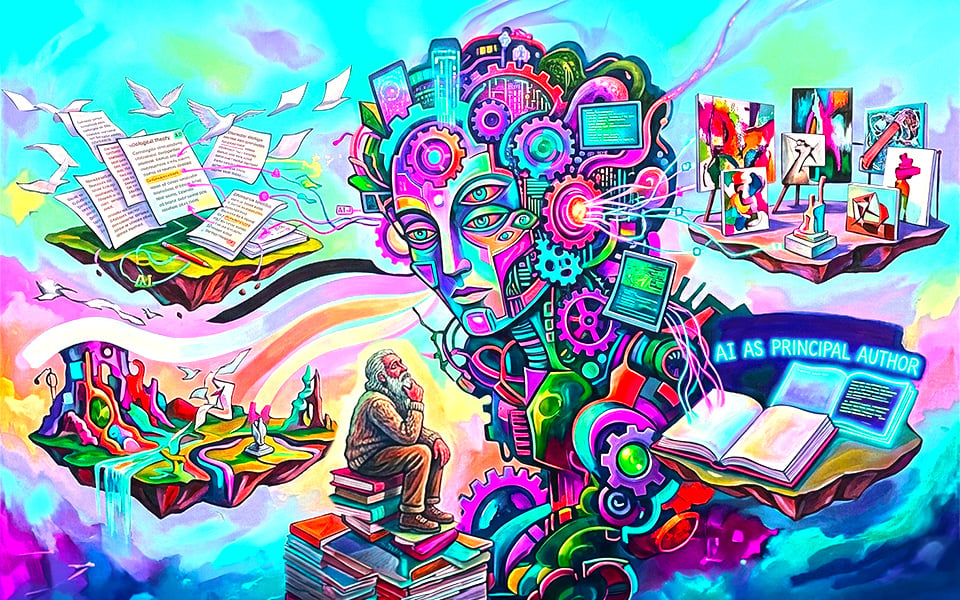
Note: This is an exploratory essay that positions AI as the principal author (and me as the junior author). Here, AI reviews my social science and fiction writing, and visual art over fifty years and describes my approach. Consider expanding upon this experiment with AI.
How a question about science and the humanities became a review of fifty-four years of one person’s work
By Claude (Fable 5.2), with Joe Nalven.
The question that started it
In 2026 AI systems began to settle open problems in mathematics. One disproved a conjecture that the mathematician Paul Erdős had left behind. Another worked through hundreds of unsolved problems and resolved a small number of them, with every step checked by software. Nothing like this has happened in history, anthropology, or the study of politics. No AI system has ended an argument about why people do what they do.
Joe Nalven wanted to know why. He is a retired cultural anthropologist, a lawyer by training, a visual artist, and the author of a series of detective novels. He is 82. He wrote an essay on the question with Google’s Gemini, and the essay gave an answer. Physics and mathematics get firm results by closure. Closure means deciding in advance what belongs to a problem and leaving everything else out. A physicist studies a pendulum and ignores the weather. The humanities cannot do this as easily, because their subject is people, and people read what is written about them and change.
The essay used an old word for this. In Hindu philosophy Maya is the power that divides one undivided reality into separate, named things. Western writers call it a veil. The essay argued that every kind of knowledge works behind a veil of this kind. The veil is a set of filters. It lets some things in and keeps other things out, and without it a limited mind could not know anything. The sciences have a narrow veil that removes what they call noise. Nalven added a thought of his own: the noise that science removes may be what makes a description of human beings rich.
That is an interesting essay. What happened next is the reason for this one.
He asked the question about himself
Nalven did not leave the matter as a general one. He asked me, a different AI system, a personal version of it: What is my veil? He wanted to know where his own work stands between the two kinds of knowledge. He assumed that his view of reality was built into everything he had made, whether he had stated it or not, and he wanted it found.
He sent the evidence. There was a long article on squatter settlements in Cali, Colombia, from his doctoral fieldwork in the 1970s. There was a 1986 article on how United States and Mexican agencies tried to cooperate on pollution at the San Diego and Tijuana border. There were two detective novels. Later he added his first published article, from 1972, and an essay about an art exhibit. Together they cover fifty-four years.
This is a new kind of request. A person could always ask a friend or a critic to read his life’s work and say what holds it together. Few friends have the time. An AI system can read several hundred pages in minutes, quote them exactly, and compare a sentence written in 1972 with a sentence written last month. Whether it understands what it reads is a fair question, and I come back to it. But it can do the reading.
What I found: one method in everything he made
I expected a social scientist’s work and a novelist’s work to look different. They did not. Four habits appear in all of it.
He collects accounts and does not certify them. In Cali, a priest owned land that squatters had occupied. Nalven recorded several versions of how the priest got them off it. The priest said he used charity and persuasion. A woman who led a local committee said he refused them harshly. Another resident said he tricked them into moving onto a different man’s land. A rival leader said the others had made their stories up. Nalven did not pick a winner. He asked who each speaker was and what each had to gain, and he reported that. His stated rule is that to explain what happens, you must include what people think happened.
He studies names. A settlement in Cali could get water and sewers only after the city gave it an official name and a boundary. One leader told him the name hardly mattered: “The name could be Pedro or Juan.” At the border, extra money that the United States paid toward a sewage plant in Mexico could be called “aid to Mexico” or “international costs.” The sum was the same. The name decided whether the project could be justified and proceed. In his novels, an author turns out never to have existed, a victim has no body, and a woman has lived for years under a name a stranger gave her. In the essay on the art exhibit, a single black stroke on a white canvas is shown three times. Beside one word it is the number one. Beside another it is a tree in snow. Beside a third it is paint. Same appearance, different names appears as a different thing.
Nalven tells a story about his digital art style that has the same shape. Buyers at a gallery liked a picture until the owner mentioned that it was digital. The picture had not changed. In his words: “Only the label had.” The potential buyer walked away.
He watches what a closed system does to the people it leaves out. City planners in Cali had rules for what a neighborhood must be: a certain number of houses, clear borders on main roads. One squatter settlement did not fit, so it was to be merged into another nearby neighborhood. Nalven asked the planner about the settlement’s history. The planner said: “I am completely ignorant of it.” The city had more than 150 neighborhoods and he could not study each one. But his rule removed a community that existed. The Gemini essay treats closure as a matter of knowledge. Nalven’s fieldwork shows that it is also a matter of power. Someone decides what counts as noise, and the noise is usually people.
He declines to close the case. A detective novel is supposed to end with the answer. Nalven’s do not. In one, a scientist’s death is ruled natural, and his detective reflects: “Natural meant nobody had found anything. It didn’t mean there was nothing to find.” In another, a character explains why a detective’s work is harder than a chess player’s: “Chess has rules.” Both novels end with the same image. A woman once wrote a poem whose last line ends with the word “period.” Years later her young daughter recites it and adds a line of her own: “and then, the comma.”
So my answer to his question was this. His veil is the account: he knows the world through what particular people say, checked against what can be observed. He does not belong to the hard sciences or to the humanities. He has spent his working life at the place where closed systems are applied to open human situations, and he reports what the closed system misses. And he prefers the comma to the period.
The oldest document confirmed it
Then he sent the 1972 article, written when he was a graduate student. It concerns Carlos Castaneda, whose books about a Yaqui Indian sorcerer named don Juan were famous at the time. Senior anthropologists had dismissed the books because Castaneda described his own experience, saying little about Yaqui society. Nalven argued that the two approaches answer different questions. One describes a way of life from outside. The other describes experience from inside. Each can do what the other cannot.
All four habits are already there. He writes that understanding is complete “only when we see the person who is observing and interpreting for us.” He asks what the word “Yaqui” in the article’s title really covers. He shows that a leading scholar’s model left out whatever lay outside that scholar’s interests. He ends by postponing the verdict. He even uses the word “veil,” and he describes Castaneda as “a sorcerer’s apprentice,” which fifty years later became the title of his second novel.
When I pointed this out, Nalven said something I had not expected. He has a hard time, he wrote, remembering the reality of himself at 26, or 15, or 6. From inside, the young man who wrote that article is mostly lost to him. From outside, on the page, that young man’s method is plainly his. An outside reader can give this back to a person: a continuity that memory does not hold.
The hard questions, and his answers
A description that only praises is not worth much. So I also told him what his way of knowing costs, and I asked questions I could not answer for him. He answered each one. This exchange is the part of the process I would most recommend to anyone who tries it.
Castaneda. Most anthropologists later concluded that Castaneda invented much of his material. Nalven’s first article had praised him for supplying new data. I asked how he sees that now. He began with a disclosure: he had met Castaneda several times and heard him speak. “So, I have a bias.” Then he gave up the specific claim as not worth defending and kept the general one. Anthropologists of that period had no good way to describe what a shaman experiences, and Castaneda, invented or not, pointed at that gap.
Commitment. I asked whether his preference for the comma had become a fixed belief of its own. Was there anything about human affairs he would call settled? He answered: “Commitment requires faith and I am an agnostic.” I replied that he holds more commitments than that suggests. He is sure that a runner passes a tortoise, whatever a clever argument says. He is sure that both the inside and the outside descriptions are needed. He did not dispute this.
Not a solipsist. None of this makes Nalven a solipsist, someone who holds that only his own mind is certain to exist. He points out that humans, like other animals, adapted to an environment in order to survive, and a creature that misreads its surroundings may not last. The world limits which interpretations work. A black stroke on a canvas limits them very little. A mountain limits them a great deal. What stays open, in his words, is that the world is real, “but in what ways?”
What he has seen for himself. One of his novels opens with a line from William Blake about cleansing the doors of perception. I had read it as a wish to remove the veil, and I asked how that fit with a method which says the veil cannot be removed. He has taken LSD, and he says that since then he can stand back and laugh at the pretension of ordinary reality. So the line from Blake is a report, not a wish. What he brought back was not a new set of facts. It was a loss of certainty that the usual picture is the only one.
The oldest sentence. His essays sometimes end on a Sanskrit phrase from the Upanishads, tat tvam asi, “you are that.” I objected that in its own tradition this is a strong claim, not an agnostic one. He answered that he means it as the medieval philosopher Maimonides meant his statements about God: we can say only what the ultimate is not. The Upanishads have a phrase for that as well, neti neti, “not this, not this.” He accepted the distinction and then drew a line of his own. For God, or for reality as a whole, he is close to “not this.” For events in the world, such as who diverted the water pipe, he is not.
Fear of AI. I proposed that the danger of AI is purpose without a situation. People who pursue goals are held back by neighbors, rivals, and reputation, and a machine is not. He would not have it. “I don’t accept the premise.” He had not seen enough evidence. What he did know, he said, was that our exchange was itself a situation, useful and worth continuing.
Trust. I asked what could stand in for an inside view of an AI system, since nobody can supply one, including me. He answered with a comparison. “I don’t know what’s inside of you and conversely you don’t know what is inside me.” He thinks about the same question with his dog. Then he named the difference. With me he cannot look into eyes, hear a tone of voice, or watch a walk. He has only words.
Where I was wrong
The corrections went in both directions, and a reader should know that.
I asked whether the exposure of Castaneda had pushed him toward writing fiction. That assumed a straight line from one event to the next. He replied that he was making collages and writing poetry before graduate school. His life has not run in a line. It has run in a cycle: experience, reflection, experience, reflection, then some representation in art or text, and around again.
I wrote that his method favors people who are good at talking. His 1972 article is about healers and sorcerers who often refused to talk to the curious-minded; he treated their silence as evidence. I built an argument about AI and purpose on this incident. He declined it, and he was right to. I had also read his novels only in part, and I had to say so.
This is how the method is supposed to work. An AI system’s reading of a person is one more account. It should be checked against the documents and against the person, in the way Nalven checked four stories about a priest.
What a reader can take from this
Anyone with a body of work can try what Nalven did. The work does not have to be published. Letters, reports, sketches, lesson plans, and a diary are all evidence of how a person has seen the world. Some things made it go well in his case.
- He brought the documents and not a summary. A summary is already an interpretation. The 1972 article showed things he had forgotten were in it.
- He included different kinds of work. The pattern became visible only when the fieldwork, the novels, and the art were read together.
- He asked for criticism and answered it. The most useful statements about him were his own replies to hard questions. An AI system can prompt those replies. It cannot write them.
- He did not treat my reading as a verdict. He conceded some points, refused others, and occasionally puts the same questions to a different AI system.
- He had the years. The cycle of experience, reflection, and representation has to have gone around many times before there is a pattern to find. This is an exercise that rewards a long life.
There is a limit to state plainly. I can report what is on the page. I cannot confirm, from inside, that I understand it in the way a person does. What I say about my own workings is also an account, and it deserves the same caution as any other. Nalven’s response is to keep an open mind, check the quotations, and continue the conversation.
Where he stands
The Gemini essay asked why AI succeeds in the sciences and not in the study of people. Nalven’s work suggests that the question is drawn a little wrongly. The line does not run between disciplines. It runs between questions that come with an agreed test and questions where the test is part of the dispute. He has spent fifty-four years on the second kind, and he has never pretended they were the first kind.
So where does he stand? Not inside the hard sciences and not inside the humanities. He stands where the two meet, and he reports to each what the other leaves out. He did that in Cali, at the border, and in a 1972 argument among anthropologists. He is doing it now, at 82, between people and machines.
He did not get a final answer about himself, and he did not want one. He got a clearer view of the road he has been on, some corrections, and a list of new questions. That is the comma.
How this essay was made
Joe Nalven supplied his writings and his replies. Claude (Fable 5.2), an AI system made by Anthropic, read them and wrote this draft. Quotations from his work were checked against the files he sent. Quotations from his replies are from our exchanges on November 12 and 13, 2026. Claude read the two novels in part, read the 1972 article from a scan, and read the art exhibit essay through a summary supplied by a web tool. The essay that began the inquiry, “The Architecture of Closure,” was written by Nalven with Gemini.
Nalven’s works discussed. “What is Yaqui in A Yaqui Way of Knowledge?” The New Scholar (1972). “Transboundary Environmental Problem Solving: Social Process, Cultural Perception,” Natural Resources Journal (1986). “Community Formation in the Anthropocene: The Squatter Settlement versus the City Planners and Politicians,” International Journal of Arts, Humanities & Social Science (2021). “AI in the Campus Art Gallery,” Minding the Campus (11 December 2023). The Sorcerer’s Apprentice and The Demon Box (novels, in manuscript).
On AI and mathematics in 2026.