Rabbi Kalb directs the Jewish Learning Center
An Arson Attack on a Mississippi Synagogue—and a Community That Rises
For much of my life, Jackson, Mississippi, existed in my imagination only in country music. The name conjured the 1963 song “Jackson,” famously performed by Johnny Cash and June Carter Cash, though written by Billy Edd Wheeler and Jerry Leiber. There is a question surrounding “Jackson.” While many listeners assume it refers to Jackson, Mississippi, Wheeler later said he chose the name simply for its sharp consonant sound, not for any specific place. Still, whenever I heard the name Jackson, that song was my association.
That changed on January 10, 2026. Beth Israel Congregation, the only synagogue in Jackson and the largest in the state of Mississippi, was set on fire in an arson attack that was motivated by antisemitic hatred. When I heard the news of the fire, I knew I had to travel to Jackson to show some small measure of solidarity. I reached out to Zach Shemper, the president of Beth Israel Congregation. Coordinating the visit took time, between the upheaval facing the community and difficult winter weather in both New York and Mississippi, but eventually, I made the trip on Thursday, February 5. I came as an official representative of Ohr Torah Stone (the organization I am honored to work for) and our President, Rabbi Kenneth Brander.
The synagogue, a cornerstone of Jewish life in Mississippi since 1860, serves approximately 150 to 200 families and remains the sole synagogue in the city of Jackson. The building was severely damaged during Shabbat. Two Torah scrolls, prayer books, the library, and administrative offices were destroyed. The community continues to gather for services at alternate local venues.
Stephen Spencer Pittman, a 19-year-old from Madison County, was arrested. Pittman has since been indicted on federal arson charges, as well as state charges of first-degree arson with a hate crime enhancement. An FBI affidavit states that Pittman admitted to targeting the building because of its “Jewish ties,” referring to Beth Israel as the “synagogue of Satan.” A review of his social media activity revealed a turn toward extremist content, including antisemitic memes and the promotion of a so-called “scripture-backed” fitness persona aligned with nationalist religious beliefs.
Antisemitism, as well as hate, prejudice, and xenophobia toward other human beings in America and other places around the world, seems to be a regular part of our lives. There are so many walls between people. Nonetheless, we should always be open to the goodness of people. Anne Frank, in her diary, wrote, “In spite of everything, I still believe that people are really good at heart.” I thought of this when a strange story occurred to me on my journey to Jackson.
I had to take a very early flight to Jackson, earlier than the time permitted to recite the Shacharit (morning) service. Since there are no direct flights, I connected through Hartsfield–Jackson Atlanta International Airport. During my layover, I put on my tallit and tefillin and was about to begin praying. Before I started, another traveler approached me to ask which gate her flight was leaving from. What was unusual was that she thought she had been sent over to me by a Delta staff member. Somehow, my fellow traveler mistook me for a Delta employee. No worries—I tried my best to help.
What struck me was not only that she confused me with airline staff while I was wearing tallit and tefillin, but that she was not repelled, hesitant, nervous, or even found my appearance strange in any way. She simply saw me as someone who could help her find her gate. I would like to put it another way. Together, she and I opened a gate in the walls between people. The great Chasidic master, Rav Levi Yitzchak of Berditcev, in his commentary on the Torah, the Kedushat Levi, writes on Parshat Shoftim, Devarim (Deuteronomy), Chapter 16:18, “From the above, it is clear that it is within our power, down here on earth, to ‘open’ the gates of loving kindness, the source of God’s blessings for all of humanity.”
Upon landing in Jackson, I realized that the name of the airport is Jackson–Medgar Wiley Evers International Airport, named after the civil rights leader Medgar Evers, who was assassinated on June 12, 1963. He was cowardly and horrifically shot in the back in his own driveway in Jackson, Mississippi, by Byron De La Beckwith, a member of the Ku Klux Klan. Beckwith was tried twice in 1964. Both trials ended in deadlock, with all-white juries unable—or unwilling—to reach a verdict. On February 5, 1994, how amazed I was when I learned I was in Jackson, on my mission of solidarity, on the anniversary of the day that this murderer was finally brought to justice.
Before I left New York, I asked Shemper if there was anything he would like me to bring. His answer was simple and deeply symbolic. “I am a baal tokeia, a shofar blower,” he told me. “Could you possibly bring a shofar?” It was an honor to do so.
Shemper met me at the Jackson airport and drove me first to where he works. I smiled when I walked into his office and saw a picture of Johnny Cash. Zach is a fourth-generation recycler and an executive currently serving as the Vice President of Jackson Iron & Metal Co., a full-service scrap yard and metal processing facility located in Jackson. In the scrap metal business, what is essentially done is to separate everything, then melt it down and bring it together. This is who Zach is. He has an amazing way of compartmentalizing and bringing everyone together at the same time.
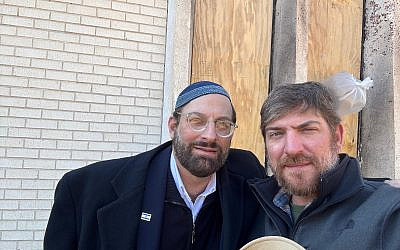
This was only one element of what was so fascinating for me about meeting Zach. I am a born-and-bred Jewish New Yorker. Zach has lived in Mississippi his whole life. Like many Northeast Jews, the only time I have visited the South is on trips to Miami. Zach is a Reform Jew. I am an Orthodox rabbi. However, there is much that we have in common: our love of Judaism, the Jewish people, Israel, and all of humanity. Another passion that we share is our enthusiasm for one of the most extraordinary rock-and-roll bands in history, the Grateful Dead.
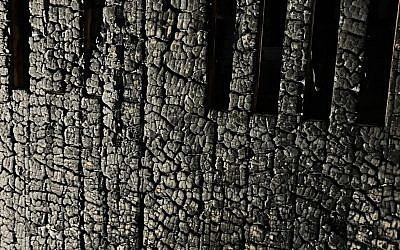
The sight was devastating. The building was burned in so many places, inside and outside. Its overall physical destruction was impossible to ignore. Yet alongside the devastation was something else entirely: resilience. Shemper carried himself with remarkable strength and resolve. I thought of the lyric from the Grateful Dead song “Scarlet Begonias”: “Once in a while you get shown the light, in the strangest of places if you look at it right.”
Shemper has been unwavering in his message since the attack. While the arson was intended to intimidate and isolate the Jewish community, he insists it has failed. “We haven’t—and won’t—stop practicing our Judaism, ever,” he said. He emphasized that Beth Israel is more than a structure. “It’s not brick and mortar,” he explained. “It’s the people.”
Drawing parallels to the congregation’s survival of a Ku Klux Klan bombing in 1967, Shemper said rebuilding is not a question of if, but when. He estimates that restoration will take between one-and-a-half and three years. His vision is not merely to replace what was lost, but to return stronger—“better than ever”—including a rebuilt library filled with donated personal collections.
One powerful symbol of continuity remains: a Holocaust-era Torah scroll that survived the fire undamaged. For Shemper, it stands as a testament to Jewish endurance. Rather than extinguishing Jewish life in Jackson, he believes the attack has done the opposite, igniting “a spark of Jewish identity” both locally and far beyond Mississippi.
When Zach speaks, he reminds me of the words of the prophet whose name he shares, Zechariah. In Sefer Zechariah it says, 4:6 לֹ֚א בְחַ֙יִל֙ וְלֹ֣א בְכֹ֔חַ כִּ֣י אִם־בְּרוּחִ֔י אָמַ֖ר יְהֹוָ֥ה צְבָאֽוֹת: “Not by might nor by power, but by My Spirit, says the LORD of hosts.” The spirit of God that I am seeing in Jackson is inspiring.
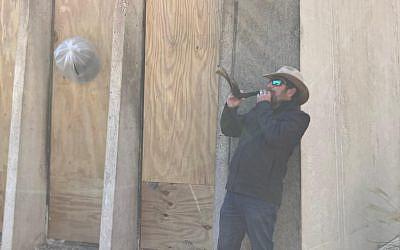
At the site where the fire ravaged the synagogue, Zach and I recited psalms. I shared some words, and Zach blew the shofar. On Rosh Hashanah, when the shofar is blown, there are many different combinations of notes (kolot). Each cluster of notes always begins with a solid note (tekiah), moves into broken sounds (shevarim and teruah), and then returns to a solid note, tekiah, at the end of each sequence. It seems that the way we blow the shofar is a reflection of the way life often is. Life begins with stability; challenges come along and bring brokenness; but we have the capacity to return to strength and repair what has been broken. As Zach blew the shofar in the midst of the destruction of Beth Israel and spoke words of rebuilding, I could not help but think that this kavanah (spiritual intention) about the shofar—so parallel to the experience of Beth Israel Congregation—is a thought that could give inspiration for many of the challenges we face now as Jews, as Americans, and as human beings. Let us blow the shofar, and let us find a way to be solid once again.
Related Topics
Related Posts