An Interfaith Sukkah at Delaney Hall
Last Thursday night, in the tender space between Yom Kippur and Sukkot, in this season of repentance, members of synagogues throughout Essex County New Jersey held a vigil outside of Delaney Hall, a private prison with the capacity to hold up to 1,000 people detained by U.S. Immigration and Customs Enforcement (ICE). The facility is a bleak fortress-like building with chain-linked fences, located in an industrial wasteland of chemical processing plants, scrap metal yards, liquid storage and tank terminals, and sewage treatment plants.
Delaney Hall is run by The GEO Group, through a $1 billion, 15-year contract from ICE. The administration would have us believe those being taken off the streets of America are “the worst of the worst.” According to reporting in The New York Times and The Guardian, the vast majority of people held at Delaney Hall have no criminal record. Most detainees do not have lawyers and have not seen a judge. Among those detained over the summer are a manicurist, two waiters, a pastry chef and construction workers.
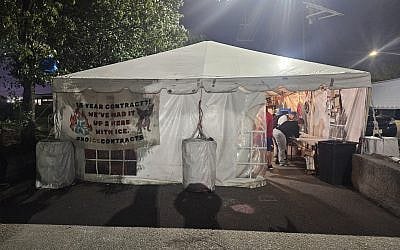
On a chilly evening, on the eve of Sukkot, about forty to fifty people from synagogues representing nearby communities gathered one hundred yards from the facility at the Hospitality Tent. The origins of the Tent began with Terry Suess who stood alone outside Delaney Hall holding a sign in protest. She was soon joined by members of Pax Christi, a Catholic Organization, whose coordinator Kathy O’Leary says, “Loving our neighbor is our resistance.”
The Tent offers a competing vision for humanity from that of Delaney Hall. Today, the Hospitality Tent is a gathering place for grassroots, interfaith groups and religious organizations and a welcoming space providing aid and comfort to the families of those detained. It’s a modest white tarp canopy calling to mind the meaning of a Sukkah, a shelter that evokes God’s presence. Inside the tent hangs a handmade sign, “Welcome to a Radical Hospitality Zone.” There are tables of donated food, diapers, and baby formula and one filled with clothes to accommodate the detention center’s changing dress codes often used as a justification to prevent visits.
Lessons from the Torah abound.
The tent brings to mind Abraham, the father of three religions who exemplifies hospitality. I thought of the verse in Deuteronomy instructing us that when celebrating Sukkot, one must include “the stranger, the fatherless, and the widow.” I was reminded of Jacob saying, “Surely the Lord is present in this place, and I did not know it.”
The night was chilly. Cantor Meredith Greenberg and Rabbi James Feder both from Temple Ner Tamid led the service, standing on a low brick ledge under leafy trees. As we watched, I noticed unexpectedly beautiful plants blossoming with gorgeous bright pink flowers, a reminder of the world’s beauty even in desolate places.
We chanted Ashrei, Mi Chamocha and the Shema. Rabbi Feder pointed to the tent and declared “that is a Sukkah,” recognizing the tent to be a metaphor for the holiday. Drivers in Mack trucks honked loudly in solidarity as they passed. I was reminded of our ancestors and the unexpected friends they made on the road. We sang what has become a kind of anthem, written by children in Dilley Detention Center, Texas, with assistance from Marving Urbach and the Peace Poets:
“I sing from here, you sing from there
Together we’ll sing down the walls everywhere”
Rabbi Feder taught there is no greater commandment than to free the captive. He preached about the experience of time and that when in captivity, a day can seem like an eternity. I thought of the story of Joseph and his innocence.
Toward the end of the service, we walked one hundred yards to the prison gate. As we sang, two people were released bringing a moment of joy and sense of hope to our gathering.
Soon after the service ended, two vans left the prison gates. I wondered who was inside and where they were being taken. Witnessing those vans leaving the facility left me feeling hopeless and wondering if our actions matter. I want to believe they do. In Judaism, memory is precious. I hope that when this dark period ends, the people being held and their families will remember that their neighbors stood with them. I hope that memory will provide for them a blessing.