
Financial Advisor, Writer, Zionist, American Patriot and Conservative
An interview with acclaimed author Andrew Ross Sorkin on his Masterpiece 1929
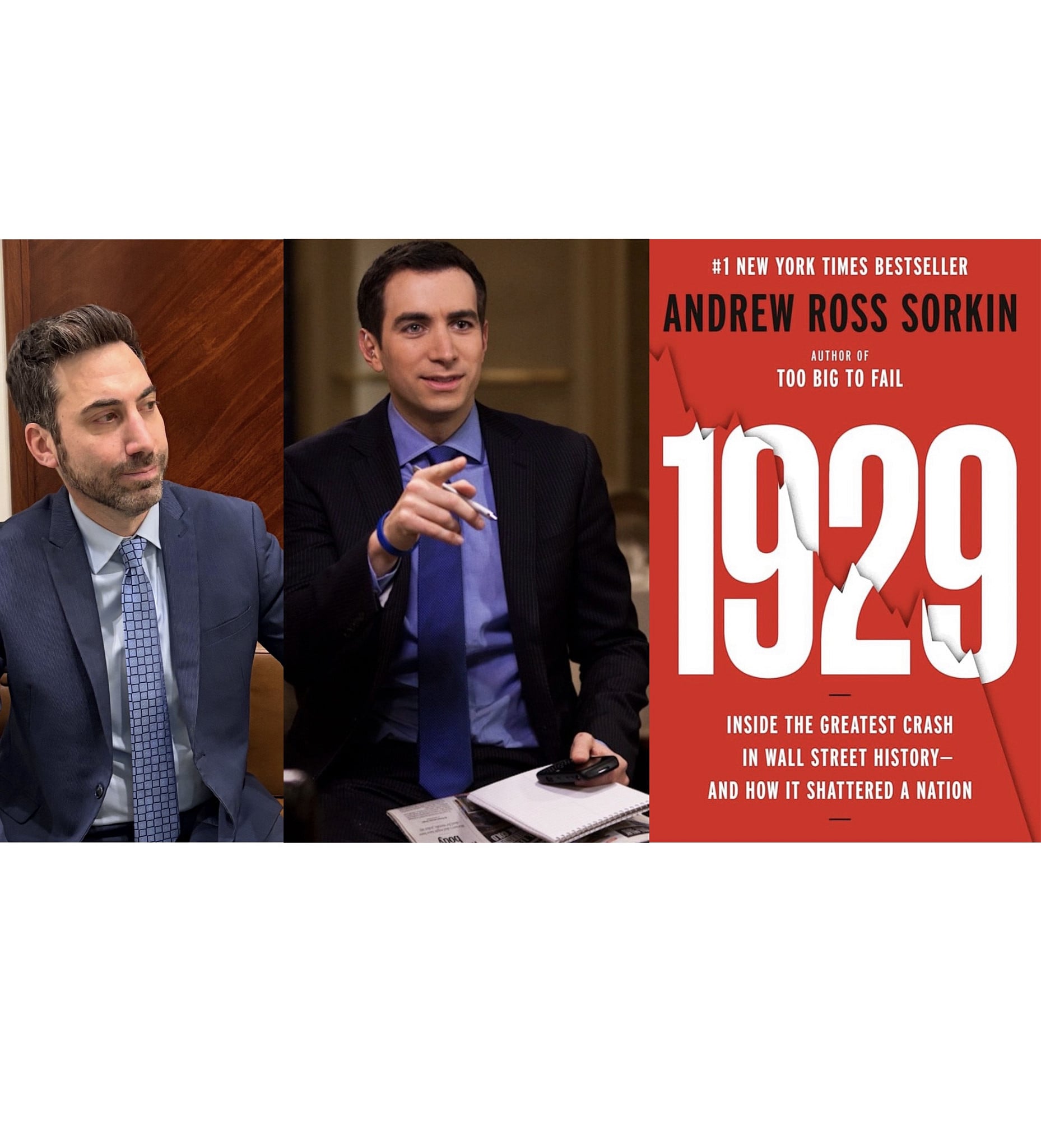
Writer Joseph Scutts and Andrew Ross Sorkin at public Speaking engagements, the cover of 1929 (photos courtesy of Joseph Scutts and Andrew Ross Sorkin)
As a Financial Advisor who has had the honor of working at over 8 Fortune 500 companies, including Wells Fargo, Citi, JPMorgan Chase, and now Merrill Lynch, I have always admired Andrew Ross Sorkin. Andrew is one of the most prolific writers of the 21st century who has an uncanny ability to take you through history as it happened.
Andrew Ross Sorkin is highly popular and uniquely prominent as a leading voice in American financial journalism and pop culture. His widespread influence and popularity span across elite business circles, mainstream television, and entertainment media. His vast reach and professional standing are driven by several pillars: As a long-standing co-anchor of CNBC’s signature morning show, he reaches millions of investors and professionals daily. He is a chief financial columnist and the founder of DealBook, one of the world’s most influential daily business and M&A briefings. His extensive broadcasting career earned him induction as a 2025 Cable Hall of Fame Honoree.
I last interviewed Andrew on his contemporary classic “Too Big to Fail”, His definitive chronicle of the 2008 financial crisis (that I personally witnessed and worked through) and the book spent over six months on the New York Times bestseller list and was adapted into an Emmy-nominated HBO movie. Sorkin expanded his fame beyond strict news audiences by co-creating the acclaimed, multi-season Showtime drama series Billions, further cementing his status in popular culture. He is a highly sought-after public figure, regularly headlining prestigious national events like the University at Buffalo Distinguished Speakers Series and local author festivals across the country.
His most recent masterpiece, 1929: Inside the Greatest Crash in Wall Street History, became an instant #1 New York Times bestseller. It was heavily praised as a “Best Book of 2025” by outlets like Time, The Economist, and The Financial Times.
Published by Viking Press on October 14, 2025, the book serves as a historical prequel to his highly acclaimed 2009 work, Too Big to Fail. The book chronicles the events surrounding the infamous Wall Street stock market crash of 1929. Sorkin uses newly uncovered diaries, memos, and historical records to reconstruct the crisis hour-by-hour through the eyes of key historical figures. Instead of focusing strictly on economics, the narrative highlights the psychology, overconfidence, human folly, and political dysfunction that drove the market into a freefall. A central theme of the book is the striking parallel between the unbridled optimism of the late 1920s and contemporary financial markets, drawing explicit lessons regarding modern market bubbles and regulatory failures.
Andrew Ross Sorkin has an uncanny and gifted ability to take you through and relive the greatest crash in stock Market History as seen through the eyes of the key players who lived through it. The 1929 stock market crash triggered the Great Depression. It wiped out billions of dollars in wealth, caused a 25% national unemployment rate by 1933, and forced nearly 10,000 U.S. banks to close. These devastating events shattered public trust in financial markets and prompted sweeping, lasting federal regulatory reforms.
The crash initiated a severe worldwide depression as foreign trade plummeted. Protectionist measures like the Smoot-Hawley Tariff Act further restricted international commerce, shrinking global trade by 66% between 1929 and 1934. Families lost their life savings, and homelessness surged, leading to the creation of improvised shantytowns known as “Hoovervilles”. The economic paralysis led American voters to turn to Franklin D. Roosevelt’s “New Deal.”
This era ushered in an unprecedented expansion of federal government intervention, public works programs, and the establishment of a social safety net. The crisis forced the government to reshape how Wall Street operated. Congress passed major laws to stabilize the markets, such as the Glass-Steagall Act of 1933, to separate commercial and investment banking, and created the Securities and Exchange Commission (SEC) to oversee trading and prevent future abuses.
I asked Andrew, who I admire and hold to the highest esteem, what he wants the biggest takeaway to be for this masterpiece of a book. Does History repeat itself? Are we living in a cycle and how do we not repeat the lessons of the past? Andrew’s brilliant answer was, “Thank you so much for the incredibly kind words about 1929—it means the world to me that it resonated with you. And I’m honored you’re writing a review for the Times of Israel. The biggest takeaway I hope readers take from the book is this: history doesn’t repeat itself exactly, but it rhymes in ways we ignore at our peril. The crash of 1929 wasn’t inevitable—it was the result of choices made by people who believed the rules didn’t apply to them, who confused a bull market with genius, and who dismissed warnings as pessimism. We’re living through our own moment of reckoning now, and the question isn’t whether we’re in a cycle, but whether we’re humble enough to learn from it. The lesson of 1929 is that we have agency—if we’re willing to look clearly at what’s in front of us and act before it’s too late.”
Related Topics