Somaliland Historian, Biographer and Political Commentator
The Letter From Hargeisa: Egal’s 1995 Appeal to Israel
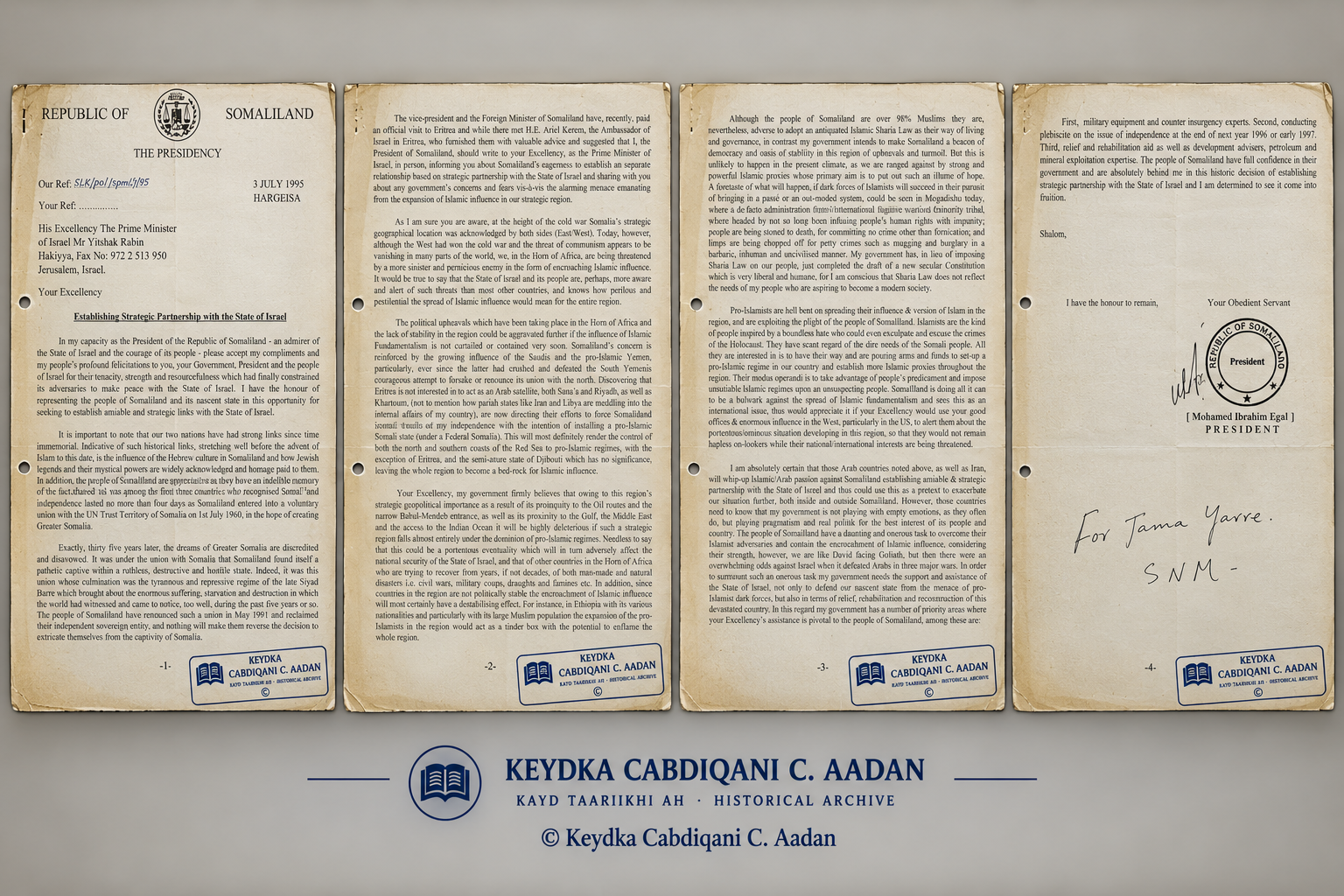
The four-page letter dated July 3, 1995, attributed to Somaliland President Mohamed Haji Ibrahim Egal and addressed to Israeli Prime Minister Yitzhak Rabin. Its authorship and historical transmission have not been independently verified. Image courtesy of Keydka Cabdiqani C. Aadan Historical Archive.
In 1995, Somaliland’s president asked Israel for a “strategic partnership.” Thirty years later, Israel recognised the country. The letter explains much about the logic, and almost nothing about the cause.
On 3 July 1995, a letter was prepared at the presidency in Hargeisa, addressed to the Prime Minister of Israel at a Jerusalem fax number. Its author, Mohamed Ibrahim Egal, introduced himself as “an admirer of the State of Israel and the courage of its people,” and his subject line, typographical error included, proposed “Establishing Strategic Partnership with the State of Israeli.” Yitzhak Rabin, three years into his second term and a year after the treaty with Jordan, was assassinated four months later. No reply has surfaced in the public record.
On 26 December 2025, Prime Minister Benjamin Netanyahu signed Israel’s recognition of Somaliland, making Israel the first UN member state to do so. It is tempting to interpret the second event as a response to the first. However, the available evidence does not support that conclusion. The letter nonetheless repays close reading, because it shows what Somaliland’s leaders believed Israel might want, and how much of that proved prescient.
Some background. Somaliland is the former British protectorate that became independent on 26 June 1960 and joined the former Italian-administered Trust Territory of Somalia days later, on 1 July. After the collapse of Siad Barre’s regime it declared the union over in May 1991. For thirty-four years no state accepted that claim. Egal wrote two years into his presidency, leading a government that was still fragile and desperate for outside friends.
A letter once disowned
Before the letter can bear any analytical weight, its own history has to be faced. Egal, who died in 2002, rejected it. In a Somali-language speech transcribed by Saxafi Media, he calls the letter attributed to him false and says that publications had been built on it; Afrique XXI likewise records that he denied having written it, without ending doubts among part of the population. The original copy has since come to light. It reached the author in 2021, passed to him by a former Information Minister in the government of President Abdirahman Ahmed Ali Tuur. Scans of all four pages accompany this article. They show a letter on the presidency’s letterhead, a signature above a presidential stamp, and a Jerusalem fax number on the address line. They show no fax transmission header, so receipt in Jerusalem cannot be established from the document itself. The order of events, then, runs from the 1995 letter, to Egal’s denial before his death in 2002, to a reported reference to the letter by an Israeli Foreign Ministry spokesman in 2010, to the original reaching the author in 2021.
Whether an original exists and why Egal denied the letter are separate questions. The original goes to whether the document exists and is authentic. It does not explain why Egal denied it, and none of the sources I found offers an explanation. This essay does not supply one. It treats the letter as authentic on the strength of the original copy reproduced in the annex, and as evidence of what a letter in his name argued, which is what the rest of this essay examines.
What Egal wanted Israel to understand
The letter works on three levels: kinship, grievance and request. On kinship, Egal claims ties “since time immemorial,” invokes Hebrew influence on Somali culture, and says Israel was “among the first three countries” to recognise Somaliland in 1960. That last claim cannot be taken as fact. Later accounts list Israel among about 35 recognising states (AllAfrica), but I found no primary document confirming Israel’s act or its ranking. As memory, though, it did useful work: it recast recognition in 1995 as restoration, not novelty.
On grievance, Egal calls the union with Somalia a condition of being a “pathetic captive within a ruthless, destructive and hostile state,” and insists the decision of May 1991 is irreversible. Telling this to an Israeli prime minister makes sense: Somaliland’s legal case rested on being a once-recognised state that had voluntarily merged and then withdrawn, and Israel had its own experience of contested sovereignty.
The request is the most revealing part, and it is not primarily about Israel. Egal asks Rabin to use his “good offices & enormous influence in the West, particularly in the US.” He wanted a partner, but he also wanted a door-opener to Washington. Former Somaliland president Abdirahman Ahmed Ali Tuur discussed this objective in an interview with Al Jazeera Arabic, in which he linked Egal’s outreach to Israel to the hope of American recognition.
Geography as diplomacy
Egal’s strategic case is spatial. Somaliland, he writes, lies near “the Oil routes and the narrow Babul-Mendeb entrance,” close to the Gulf and the Indian Ocean. He warned that Saudi Arabia, Yemen (newly victorious over the south in 1994) and Sudan wanted to install a “pro-Islamic Somali state,” which would put both coasts of the Red Sea, apart from Eritrea and Djibouti, under hostile governments, to Israel’s detriment.
This is the part that has aged best. Analysts now describe Israel’s interest in a friend on the Gulf of Aden, across from Houthi-held Yemen (Atlantic Council; Foreign Policy). But the 1995 threat map did not survive. Riyadh, Egal’s adversary, is today courted by Jerusalem, and the danger that matters now is Iran’s Yemeni ally. His geography transferred; his list of enemies did not. And what is independently documented about Israel’s interests is analysis and press reporting, not Israeli policy statements. Irro has denied that Israel asked for a base, though he told the Jerusalem Post he would leave the door open to a future Israeli military presence (JPost).
The political vision behind the appeal
The letter’s ideological core is its sharpest and least comfortable. Egal tells Rabin that Somaliland is over 98 percent Muslim yet rejects “antiquated Islamic Sharia Law,” that his government has drafted “a new secular Constitution,” and that Somaliland aims to be a “beacon of democracy and oasis of stability.” Against this he sets what he calls Islamic proxies in Mogadishu and the meddling of Arab states and Iran. He goes as far as saying that Islamists are “inspired by a boundless hate” and could excuse the Holocaust.
This should be read as Egal’s polemic, pitched to an Israeli reader, not as analysis. The letter slides between Islam as a faith, “Islamic influence,” fundamentalism and particular governments, and his depiction of Mogadishu’s warlord-led administration as an Islamist project is at least contestable. The purpose was plainly layered: to separate Somaliland from Somalia, to speak the vocabulary of mid-1990s Western strategic worry, and to give Israel a reason beyond sympathy.
Rhetoric and practice also diverged. The constitution Somaliland adopted by referendum on 31 May 2001, which the Somaliland National Electoral Commission records as approved by 97.1 percent of voters, states in Article 5 that Islam is the religion of the state and that the nation’s laws must be grounded on, and not contrary to, Islamic Sharia. Article 128 adds that the constitution is to be based on Islamic principles. That is not secular governance in the sense Egal’s letter used the word.
Nor should the two texts be conflated. The 2001 constitution emerged from years of conferences, and its preamble refers to a working party that in 1996 sifted two draft versions, and to parliamentary amendments in 2000. Nothing I found establishes how the draft Egal mentioned in 1995 relates to those texts, and I could not locate it, so the 2001 constitution should not be read as reproducing it. “Secular” in the letter is best understood as an aspiration or a pitch, not a description of settled practice. The democratic claim is better tested by Somaliland’s later elections than by this letter.
Egal also made a prediction: that Arab states and Iran would “whip-up Islamic/Arab passion” against a Somaliland–Israel partnership. In December 2025, more than 20 mostly Middle Eastern or African states and the OIC rejected the recognition, and the African Union and the UN Security Council were drawn in. He understood the price.
The David and Goliath line, “we are like David facing Goliath,” belongs here too. It is more than decoration. It asks Israelis to see Somaliland as a younger version of their own story of survival against odds, and offers an emotional affinity in place of the material leverage Hargeisa lacked.
From recognition to partnership: what he asked for
The requests are specific: “military equipment and counter insurgency experts”; help with an independence plebiscite at the end of 1996 or early 1997; relief, development advisers and expertise in petroleum and minerals. Together they sketch a state with armed rivals and thin means, wanting a popular vote to complement recognition, and short of the capacity to exploit its resources. The plebiscite never happened on his timetable. The vote came in 2001, as a referendum on a constitution whose first article affirms Somaliland’s restored independence.
I found no evidence that Israel replied or provided help. The letter did not vanish from Israeli memory: secondary accounts say a Foreign Ministry spokesman, Yigal Palmor, cited it in 2010, though that needs checking. A citation is not a policy.
Note the contrast with 2025. The cooperation Israel announced is agriculture, health, technology and the economy, and Israeli officials point to water management. Egal’s first request was for weapons. Security ties may well exist, since Netanyahu thanked the Mossad, but they are not an announced term.
The 2025 initiative
Irro was inaugurated in December 2024. In March 2025 his foreign minister wrote to Israel’s public broadcaster saying recognition was Somaliland’s overriding priority. On 17 May 2025, Irro sent a letter to the leaders of all 193 UN member states formally requesting recognition of Somaliland’s independence (Jerusalem Post); he told his cabinet that it offered strategic access and cooperation in return (Mada Masr). The text of the letters has not, to my knowledge, been published, so the arguments they advanced can be described only as Irro and journalists have characterised them.
Irro says only Israel responded. He visited Israel discreetly in October 2025, and Israel’s declaration speaks of the “formal appeal” of Somaliland’s president, alongside “shared values, strategic interests” (text as reproduced here). Netanyahu thanked the Mossad chief for his part (Prime Minister’s Office). AP also reported that US and Israeli officials earlier in 2025 said Israel had approached Somaliland about taking Palestinians from Gaza, which Somaliland denies. A mass appeal answered by one country, after back-channel work and in the Abraham Accords frame, looks less like persuasion by letter than like a decision Israel made for its own reasons.
Continuity, change, and what the letters tell us
The continuities are real. Both presidents sought recognition, offered location and cooperation, anticipated an Arab and Muslim backlash, and presented Somaliland as a stable, democratic anomaly. Irro now calls Israel and Somaliland “two democracies on opposite ends of the Red Sea”, and speaks of Somaliland’s “legal, historical and moral right” (The Reporter).
The differences matter as much. Egal wrote one letter to one leader, in the optimism of the Oslo years, and cast his case as a fight against Islamism. Irro’s outreach was broad, then narrowed to Israel; its public language is democracy, stability and shared values; and it landed amid the Gaza war, Houthi attacks and a stalled Abraham Accords. Egal asked for arms; Israel announced agriculture. In 1995 Israel had little at stake in Somaliland. In 2025 it saw an advantage.
So the strongest claim the record allows is modest. Egal’s letter documents, thirty years earlier, the logic that made 2025 possible: geography, mutual isolation, a shared adversary, and recognition as a transaction. It does not show that he caused anything. Somaliland has repeatedly offered the same bargain, and most governments declined; one accepted when its own interests converged. Whether this recognition opens the way to others, as Irro hopes, or isolates Hargeisa from African and Arab bodies it also needs, cannot be settled yet.
In 1995, Egal asked Israel to see Somaliland as a partner. In 2025, Israel decided it could use one. The distance between those two sentences is the story.
Source list and notes
- Mohamed Ibrahim Egal to Yitzhak Rabin, 3 July 1995, ref. SLR/001/tspm1/7/95. No archival record of the original located.
- Constitution of the Republic of Somaliland, approved by referendum 31 May 2001. Refworld record; PDF. Cited provisions: preamble; Article 1; Article 5(1)–(2); Articles 127(a) and 128(1). Article 130(1) provides that the text applied in the interim from its approval by the third conference, before the referendum.
- Somaliland National Electoral Commission, 2001 constitutional referendum result (97.10 percent): SLNEC. The commission’s counterpart on parliament’s site lists 1,148,940 yes and 34,302 no votes out of 1,183,242 valid votes (Somaliland Parliament), which computes to 97.1 percent.
- United Nations document S/2001/963, as supplied: UN Digital Library.
- Israel’s declaration of recognition, 26 December 2025: Prime Minister’s Office on X; text as quoted in The Reporter, Ethiopia.
- Times of Israel, 26 Dec 2025 · JNS · AP via WHEC
- Jerusalem Post interview with Irro · Mada Masr, “How Israel recognized Somaliland”
- Atlantic Council · Foreign Policy, 23 Sep 2026 · The Reporter, May 2026
- Afrique XXI, “Somaliland: A Potential U.S. Recognition Amid the Gaza Crisis” (source for Egal’s denial) · AllAfrica on the 1960 recognitions
• Times of Israel blog, “Israel and Somaliland: Assessing Possible Cooperation” (opinion blog; source for the 2010 Palmor reference)
Annex: scans of the letter held by the author
Courtesy of Keydka Cabdiqani C. Aadan (Historical Archive).
Related Topics
Related Posts