
An Irish ‘Cute Hoor’s’ Defense of Zionism
I write this with some considerable trepidation.
Fintan O’Toole comes close to a secular liberal God in Ireland.
The veteran, award-winning Irish Times columnist is an institution and an icon of Dublin’s middle-class establishment.
But Ireland’s anointed moral archbishop has, in recent years, strayed badly in his writings on Israel, antisemitism and the Jewish people.
Fintan O’Toole’s latest Irish Times column presents itself as an argument against antisemitism and a defense of Zionism against the charge of racism. Yet somehow, he manages to undermine the very historical foundation of Zionism even as he appears to defend it, while simultaneously downplaying Irish antisemitism.
That requires some intellectual contortion.
Let me be clear. Israel is not above criticism. Certainly this current far-right extremist government deserves fierce scrutiny. Accusations that Israel may have committed genocide in Gaza are serious and legitimate.
Earlier this summer, in Haaretz, I called on Yair Golan, leader of the Democrats, to “simply declare that the occupation is an abomination and must end”.
I have pleaded with my fellow Israelis, in The Irish Times: “Deniability of what has happened and is happening in Gaza in our name will not be ignored. Indifference will not be forgiven. Silence will not be forgotten”.
You can argue against Zionism. You can dispute the political implications of the Jewish historical attachment to the Land of Israel. But to craft an ostensibly empathetic Zionist argument while giving so little attention to the historical and national attachment at its heart is, frankly, odd.
O’Toole’s comparison between Irish emigration to America and Australia, both inhabited by “Indigenous peoples”, and the Jewish connection to Israel was clumsy at best.
“As Irish people,” O’Toole writes, “we have less excuse than most for not understanding that it is possible to be both a refugee and a colonist.”
The analogy risks collapsing two different histories into a single colonial narrative. Jewish attachment to the Land of Israel is rooted in history, religion and language, as well as centuries of continuous Jewish presence long before modern Zionism and the Holocaust. Those foundations complicate any account that treats Jewish national identity as principally a colonial project.
The most revealing passage, however, was O’Toole’s argument that “we have to be completely consistent in opposing the dehumanisation of Palestinians – and we must be equally unfailing in opposing the demonisation of Jews. I know that for many readers this second claim may border on the insulting”.
What?
“Opposing the demonisation” – not of “Israelis” or “Zionists” – but “Jews” – “may border on the insulting”.
Ireland, like almost everywhere, has an antisemitism problem, so O’Toole’s words here are peculiar. There is a hint of pearl-clutching, of eye-rolling at the very suggestion that Irish people might need reminding to oppose antisemitism. The implication seems to be that, naturally, we are innocent of such horridness — and that even suggesting otherwise is insulting. Perhaps I am misreading him, but I imagine his words will insult Irish readers who take antisemitism seriously.
But where are ordinary Israelis in all of this? Their society, culture, democratic struggles, extraordinary achievements and legitimate attachment to their country barely register.
Today’s Israeli Jews appear largely as the problem to be explained — the “Israeli regime” — rather than people with their own fears, pain and desire to live in safety without having to apologize for simply existing. They are, in effect, airbrushed out of the story.
One could say this opinion piece wasn’t O’Toole’s finest moment. But even that gives the argument more credit than it deserves. A less generous interpretation might simply call this a particularly brazen form of Irish cute-hoorism, an argument that appears to acknowledge Zionism’s legitimacy while quietly stripping away its historical foundations.
A cute hoor — in Irish parlance — knows precisely how far he can push things while maintaining plausible deniability.
This is pushing it.
O’Toole writes: “The best study we have of Irish attitudes to Jewish people is one conducted in 2023 by Miceal Canavan of Queen’s University Belfast and Liam Kneafsey of Trinity College Dublin. It found little evidence of hostility to Jews.”
This is astonishing.
Writing in 2026, O’Toole makes no mention of a March report by the Jewish Representative Council of Ireland documenting 143 reported antisemitic incidents over a six-month period.
Imagine the reaction if a prominent Irish commentator discussing the Irish LGBTQ or Irish Muslim community ignored their voices in favour of an older study that suggested little hostility towards them.
The cancellation of a conference on antisemitism in Dublin has attracted international attention.
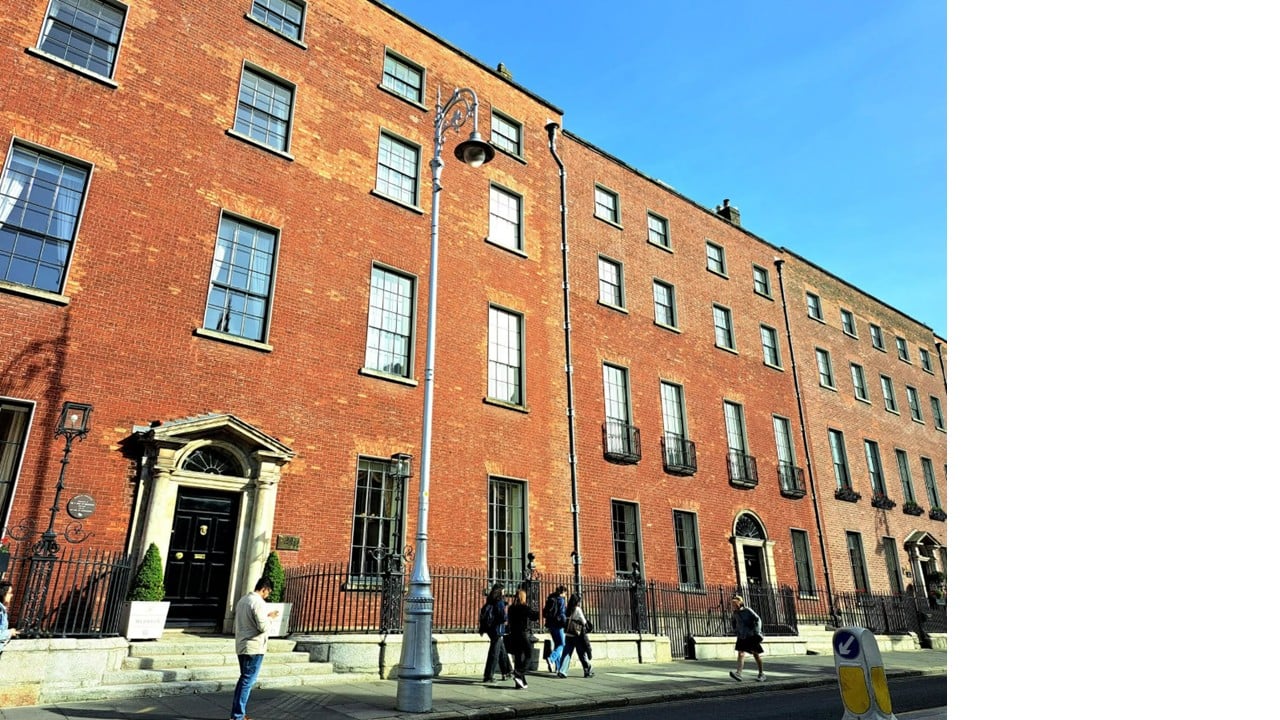
We do not know why the Herbert Hotel cancelled the booking. Yet O’Toole writes: “one suspects that the cancellation was motivated more by a desire to avoid the possibility of protest than by any conscious prejudice”.
Why supply a sympathetic explanation for a decision whose motives he cannot know?
If a hotel cancelled a conference on homophobia for fear of homophobic protesters, would that be an adequate defense? Or would we ask why those hostile to the conference had effectively been given a veto?
This is not the first time O’Toole’s language on Jews and Israel has raised questions.
The ghoulish accusation that, for Israeli leaders, “the killing of children is the ultimate expression of power” was a strikingly loaded formulation. It is hard to see how such wording passed editorial scrutiny. To some ears, it evokes the dark history that portrays Jews as deliberate killers of children. That carries serious historical resonance, whether or not O’Toole intended it.
A couple of weeks later came another baffling intervention: an A-to-Z catalogue of antisemitic tropes, some of them graphic and deeply disturbing, reproduced one by one, only for O’Toole to proceed to knock them down. I struggled to fathom the point of the exercise—unless it was a response to the eyebrows raised by his previous article a fortnight earlier.
In a separate opinion piece, “Eurovision glitz is part of Israel’s claim to be European – and that matters,” O’Toole argued that “Israel’s Europeanness is a political construct,” describing Israelis as seeking to preserve a European identity while being “European Jewry… reborn in the Middle East.”
Israeli Jews are implicitly cast as wannabe Europeans while simultaneously being condemned as European colonizers. The effect leaves little room for the complexity of Jewish identity or history, including the fact that Moroccan Jews have historically formed one of Israel’s largest Jewish communities. Around half of Israeli Jews trace their heritage to the Middle East and North Africa, from Morocco and Algeria to Iraq and Iran. Many of their families have histories of displacement, persecution or expulsion from countries across the region.
Taken together, O’Toole’s omissions are striking: the Irish Jewish community’s own report on antisemitism; the fears and experiences of Israelis living today; the centuries-old Jewish attachment to Eretz Yisrael, the Land of Israel, expressed in prayer; and the histories of Jewish communities across the Middle East and North Africa, including their displacement and expulsion.
Each omission can be explained away individually. Taken together, they raise a more troubling question about the story O’Toole has chosen to tell.
What we are left with is a purported defense of Zionism that leaves its historical foundations distinctly indefensible, alongside a purported examination of Irish antisemitism that ignores the Irish Jewish community’s own report documenting it.
Cute hoor indeed.
But who in Ireland even notices?
Editor’s note: A shorter, substantially edited version of this article was published by Village Magazine in Ireland. This is the original, full-length version, submitted to Village before its subsequent editing and publication.