
Writer, Expat, Single Dad
An Open Letter to a Pastor Who Cropped the Truth
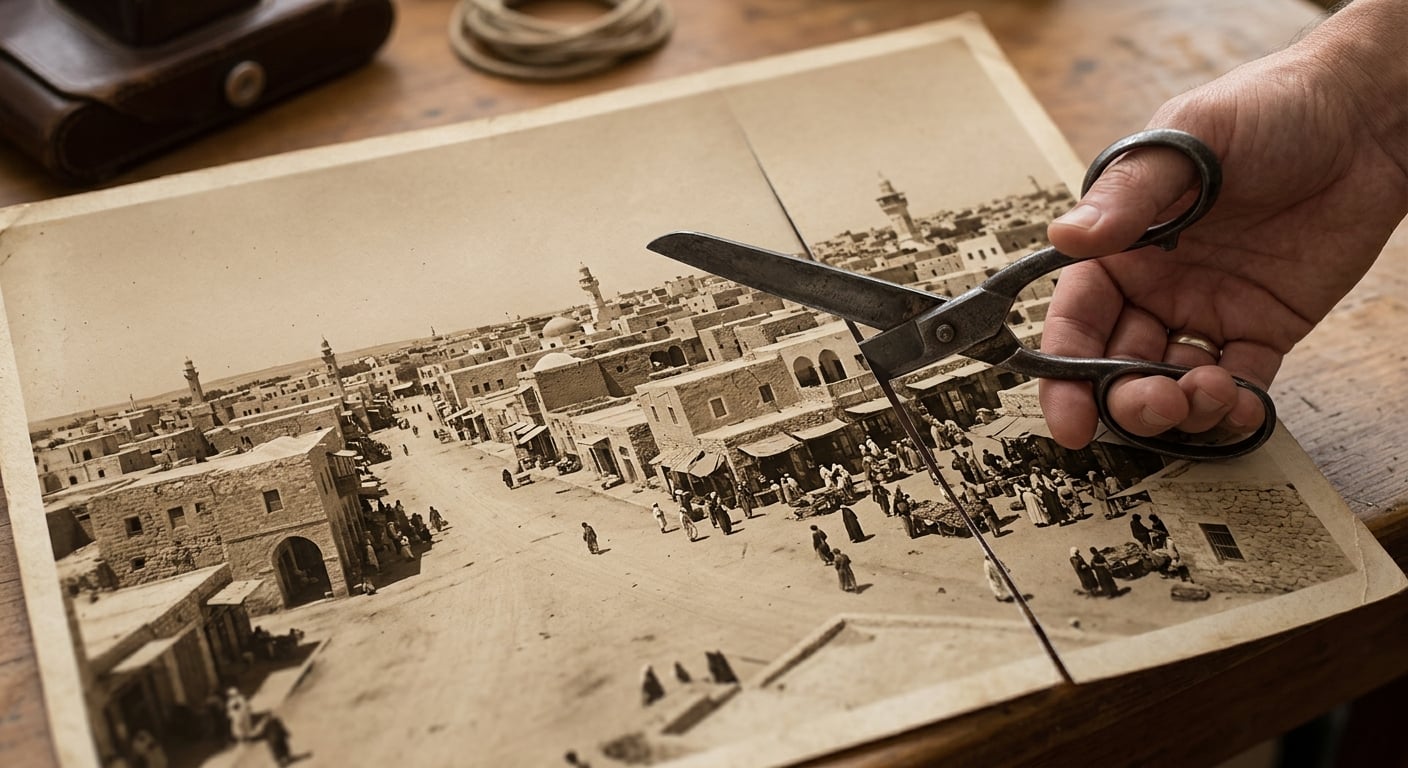
A cropped photograph is not truth
An Open Letter to Rev. Sara Ofner-Seals, Associate Pastor at Plymouth Congregational Church, Fort Wayne, Indiana
Dear Rev. Ofner-Seals,
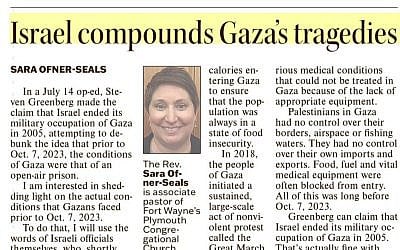 In your July 29 op-ed, you painted a bleak portrait of pre-war Gaza. You supported your argument with verifiable facts and correctly attributed quotes. Yet you offered readers a cropped photograph—one that hides half the frame, shows nothing false, and still isn’t the truth. What you cropped out is the context that could have turned a collection of facts into an honest picture.
You paint Egypt and Israel’s pre-war blockade of Gaza as proof that Gaza was and is a “concentration camp”—an egregious and offensive weaponization of Holocaust imagery to make your political point. The Fort Wayne Jewish community would do well to take note of language like yours, which feeds the growing normalization of antisemitism in public discourse. In any case, you cropped the photograph by never addressing why there was a blockade.
Israel ended its presence in Gaza in 2005. Shortly thereafter, Hamas took over in a bloody coup. It quickly became clear that rather than investing in public projects that could have helped Gazans, the terror organization was building a rocket arsenal and a tunnel network using smuggled cement and steel—materials that could have been used to build hospitals, schools or civilian infrastructure. Israel and Egypt responded jointly, imposing a blockade that restricted the entry of dual-use materials into Gaza. Food and humanitarian supplies continued to enter Gaza, as documented by the UN Office for the Coordination of Humanitarian Affairs’ Gaza Crossings data.
You attribute Gaza’s food insecurity to the blockade. But according to UNICEF’s Palestinian Multiple Indicator Cluster Survey (2021, p. 172), pre-war malnutrition in Gaza was the lowest in the Arab world. Gazans were not starving. Caloric intake was calculated not to perpetuate food insecurity but to avoid it. Did more than one Israeli politician make a stupid remark about the blockade? Sadly, yes. Was it policy? The UN’s data proves it was not.
You note multiple Israeli military operations in Gaza between the Hamas takeover and its 2023 invasion. This is correct. But why did these operations take place? This part of the photo was cropped.
Each Israeli operation followed months or years of rocket fire aimed at Israeli population centers—over 20,000 rockets and mortars between 2007 and 2023. You correctly note that these operations were known in military and political circles as “mowing the grass.” The term, coined by scholars Efraim Inbar and Eitan Shamir in a 2014 academic paper, refers to the periodic degradation of Hamas’s military capability—not, as your article implies, the culling of Palestinian civilians. Even this metaphor was cropped.
The list goes on. You present the Great March of Return as nonviolent civil disobedience, without mentioning that Hamas co-opted the March, that its own leaders publicly said it was not peaceful resistance, or that on a single day 50 of the 60 Palestinians killed were Hamas members—by Hamas’s own admission on Palestinian television. These are just a few examples. Your article is filled with similar omissions.
I am a long-time opponent of Israel’s policy toward the Palestinians. I revile Israel’s current extremist, racist and corrupt government. The violence of Israeli settlers is a personal embarrassment to me and should be to any Jew of conscience. Yet my activism—on this blog and on the ground, where I have lived for decades—is grounded in a full, uncropped picture of this region’s complex, nuanced and frequently ugly reality.
Your arguments come from a different place. They reflect a narrative promoted by organizations that share a common, simplistic premise: the Middle East has one villain, one victim, and one solution.
In this narrative, egregious terror targeting innocent civilians is “legitimate resistance,” and Israel—a UN member like Tanzania or Indonesia—should be erased from the map. Israelis—over 50% of whom are of Middle Eastern extraction—are “white settler colonists” who don’t belong in the Middle East. The subjugation of Palestinian women, pervasive institutional violence against LGBTQ Palestinians, or any inconvenient fact that complicates the narrative, simply goes unmentioned.
When 72% of Palestinians polled by the Palestinian Center for Policy and Survey Research expressed support for the October 7 atrocities, this narrative questioned the wording of the poll. When 74% said they want a Palestinian state “from the river to the sea”—a phrase that leaves no room for Israel’s existence—this narrative explained it as figurative. When demonstrators in London and New York chant “Globalize the Intifada,” this narrative assures us they’re calling for peaceful protest—an interpretation that is ridiculous to anyone in Ramallah, Cairo or Tel Aviv.
It is a narrative that often takes root among well-meaning people who return home from a visit to the Middle East convinced they understand a region that has humbled statesmen and scholars for generations. It is a narrative that reduces one of the most complex, ethnically layered and religiously charged conflicts on earth to terms suitable for a bumper sticker.
You are certainly entitled to adopt and perpetuate this narrative. What you are not entitled to do is weaponize the Holocaust—which has nothing to do with the issue at hand—and ask readers to accept a cropped photograph as truth.
Sincerely,
Steven Greenberg
Related Topics
Related Posts