
PhD | Sr. Change Leadership and Crisis Management Expert
An Unbreakable Bond Beyond the Ballot Box
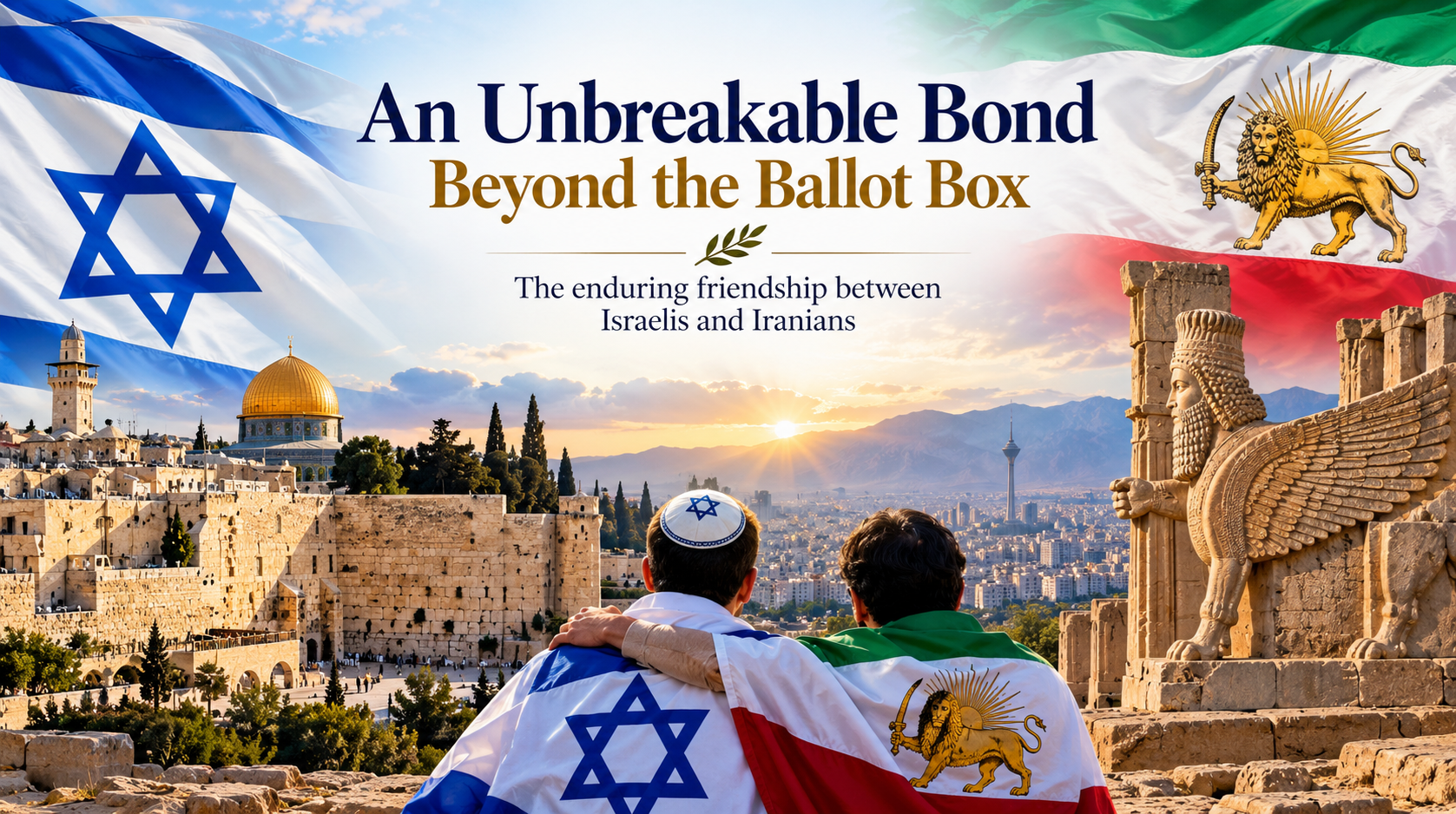
Unbreakable Bond
The Enduring Bond Between Israelis and Iranians
Dr. Alan Bostakian, MCMP, FIoL
Israelis have voted, and in the coming days the numbers may settle into a government. Seats will be counted, and coalitions will be negotiated. The world’s attention naturally turns to the results, the composition of the Knesset, and the country’s political future. Yet beyond the electoral headlines lies a relationship of profound historical and strategic significance: the enduring bond between the Israeli and Persian peoples, and the extraordinary opportunities that lie ahead.
But for those of us who have spent years building or strengthening bridges between the Israeli and Iranian peoples, one point deserves to be stated clearly on the morning after: the most important relationship in this story was never written on a ballot. It belongs to two ancient peoples. And it will outlast every election cycle still to come.
A Friendship Older Than Any Government
The bond between Jews and Iranians began roughly 2,500 years ago, when Cyrus the Great allowed the Jewish people to return from exile and rebuild their Temple in Jerusalem. In modern times, that friendship took practical form. Before 1979, Israeli engineers worked across Iran, helping communities recover from disaster and building water systems that farmers relied on for years. Israeli and Iranian professionals knew each other as colleagues, not as enemies.
The hostility that followed was imposed by the regime in Iran, which made hatred of Israel a pillar of its ideology while the country’s own rivers, lakes and aquifers dried up. Protest chants in Iranian streets, voices across the diaspora and messages from inside the country tell the same story: the Iranian people do not share the regime’s obsession. That is why the friendship has survived 47 years of official enmity.
The Cyrus Accord Belongs to Peoples
When Prince Reza Pahlavi called for elevating the Abraham Accords into the Cyrus Accord, he was addressing the State of Israel and its people. The vision is simple and lasting: a free, democratic Iran that recognizes Israel and partners with it on water, agriculture, energy, technology, health, and trade.
Israel’s election offers a timely opportunity to reaffirm that vision and the value of sustained engagement. Lasting peace agreements are built between nations and carried forward. Israel has shown this before. Its peace agreements have endured through every political season, because they serve the national interest rather than a political camp.
The Cyrus Accord is that kind of commitment. It speaks to Israelis on the right, in the center, and on the left, because a free Iran at peace with Israel is not a partisan goal. It is a strategic, economic and moral gain for every Israeli, and for every Iranian who wants a normal future for their children.
I want to be clear about one thing. Many in the Iranian community deeply respect Prime Minister Benjamin Netanyahu. Over many years, he has spoken directly to the Iranian people, separated them from the regime that oppresses them, and promised Israel’s help once Iran is free. That message has been heard and remembered. But the respect we owe some individual leaders is in addition to the friendship we have with the Israeli nation as a whole. Israel will continue to find the Iranian people a willing partner, and in the Iranian diaspora a friend who keeps its word.
Iran Prosperity Project
Iran faces serious challenges including water, environment, infrastructure, energy, and economic development. Addressing these issues will require domestic expertise, international partnerships, innovation, and institutional capacity.
This is where the Iran Prosperity Project comes in. Under the leadership of Prince Reza Pahlavi, about 200 advisors and experts have prepared a post-regime plan covering political transition and economic stabilization, as well as water, energy, the environment, and many other areas. The project leader and a few experts have already met with Israeli counterparts to explore how Israeli know-how can help address Iran’s challenges.
Those conversations are with Israeli institutions, universities, companies, and civil servants. They are not only with the government. That is why this partnership is so durable: it rests on shared needs and proven solutions, not just the political calendar.
In my own work on change leadership and crisis management, one lesson keeps returning. Recovery after a national breakdown depends on continuity: plans that survive leadership changes (if they happen) and partnerships built to last. The Iran–Israel partnership on water and environment (as an example) is built exactly that way.
The Cyrus Accord represents an important expression of that possibility. The Iran Prosperity Project offers a practical foundation for considering how international cooperation could contribute to Iran’s recovery and prosperity.
In Canada, the Alliance Is Already Real
If anyone needs proof this friendship isn’t a slogan, they can find it in Canada. In Toronto, Montreal, Vancouver, and beyond, Jewish and Iranian Canadians have stood side by side at rallies, vigils, and community events. Jewish organizations showed up for Iranians when the regime killed protesters in our homeland. Iranian Canadians showed up for Jewish neighbors as antisemitism rose across the country after October 7. These moments are more than symbolic gestures. They demonstrate how relationships between communities can endure despite the hostility imposed by political regimes.
In Toronto, Prince Reza Pahlavi spoke of the Cyrus Accord as the future of relations between a free Iran and Israel. It was in Toronto that hundreds of thousands of Iranians filled the streets to demand freedom, with Jewish friends marching beside them. No government arranged these moments. They grew out of friendships among families, activists, students, and professionals who live and work together.
None of that changes because of an election in Israel. Our two communities in Canada will keep showing up for each other, keep confronting hatred together, and keep preparing for the day when Canadians of Iranian and Jewish heritage can travel freely between Tehran and Tel Aviv.
What Any Israeli Government Can Count On
The message from the Iranian people and from our diaspora is the same:
- The friendship stands. The bond between Israelis and Iranians is older than any state and stronger than any regime.
- The Cyrus Accord stands. A free Iran will seek full peace and partnership with Israel.
- The partnership on expertise and technology stands. The Iran Prosperity Project is counting on Israel’s expertise, and that need will only grow.
- The Canadian alliance stands. Jewish and Iranian Canadians will keep standing together, at home and on the world stage.
Elections are moments. Friendships between peoples are measured in centuries. The regime in Iran has spent 47 years trying to turn Iranians and Israelis into enemies, and it has failed. Israel’s democracy will always choose its leaders, as it should. When they are free, the Iranian people will choose theirs. And when that day comes, the two governments will find that their peoples have already done much of the work.
The future of this relationship was never on the ballot. It is waiting for us to free Iran.
My professional work in change leadership and crisis management has reinforced an important lesson: meaningful transformation requires more than a compelling vision. It requires readiness, stakeholder engagement, institutional capacity, and the ability to sustain progress over time.
The engagement of Prime Minister Netanyahu and Prince Reza Pahlavi has renewed visibility on the possibility of friendship and cooperation between the two nations. The next essential task is to strengthen the foundations that can turn this possibility into reality.
Related Topics
Related Posts