Jewish values, leadership, and honest conversation
Anatevka Had No Fourth Path. We Do.
Monday night I saw Fiddler on the Roof. In Yiddish.
Part of it was intellectual curiosity. Yiddish was the lingua franca of that world. Sholem Aleichem wrote in Yiddish. Tevye der Milkhiker — Tevye the Dairyman — was born in Yiddish. Hearing it in the original felt like something I owed to history.
I was not prepared for what it would do to me.
Most people know Fiddler from the 1971 film — warm, elegiac, bittersweet. But Sholem Aleichem’s original Tevye stories are darker than that. Much darker. This production honors that darkness. There is no softening, no redemption arc. The arithmetic of Anatevka is brutal and honest: those who stayed in Russia and Eastern Europe were killed — first by Stalin, then by the Nazis. Those who went to America found freedom, yes — but also the slow dissolution of everything that made them who they were. Assimilation was not salvation. It was a different kind of ending.
When I first saw the film as a teenager, Anatevka felt like ancient history. A sepia photograph of a world that had nothing to do with mine.
Monday night, it felt like a headline.
During the pogrom scene, as the mob tears through Anatevka, they rip apart the centre-stage backdrop — a single word, in Hebrew letters: Torah. Theatrically effective. But my body didn’t process it as theater. I reacted as though an actual Torah had been desecrated. And in the same instant two images collided in my mind. The first: the hostage posters that went up across cities around the world after October 7th — photographs of the 251 men, women, and children taken into Gaza — and the way those posters were torn down, methodically, defiantly, as if erasing the image could erase the crime. The second, much closer to home: Esti, a young woman from our community who has been found safe after missing for two weeks, whose posters have gone up across our city — and some of which have already been torn down. There is something about the tearing of a sacred image, whether a backdrop bearing a holy word, a photograph of a kidnapped human being, or a poster of someone’s missing child, that reaches somewhere beyond argument. It is violation. It is the impulse to erase — a name, a word, a person — that has always been part of the same dark human instinct.
I teared up. Right there in the theater.
The feeling I couldn’t shake: this is not history. This is now.
The Shabbat, in synagogue, and we read Parshat Naso — home of the Birkat Kohanim, the Priestly Blessing:
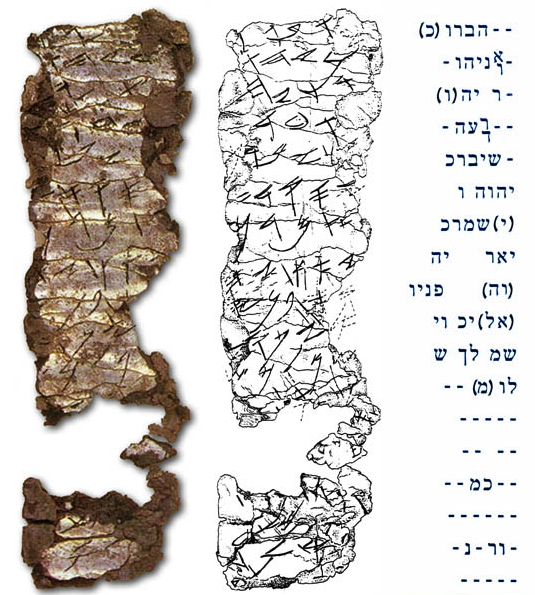
Y’varech’cha Hashem v’yishm’recha. Ya’er Hashem panav eilecha vichuneka. Yissa Hashem panav eilecha v’yasem l’cha shalom.
May God bless you and protect you. May God’s cause God’s presence to shine upon you and be gracious to you. May God in lifting up God’s presence toward you and grant you peace.
These twenty-three words are the oldest known biblical text ever discovered. In 1979, archaeologist Gabriel Barkay found two tiny silver amulets in a burial cave at Ketef Hinnom, outside Jerusalem — no bigger than a thumbnail, dating to 600 BCE, four hundred years older than the Dead Sea Scrolls. Inscribed on them: this blessing. Word for word.
We have been saying these words for twenty-six hundred years. Through every pogrom. Through every torn backdrop.
Earlier that week I had studied with Yehudah Kurtzer of the Shalom Hartman Institute, whose question I haven’t been able to put down: what does it mean not merely to survive — but to thrive? And beyond thriving: to excel?
I keep finding the answer in the three-fold blessing.
The first clause — y’varech’cha Hashem v’yishm’recha, may God bless and protect you — is survival. We need it. But a community organized only around survival is a community defined by its enemies.
The second clause — ya’er Hashem panav eilecha, may God cause God’s presence to shine upon you — is thriving. Illumination. Wisdom. And here is what the data shows: more than forty percent of Toronto’s Jewish children are enrolled in Jewish day schools. In my own congregation, seventy-four percent of members identified learning as a core priority in their Jewish lives. Not nostalgia. Priority. Some of the sharpest observers of Jewish life today have reached a striking conclusion: at this moment of rising antisemitism, the answer is not to pull back. It is to lean in. To make Jewish wisdom and practice more native, not less. The Jews finding genuine resilience right now are the ones for whom Jewish life runs deep enough to draw from when the world grows hostile.
The third clause — yissa Hashem panav eilecha v’yasem l’cha shalom, may God grant you peace — shalom, shalem, wholeness — is excellence. A community integrated and morally coherent, holding itself accountable not merely to what it is permitted to do, but to what it is called to become. And Israel — whatever its current anguish, whatever its current government — is a sovereign Jewish state with elections coming. Israelis will have a choice about their direction. That too is something Anatevka never had.
Fiddler ends in darkness because Anatevka lacked the structures to sustain Jewish flourishing. It was at the mercy of powers it could not control.
We are not Anatevka. Toronto, and Israel, despite their current challenges, are purposeful, vibrant, flourishing Jewish communities. The fourth path — neither ash nor assimilation — is not a fantasy. It is what we are building, imperfectly, stubbornly, together.
Two silver scrolls sat in the earth for twenty-six hundred years, carrying these words forward through every destruction. We are still here to say them.
And we are still here to mean them.
Related Topics