Jewish values, leadership, and honest conversation
Ancient Alliance: What Jewish & Persian Students Know
Not all distance is the same.
There is the distance of genuine conflict — of peoples whose interests are irreconcilable, whose histories are defined by what each has done to the other. Closing it, when it can be closed at all, requires years of painful, incremental work. The distance between Israelis and Palestinians is something like this. Pretending otherwise is sentimentality, not hope.
And then there is a different kind of distance. The distance of misrecognition. Of two peoples who are, at the level of actual values and actual history and actual shared enemies, natural allies — separated not by genuine enmity but by assumption, ignorance, and the successful projection of a conflict that belongs to governments and not to the people living under them.
Last Friday night at Beth Tzedec in Toronto, a room full of Jewish and Persian university students demonstrated, with startling clarity, which kind of distance had been keeping them apart.
It was not the first kind.
The Jewish-Persian relationship is one of the oldest and most persistently misrepresented in human civilization. When Cyrus the Great issued his edict in 539 BCE — releasing the Jewish people from Babylonian captivity and financing the rebuilding of the Temple — the Jewish people received it not as diplomacy but as theology. The Book of Isaiah calls Cyrus by a title given to no other non-Jew in the Hebrew canon: meshiach — anointed one. The Talmud itself was compiled under Sassanid Persian rule, its rabbis in continuous intellectual engagement with Zoroastrian civilization. Their Persian interlocutors were not enemies. They were co-architects of a shared world.
This is the natural grain of Jewish-Persian history. Alliance. Mutual recognition. Shared civilization.
It took a theocratic revolution in 1979 to rewrite that story. And the rewrite has served exactly one party’s interests.
The Persian students who gathered at Beth Tzedec last Friday are not representatives of the Islamic Republic. They are, many of them, its refugees. The children and grandchildren of families who fled. People who know, from the inside, what it costs to live under a regime that has made the destruction of Israel a founding ideological commitment while oppressing the Persian people it claims to represent.
These students did not come to make peace with Jews. They came because they already knew whose side they are on.
What they did not yet fully know was each other. Not as enemies — as people. The gap was not enmity. It was assumption. But the work of Friday night was not reconciliation. It was introduction. There is a difference.
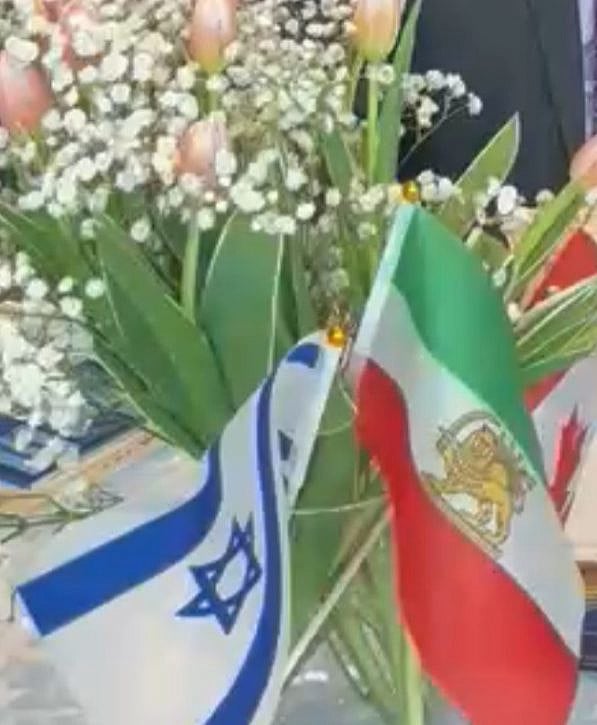
On every table: three flags — Israeli, Canadian, Persian. Not arranged in hierarchy. Not requiring explanation. Simply present as a given. The Islamic Republic would find that image intolerable. An Israeli flag and a Persian flag on the same Shabbat table, placed there by Persian students without hesitation. That, more than any speech, is the answer to what the regime has tried to make of this relationship.
Before the meal I offered a short d’var Torah. The Mishnah closes — six orders, sixty-three tractates, centuries of accumulated legal reasoning — with this:
“Learners — wise learners — increase peace in the world.”
Not leaders. Not diplomats. Learners. People who remain open to being changed by the encounter. Who have not decided in advance what the person across the table can teach them.
I also offered a Persian saying: “The wise person makes peace with an enemy. The fool makes war with a friend.”
Two traditions. One conviction. A room full of people who were, it turned out, already friends who hadn’t yet been properly introduced.
One of the Persian students, Ash, spoke during the dinner. I want to reproduce what he said as faithfully as I can, because it deserves to be heard beyond that room.
Ash spoke about the regime with a clarity that was neither performed nor bitter — the matter-of-fact clarity of someone who has simply lived the truth of it. The Islamic Republic does not represent the Persian people, he said. It never has. And then he said something that stopped the table.
Iranians inside Iran — his relatives, his friends, people he is still in contact with — are not mourning the military strikes. Many of them are relieved. Because they know what their own government has been doing with the country’s infrastructure. Azadi Stadium — Iran’s most iconic soccer venue, a place of national pride — was commandeered by the IRGC as a military staging ground. When it was targeted, it was targeted for that reason. His people hear from the inside what the outside world argues about from a distance: that the targeting has been precise. That the loss of innocent life — always tragic, never acceptable as policy — is not the intention. That there is a difference between a military campaign and a war on a people.
He was not naive about the cost. He named innocent loss directly, and with grief. But he refused the framing that treats precision and tragedy as contradictions. Sometimes, he said quietly, they coexist. And the people living under the regime understand that better than those watching from the outside.
Then Ash spoke about history — about two ancient civilizations whose relationship did not begin with the Islamic Republic and will not end with it. He said he hopes to live to see a day when Jews and Persians can again interact openly, productively, without fear. When what was true for centuries can be true again.
He was articulate. He was knowledgeable. He gave me genuine hope.
The evening ended with Od Yavo Shalom Aleinu — peace will yet come to us — sung together. Then Hatikva, offered by the Jewish students while the Persians held respectful silence. Then Ey Iran — a love letter to the homeland, to the Persian people, to what was and what might yet be. The Jewish students held that silence in return.
Three flags. Two anthems. One Shabbat table in Toronto.
The Jewish-Persian divide, at the level of these students, is not a conflict requiring resolution. It is a misrecognition requiring only the chance to meet. To discover what was always true and had simply not yet been spoken aloud.
“Learners — wise learners — increase peace in the world.”
Last Friday night, a room full of natural allies finally met each other.
Ash gave me hope they will not stop here.
Related Topics
Related Posts