Advancing Women's Health, One Policy at a Time
Ancient Midwives, Modern Mandate
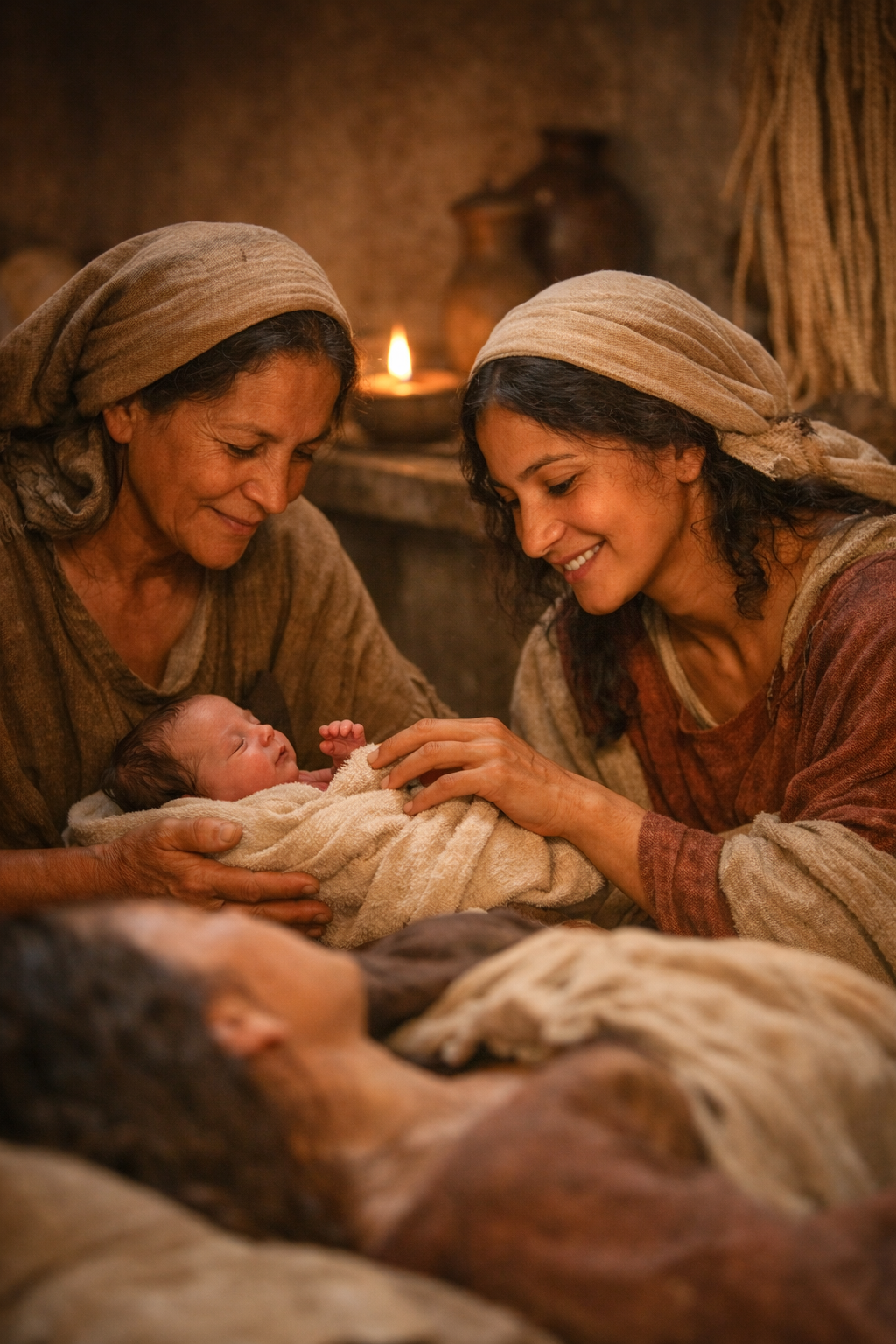
(AI)
We are taught to believe that change comes from governments, politicians, money, and major institutions. But history keeps proving the opposite: the world shifts because a few people, often unseen and unheard, choose to do what is right when it matters most.
This week in the Bible we read about two women.
Shifra and Puah.
Two midwives.
Two individuals living under the most powerful empire of their time.
No rank, no protection, no authority behind them.
They were ordered to kill every male newborn. They refused.
Their resistance happened silently, behind closed doors, in the intimate space of birth.
They protected life when they were commanded to end it, and through that single decision, they preserved an entire people. It is one of the earliest documented examples of women using their professional role to stand against injustice.
And that profession, midwifery, is older than any empire that tried to control it.
For as long as there have been women there have been midwives.
Midwifery predates written history. Archaeological and anthropological records show midwives assisting births in ancient Mesopotamia, Egypt, Greece, and across Indigenous societies long before biblical times. It is perhaps humanity’s oldest profession, built on skill, knowledge, and women’s leadership.
And today, after thousands of years of accumulated experience, midwifery is not a relic of the past, it is the modern gold standard of maternal and newborn care. The profession that has existed for millennia is now backed by the strongest global evidence we have.
The World Health Organization, the Lancet Series on Midwifery, and decades of global research all show the same thing:
Midwives should be providing up to 90% of all sexual, reproductive, maternal, newborn, and adolescent health, and is one of the most effective, evidence-based interventions to save maternal and newborn lives.
If every woman had access to a midwife, 4.3 million lives could be saved by 2035.
This isn’t theory. It’s data.
However, despite the overwhelming global evidence, today millions of midwives are trained, certified, and recognized by global standards, yet too often still constrained or undervalued, limited by policies that fail to respect their autonomy, independence, and expertise.
Shifra and Puah weren’t an exception, they were part of a lineage. For millennia, midwives have defended women, babies, and families, while serving as the primary healers of their communities, and they are still doing it today, often without the very systems that should support them.
Their actions are rarely public.
They happen quietly, professionally, and with precision.
Behind curtains in crowded wards.
In clinics and community centers.
In ambulances.
In homes.
In conflict zones.
In places where women have no one else advocating for them.
Midwives stand between women and harm.
They uphold evidence when systems ignore it.
They defend dignity when institutions overlook it.
They practice skilled, life-saving care in places where no one is watching.
Silent defiance is not just a biblical story.
It is daily professional reality.
Eons ago two midwives saved humanity. Imagine what could happen today if millions of midwives were fully integrated into health systems worldwide, supported, respected, and enabled to practice to the full extent of their training.
Every woman deserves a midwife.
Every family deserves safe, evidence-based care.
Every health system needs the expertise midwives bring.
The quiet courage of Shifra and Puah is not ancient, it’s a mandate.
The world changed once because two midwives refused to follow a broken system. Their story is a reminder that the world does not change when systems decide to do better. It changes when individuals refuse to accept anything less
If we want a better world for women and families, we must do what Shifra and Puah did: we must stop waiting for systems to fix themselves. The responsibility, and the possibility, begins with us.
Related Topics
Related Posts