Ecohasid meets Rambam
“And I will break war from the land” – Sinai, Shmitah, and the covenant with all life
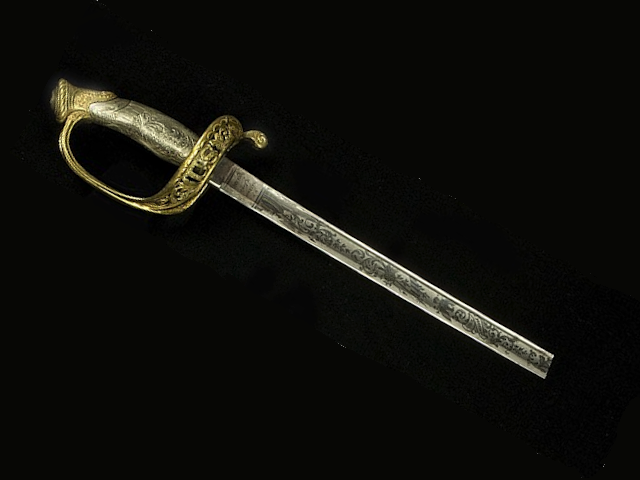
(cc) Wikimedia/Missouri Historical Museum
The haftarah for Parshat Bemidbar, the beginning of the book of Numbers, comes from the prophet Hoshea, and it includes a strange sounding promise: “bow and sword and war I will break eshbor from the land”. This means something like “war and human violence will cease” – but why “break”?
Breaking a sword or bow is clear enough, but breaking a sword from the land implies that the sword is embedded in the land, stabbing the land itself. We hear in many places in scripture that violence between human beings, blood spilled between human beings, pollutes the land, and we can see it with our own eyes. But Hoshea’s image is even more vivid than that.
The first image of a sword in Tanakh is the flaming sword that guards Eden after Adam and Chavah (Eve) are sent away. It is a sword that protects the land, acting as a shield, not cutting anyone but simply blocking a path. Before that, in Eden, we have the image of a world entirely without violence. God gives the fruit trees and the green plants to the humans and all the animals to eat: “for you they will be for eating, and for the wild animals in the land and the birds and everything crawling on the land in which there is a living soul” (Gen 1:29–30). The other animals and human beings eat alongside each other, instead of being each other’s food.
Of course, things go very wrong. But God doesn’t just send Adam and Chavah to wander in the wild. Rather, God returns them to the very spot where the first human was first formed out of dirt from the ground, afar min ha’adamah (Gen 3:23), as if to say, “You know that this soil is you, so you will know how to take care of it.”
The first time blood pollutes the ground, Kayin (Cain) kills Hevel (Abel) in that same place, and “the land opened her mouth to receive [his] brother’s bloods”. (Gen 4:11) Kayin is driven away from the ground itself as punishment, and here the saga of human alienation from the Earth begins in earnest. By the time we get to the sixth chapter of Genesis, we hear seven times that the evil committed by humanity has “ruined the land”. Human violence, chamas, destroys the land.
We know the story: God will wipe humans off the earth in order to bring healing to the land. But first God instructs Noah’s family to gather food for all the animals and for themselves into the ark, to spare a remnant that can carry life forward in the post-flood world. In the ark, then, there is a brief return to something like Eden. The human family eats from the same food supply and sleeps alongside the other animals, living peaceably for the year they are shut in during the flood.
That harmony, however, is shattered the minute they emerge from the ark: “a dread and terror of you will be over all the wild animals and the birds and everything that crawls, and the fish, for I have given them into your hands. Like green plants I give them to you all to eat. Only don’t eat the soul, which is the blood.” (Gen 9:2-4) Humanity will continue to be the source of bloodshed.
This is followed by the first covenant, the Rainbow covenant – which is not made between God and people, but rather between God and all the creatures, and between God and the land. The rainbow becomes a reminder that God will not forsake the other creatures, even if human beings will.
It seems then that Eden is lost forever, but Avram (Abraham) entices God to try one more time to make peace between human beings and the rest of life and the earth, this time by taking one land where one family of humanity will live alongside other species in blessing.
The vision of that world is spelled out at Sinai, where the Israelites are given rules and more rules about how to create a just and holy society. Those rules culminate in the commandments about keeping the Shmitah or Sabbatical year and the Jubilee year, as we read in the Behar and B’chukotai, the two portions that come before Bemidbar. (See “Shmitah: The Purpose of Sinai”.)
The Torah signals to us that the intent of Shmitah is to return to Eden in several ways. One signal is that in the Shmitah year, humanity and the other animals again share the same food. As it says, whatever grows from the land in the Shmitah year “will be for you for eating, for your servant and for your worker and for your sojourner who lives as a stranger with you, and for your animal and for the wild animal that is in your land.” (Lev 25:6–7)
The rabbis picked up on this cue about eating and emphasized it. The halakhah says that people have to take down their fences or leave open their gates in the Shmitah year, so that any creature, wild animals included, could enter and share whatever bounty grew. Not only that, the rabbis also ruled that people shouldn’t eat any produce in their own houses once it had stopped growing in the field. Instead, they would only eat what the wild animals could eat.
It was as if the whole society returned to a time when food was foraged rather than farmed. A time before agriculture, before people ate “by the sweat of their brow”.
Creating a society that could undergo such a radical transformation once every seven years was the fulfillment of the covenant of Sinai. If the Jewish people would uphold this covenant, then, God promised,
I will walk among you, and I will become God for you and you will become My people. (Lev 26:12)
This wasn’t a full restoration of Eden, because people could still eat the (kosher) animals – even though by eating only domesticated animals, the element of terror was replaced by familiarity. But it was a taste of Eden, a full year of it, when people could imagine and experience a different world. If the people will observe Shmitah, God promises, and break the plow from the earth, then “I will set peace in the land” – so that “no sword will pass through your land”.
The final vision, where Eden is restored, evokes for many people the image of lion and calf and wolf and lamb lying down together. Isaiah’s imagery is really about how nations should interact with each other. The ultimate expression of Eden comes not in Isaiah but in Hoshea, in the passage quoted from at the beginning. In one of his most intense and beautiful passages, Hoshea delivers this message in God’s name:
I will cut a covenant for them on that day, with the wild animal of the field, and with the bird of the skies and what crawls on the land – and bow and sword and war I will break eshbor from the land, and I will make them lie down in safety. (Hos 2:20)
[Listen to Shimshai’s beautiful rendition of these verses on YouTube.]
This ultimate vision is a new covenant – a covenant with all creatures, recalling the Rainbow covenant after the flood; a covenant with the people, recalling Abraham’s covenant; and the creating of a new world where other animals will no longer be in terror of human beings, recalling Eden.
This new covenant also recalls the covenant of Shmitah (the Sabbatical year). Hoshea’s words echo what we began quoting above from Parshat B’chukotai, which describes the world the Jewish people can create if they fulfill the Shmitah covenant:
You will dwell in safety in your land, and I will set peace in the land, and you will lie down and no one will make you tremble, and I will stop any harmful animal and no sword will pass through your land… I am YHVH your God who brought you out from Egypt, from being slaves, and I broke va’eshbor the bars of your yoke and made you walk upright. (Lev 26:5-6, 12)
We can learn from this that the strange phrase in Hoshea, “and I will break bow and sword and war from the land”, means that just as the people were freed from Egypt, so will the land be freed from human violence. For, Hoshea hints, human violence encages and enslaves the land as oppressively as the Egyptians enslaved the Hebrews. This freedom is not just for the people, but for the land and for all creatures, and not just once in seven years, but for all time.
And this is the vision of Sinai, and the promise of Torah: to call out liberty and freedom, d’ror, not just to Israel, not even just to human beings, but to all creatures living on the earth and in the land: “And you will call out freedom in the land to all that dwell in her.” (Lev 25:10) It is a call that we are still waiting to hear, a promise yet to be kept. Only then, says God by way of Hoshea, “I will betroth you to me in faith, and you will know YHVH. And I will answer the heavens, and the heavens will answer the earth.”
Then, says Hoshea, again echoing the Shmitah covenant,
I will say to ‘not-My people’, ‘My people are you’, and (this people) will say, ‘my God’. (Hos 2:22–25)
Every war is a war against the earth, every sword or arrow, bomb or missile that draws blood stabs and wounds the earth, no matter which side one is fighting for. May it be God’s will that the bow and sword and war be finally broken from the land, lest the land, and its peoples, become too broken to be healed.
Related Topics
Related Posts