
And salt she became
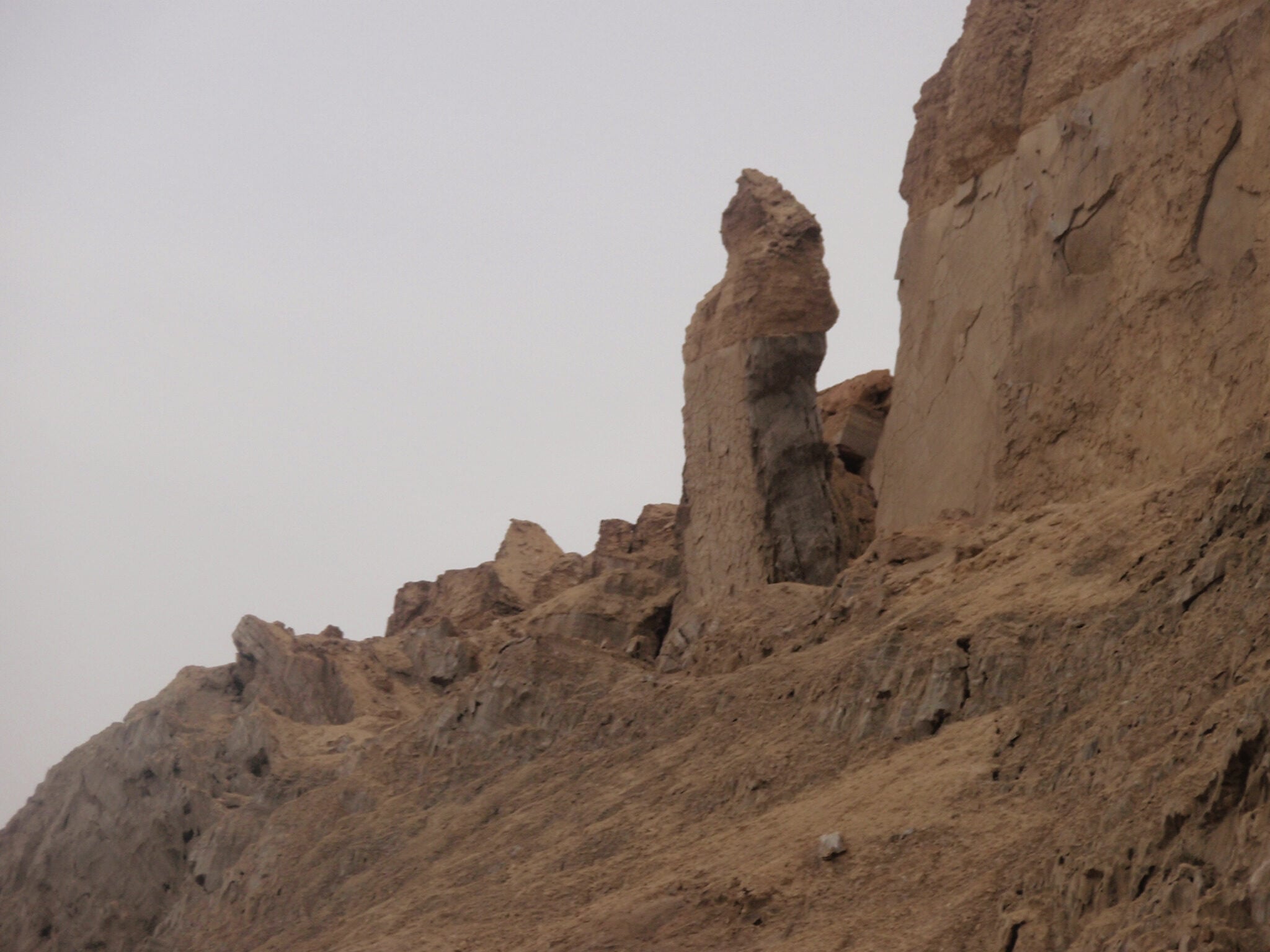
Out in the small and insignificant plains of Tzo’ar, writes the Sefer HaYashar, stands a pillar of salt. “The oxen which frequent that place daily lick the salt pillar until they come to the toes of its feet, but by morning, all they licked off would grow again to be consumed again the coming day, even to this day.”
A salt pillar; a monument. All that remains of the wicked legacy of Sodom and Amorah.
A salt pillar that was once a woman — Lot’s wife did what she was told not to do. She looked back toward the city mid-destruction and salt she became.
I’m fascinated by the rabbinic differences in opinion surrounding Lot’s wife. Some of them, as might be expected, believe that she got what was coming to her and was punished for prior sins. Others seem to express some understanding: “The compassion of Irit the wife of Lot was stirred for her daughters, who were married in Sodom, and she looked back behind her to see if they were coming after her or not.”
The angel told her not to look back. Maybe she was curious; maybe she was haunted by the not knowing. Maybe she was still hoping her daughters would catch up. We don’t know why she looked. But we do know she looked.
And then, she was salt.
Salt is a very Biblical motif. Talmud Berakhot connects it with the word covenant; frequently, the words are used together. Brit Melach: a covenant of salt. “Covenant is used with regard to salt, and the word covenant is used with regard to afflictions,” Rabbi Shimon Ben Lakish is quoted as saying. “Salt sweetens the taste of the meat and renders it edible… the suffering cleanses a person’s transgressions, purifying him for a more sublime existence.”
Salt, covenant, suffering.
Lot’s wife is often invoked by feminist writers and modern midrashim. There is something about her end that is haunting, unsettling, female even. She is the quintessential victim or rebel; everywoman, mother, human. Consider excerpts from these four poems, which capture something about how her likeness has been written and rewritten:
I wanted to ask my husband,
a man scared easily, by wind,
my husband, who believed nothing his fault:
Couldn’t you have held my hand as we rushed away from the burning city?
Couldn’t you have looked back to try and save me
as I disappeared from your grasp?
(Tani Arness)
***
I don’t believe she looked back
in longing for a home that was never hers. Did she understand,
quick as thunder’s whip, that she could not follow a man who
offered her daughters thoughtlessly as water to a throng of thirsty
lips? (Holli Carrell)
***
It is easy for eyes that have always turned to heaven
not to look back;
those who have been—by necessity—drawn to earth
cannot forget that life is lived from day to day.
Good, to a God, and good in human terms
are two different things.
On the breast of the hill, she chooses to be human,
and turns, in farewell—and never regrets
the sacrifice. (Kristine Batey)
***
They say I looked back out of curiosity.
But I could have had other reasons…
I felt age within me. Distance.
The futility of wandering. Torpor…
I ran on,
I crept, I flew upward
until darkness fell from the heavens
and with it scorching gravel and dead birds.
I couldn’t breathe and spun around and around.
Anyone who saw me must have thought I was dancing.
It’s not inconceivable that my eyes were open.
It’s possible I fell facing the city.
(Wisława Szymborska)
Dirshuni: Contemporary Women’s Midrash, a compilation of modern commentaries on the stories of TaNaCh, writes an especially poignant version:
And his wife looked behind, and became a pillar of salt (Gen 19:26). Tear after tear dripped from her eyes, and the tears grew fuller and fuller, stronger and stronger, until they became a pillar of salt. She stumbled and fell, and stirred no more.
And Lot did not look back.
Our Sages of Blessed Memory said, with salt she sinned and with salt was she punished. And I say, she sinned not, but was punished all the same.
As a mother of two daughters: had I been there — had I been her — I, too, would be salt.
And I will say one more thing. Perhaps it was not the punishment we think.
Her husband and daughters are gone, but Lot’s wife still stands: a pillar, a monument, for all time. She may not have been a good person, but if she looked back in that moment, consumed by a terrible curiosity or a horrible empathy or the all-consuming grief of a mother — perhaps she exists outside the plane of good and bad.
Perhaps she is frozen for all time because she is asking us to answer the very same question.
Wouldn’t you look back?