And the violence escalates…A Protective Presence Shift
Note: the blogs build on one another, like a story. Therefore, if you are new to these blogs consider starting with the first blog.
I can’t stand racist labels. The settlers call the Palestinians terrorists and many activists call the settlers terrorists. I see kids who are younger than my own, being exploited. The settler children have never been exposed to any other perspective; they think it’s us or them. Groomed as violent racists from birth.
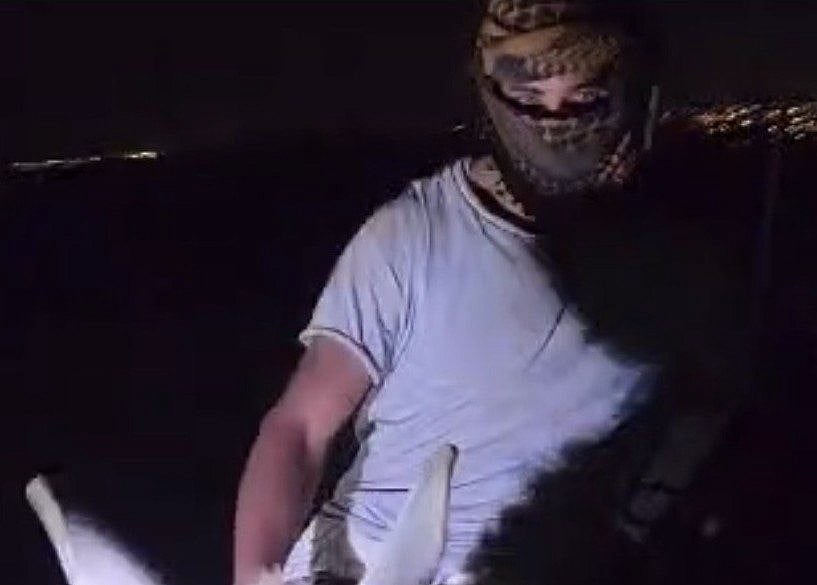
Since we film all interactions, I watch many activists interact with them as though they’re the scum of the earth. I also watch myself and realize I *never* shut up. I’m talking, talking, all the time with every trespassing settler. Every time I see Nehoriah I run up to him with a big smile. Not just because he has a reputation for aggression and interacting with him positively might reduce his immense anger—in other words, not just to protect myself. But because he looks sad and unloved. I want him to feel that I am happy to see him. And I want to expose him to another perspective.
“We are the same,” I tell him. “Perhaps I believe in a greater Israel too. But not like this. Not by terrorizing innocent people!”
He rarely responds. He has probably been told not to talk to us.
“When the strong hurt the weak, history condemns them. Every. Single. Time. Nobody agrees with what you’re doing. Nobody in the whole world, not even most Israelis. Certainly not the Jews. People are attacking Jews in the Diaspora because of your actions. Please see the whole picture. Please stop being so *sure* that you are right. Why do young people always think they know everything? Old people like me know we don’t know anything.”
And on and on. I have spent the last month talking the poor guy’s ear off. I never shut up.
My partner comes up to us. “That delinquent kicked me last week. He’s sick in the head.”
I gaze earnestly into Nehoriah’s puppy eyes. “I know he’s got a good heart.”
Nehoriah’s face softens and then, quick as a flash, he blows a kiss. A very small kiss, instantly subdued, but a definite pursing of the lips. I can’t believe it! The first positive sign! I’ve made a connection! My approach has been justified!
When the settlers finally leave, we troop up to Husni’s house to rest. I stay with three different families and I’m fond of all of them, but Husni and Fatima’s house has the only decent toilet, and Fatima makes the best food. I feel a bit conflicted about the food. We’re not guests. We’re here because our nation is trying to ethnic cleanse them by ruining their lives. We’re here so they have someone to call for help if settlers attack.
Still, goddamn, Fatima is a good cook. Little bowls of labane, humus, scrambled eggs, sauteed tomatoes, olives, delicious bread. Always too much, but I force myself to eat it because I was brought up to eat everything on my plate. Fatima immediately brings more, ignoring my panicked, “La shookran! La shookran!”
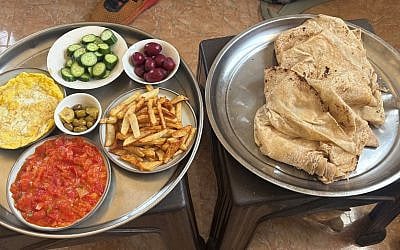
My partner, Jacob, subsides into giggles. “You have to leave a little bit, to show you’ve had enough,” he explains. “If you finish everything, it means you want more.”
Damn, I make a lot of mistakes, despite my desire to please. Once Husni came to open the lock on the gate to let us in; there were settlers nearby and his hands were trembling. I helped him to close the gate and put my hand on his shoulder, in solidarity. He jumped a mile. I shouldn’t have touched him. But he’s an old man and I can’t forget the sadness in his voice when he recounted how he used to drink tea with the settlers. That he doesn’t understand what’s happening now.
“Should I burp after the meal? To show I liked it?” I ask Jacob. I’m sure I’ve read that somewhere. He gives me a pitying look.
After dinner Fatima’s only girl prances before me with a bits of silly putty plastered over her face. The cutest four-year old—I wish the family would let me post photos.
She squishes the putty into a ball and throws it at me. I turn away and roll it into a long string, pushing one end into my nose. It’s supposed to represent snot and make her laugh, but she doesn’t get it. She squishes it again and throws it to me, hard. I find most Middle Eastern children rough compared to Canadians. I throw it back. She lobs it so hard it almost takes my eye out. I want to tell her that I couldn’t stand playing with my own kids and I don’t bloody well want to play with her either.
A newbie replaces Jacob for the night shift. We are sleeping with Yosef, because their fence has been destroyed so they’re more vulnerable. I use Fatima’s nice toilet before I regretfully depart. At Yosef’s, we throw mattresses on the floor and crawl under our thick blankets in the heat; I sleep in my sweaty clothes.
I am pulled out of my dream by Yosef’s frantic hiss, “Settlers!” That’s the first Arabic word I learned. I grab my phone and march towards the door, ready to film like I do during the day. We open the door and I glimpse several masked figures on donkeys right in front of the door—right there—swinging batons in their hands.
And the violence escalates…
We leap back inside and slam the door just in time; a heavy rock pounds against the door. The door doesn’t reach the ceiling. What if they squirt pepper spray into the room, like they did in Duma? What if they break in? What am I supposed to do? Am I supposed to be Gandhi…or Genghis? Will my trembling body give me that choice?
Yosef motions us into the back room, where there’s another door. I haven’t been in the back room and I am surprised to see several women, still lying on their mattresses. For a minute I’m insanely jealous. I want to lie in my bed and let the men protect me, too. Why do I have to be a Western woman and pretend to be brave? It’s men creating all the violence, anyway.
We peer fearfully out the back door. To my intense relief, they aren’t there. Yosef starts to laugh. I’ve noticed the Bedouin love to laugh. They laugh a lot more than the settlers. Or me.
We all lie down again and I cry to focus on my breathing and calm myself.
And the violence escalates.
Fat chance.