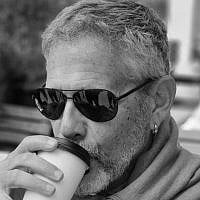
Sometimes everything begins with a simple word. A musician and composer, Andrey Solodenko, wrote on Facebook that he was looking for a kitten. Just that… nothing more. But sometimes the smallest request opens an entire world.
That message reached the Kanevsky family — Vova and Lora — who have had their barbershop on Brighton for 47 years. They passed it on to me. And that’s where this story really begins.
I’m now studying to be an animal chaplain. What does that mean? It means learning to listen to both humans and animals… to see how their lives are woven together. And so, hearing this request, I decided to give Andrey a two-month-old Scottish kitten.
And then something surprising happened. Usually, kittens in a new home hide. They’re scared. But this one… immediately started to play. And I realized — it had something to do with my very first lesson with Sarah Bowen, our teacher and a global leader in animal chaplaincy. She spoke to us about Umwelt — the idea that every creature lives in its own perceptual world. The bee has one. The bird another. The cat yet another. Which means… if we want to truly be with an animal, we must try to see the world through their eyes. Not just ours.
So I thought: if I myself were carried in a closed carrier, how would I feel? Terrified, right? That’s why I didn’t put the kitten there. I carried him in my arms. I drove with one hand on the wheel, and with the other I held him. He climbed over me, played, explored. I stroked him, whispered to him… and he felt no fear. Only curiosity. Interest. That’s how, through play and trust, he entered Andrey’s home.
In Kabbalah there is the concept of tzimtzum — contraction, limitation. A carrier is exactly that: constriction, smallness, fear. But open arms — that is space, that is trust, that is Or Hadash, new light. And it was this light that allowed the kitten not to shrink back, but to leap forward.
Animals don’t speak in words. But they speak — in body language. And when we learn to read the language of animals, we become better at reading the language of people too. There’s a mystery in that.
The Talmud says: “Whoever shows mercy to creatures, Heaven shows mercy to them.” And it’s true. Every encounter has a purpose. Every being has its moment. That evening, a musician and a kitten met. And I happened to stand in between, as a bridge.
And there’s another note to this story. Andrey and I are both from Ukraine. In such difficult times… sorrow seems to bring people closer. It softens hearts. It opens them. And it draws people to animals too — who become our companions, our comfort, our warmth.
Today Andrey has a small friend, who will purr in unison with him. And I have the quiet certainty that this was my first real act of service as an animal chaplain.
Because true service doesn’t begin with big words. It begins with a simple act of kindness. Sometimes it sounds like music. Sometimes… like the soft purr of a kitten.
Rabbi Moshe (Mikhail) Salita is a Brooklyn-based rabbi, legal scholar, and emerging animal chaplain whose work unites Jewish spirituality, international law, and compassion for all living beings.
He holds a Master’s in International Law (with honors) from the National University “Odesa Law Academy,” where he is currently a PhD student researching the restitution of unlawfully confiscated Jewish communal property in Soviet Ukraine. He also earned a Master’s in Library and Information Science from Pratt Institute (New York) and a Master’s in Education and Special Education from Touro University, with graduate certificates in Applied Behavior Analysis (ABA) and Bilingual Education.
Rabbi Salita is an ordained rabbi of the Jewish Spiritual Leaders Institute (JSLI), a Doctor of Ministry student in Jewish Spirituality at the Graduate Theological Foundation, and an Animal Chaplain-in-Training with the Compassion Consortium in New York. His mission is to weave together justice, mercy, and creation care into one sacred path of Tikkun Olam — healing the moral and spiritual wounds of the world.
He serves as Executive Director of the Salita Foundation, originally founded by his brother, Dmitriy Salita — former WBF World Champion boxer, and inductee of both the New York Boxing Hall of Fame and the Jewish Sports Hall of Fame. Today, Rabbi Salita leads the Foundation toward a broader vision — uniting humanitarian ethics, environmental awareness, and cultural restitution.
Through the Foundation, he has launched the “Eco-Kosher Initiative,” a global program encouraging support for businesses and individuals who respect the environment, animals, and their communities. For him, “eco-kosher” is not limited to food — it is a moral philosophy of living in balance with creation, where sustainability and holiness walk hand in hand.
He is also devoted to preserving and gaining international recognition for the rare Israeli cat breed Kanaani — a living symbol of harmony between Jewish heritage and the natural world.
A descendant of Sruel ben Aharon Lekhtman, a Ruzhiner Hasid and brick-factory owner in Kitai-Gorod, Kamianets-Podilskyi — once a spiritual heart of the Ruzhin Hasidic movement in Tsarist-era Ukraine — Rabbi Salita continues his ancestor’s legacy of faith, integrity, and bridge-building. Sruel Lekhtman served as a close friend and estate manager for Pan Dembitsky, a Polish landowner remembered with respect in both Jewish and Ukrainian memory. Their friendship, crossing lines of faith and culture, remains a profound symbol of coexistence — especially meaningful for Ukraine today.
Although Rabbi Salita received Reform rabbinic education in the spirit of Jewish Universalism, he maintains a deep spiritual connection with Chabad, whose living Hasidic tradition unites intellect, compassion, and joy.
Following the example of the prophets — from Adam, the first caretaker of creation, to King Solomon, who understood the language of animals, and to Rav Papa, the sage who spoke kindly of cats — Rabbi Salita teaches that true holiness is revealed through compassion for all living beings. His life’s work is to show that caring for animals and serving God are one and the same sacred breath.