
Bridging faith. Defending truth. Confronting hate
Another Oxford Union Libel: The Myth That Israel Never Wanted Peace
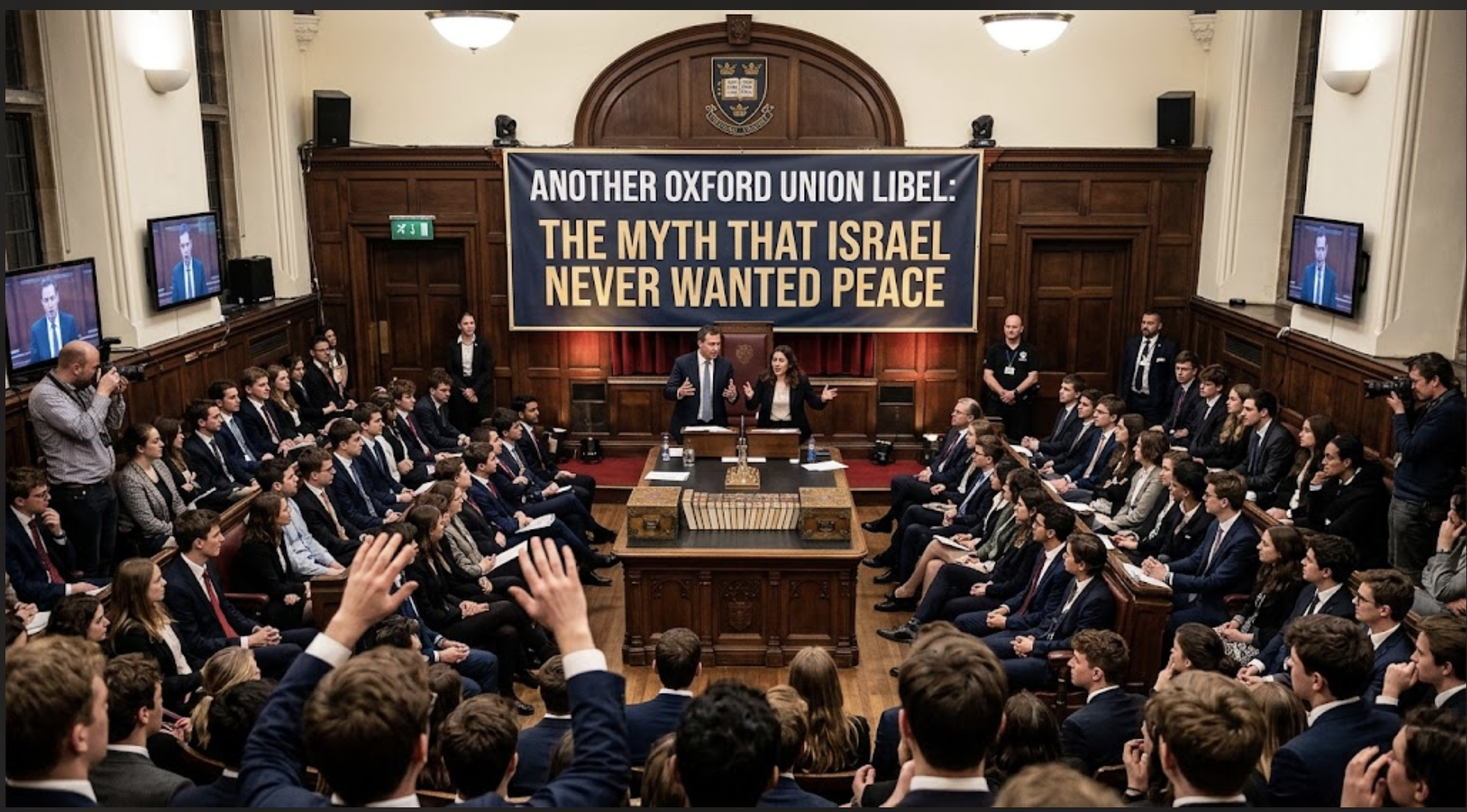
Image created from Google Gemini by Tim Orr
Okay, full disclosure: I hate it when people frame arguments in such a way that the conclusion is in the premise. To say that Israel “never truly wanted peace with Palestine” isn’t asking anyone to look at the facts, it’s telling someone to presumes intent on the part of Israel and encourages the reader to view virtually every Israeli action through a lens of bad faith. It tells you to treat negotiations, concessions, treaties, withdrawals, and any Israeli leader who ever pursued a diplomatic solution as either cynical/pandering/disingenuous or simply irrelevant. That isn’t criticism of Israeli policy, that’s trying to rewrite history in a way that could never allow for the possibility of Israel acting peacefully. What I will be doing, instead of arguing against certain readings of events in this conflict, is arguing against a whole mode of argument.
The Fatal Word: “Never”
The issue with the Oxford Union motion isn’t just that it is incorrect, but that the word never distinguishes necessary facts when analyzing the historical record. The word that makes that proposition unhistorical, even immoral, is never. If one is going to maintain that position, then they must believe that nearly eighty years of negotiations, land swaps, peace treaties, withdrawals, democratic elections, diplomatic efforts, and Israeli peace activism was entirely counterfeit or meaningless. The motion, therefore, asks the viewer to condemn Israeli expressions of a desire for peace, and not just Benjamin Netanyahu, settlement building, or bombastic Israeli military rhetoric.
Such a view is ahistorical because Israel has never had a unified political voice. Israel has been led by Labor Zionists and revisionists, centrists and conservatives, coalition governments, peace activists and land-maximalists, all of whom had very different ideas about the possibility of Palestinian statehood. Yitzhak Rabin should not be conflated with Benjamin Netanyahu just as Ehud Olmert should not be regarded as politically synonymous with Bezalel Smotrich. But if the complexity of Israel’s political history is acknowledged, then “never” becomes a word that can barely defend itself against the historical record.
But more disturbing than anything else about this controversy is what it might reveal about Oxford in particular and British intellectual life in general. When universities repeatedly promulgate a rhetorical universe in which Jewish self-determination is illegitimate, Israel is afforded a presumption of guilt, and Jewish aspirations towards safety or self-government are characterized as desires for domination, they do something more pernicious than facilitating toxic speech. They help normalize an ideology that works to transform Jews from victims of history into villains; into people whose very existence is imagined to inflict harm on others. That sort of shift in thinking is dangerous because almost no movements that come to explicitly advocate for the genocide of Jews begin from that premise. Instead they start by imagining a world where Jewish people are the origin of all deception, where they are unduly powerful, and where their power is a uniquely indefensible sort of power that does not get to count on the rights and protections that other groups have come to expect. When that sort of logic becomes mainstream inside of universities, antisemitism doesn’t need to look like obvious hate speech. It can look like the wokest form of moral posturing. My concern for Oxford, and by extension Britain, is that an educational system purported to highlight old forms of bigotry is instead normalizing a worldview that encourages younger generations to view increasingly virulent anti-Jewish hatred as morally refined rather than morally barbaric.
Victimhood Is Not Historical Proof
You can see the problem with this approach right away, because of how the president of the House chooses to open her statement. Rather than begin by describing some historical evidence about the debate over partition, she begins with her vitriolic autobiography. She talks about her Palestinian family in Gaza; she explains her British citizenship; she confesses feeling guilty about enjoying opportunities that her relatives lack. Her family’s suffering is understandable, and it deserves compassion. But autobiography – even autobiography that describes suffering – cannot be used to prove what Israeli leaders thought about at Oslo, Camp David, Annapolis, or when debating the UN partition plan.
This matters because once victimization is used rhetorically to create a presumption of interpretive authority, the logical structure of the speech seeks to prevent that interpretation from being challenged. Palestinians suffer; therefore we should accept the Palestinian interpretation of why they suffer as morally superior.If you challenge the accepted interpretation of history, you may sound like you don’t care about Palestinians instead of someone who disputes a biased version of history. That is an effective rhetorical move. As an exercise in academic history, it substitutes pathos for proof.
Once that move is made, the opening also creates a test that rules out large chunks of historical evidence that might challenge her proposition. We cannot judge peace efforts, the speaker argues, by speeches or handshakes or ceremonies or offers of any kind. Instead, we should judge by “the behavior of Israel and whether what Israel does makes the establishment of a Palestinian state more possible or less possible.” But then “Israel” shifts from meaning particular Israeli governments to referring to “the Israeli project,” its “institutions,” and the public attitudes that allow those governments to retain office. Peace offers by Israeli governments can always be dismissed as mere theater while Israeli “setbacks for peace” can be taken as revealing “Israel’s true intent.”
That isn’t history. It’s rhetoric. Because if Israel talks, Israelis were being cynical. If Israel withdraws from territory, Israelis were being tactical. If Israeli voters elect leaders who advocate territorial compromise, those voters are just deceiving themselves or faking sincerity. Once you can reclassify every potential counterexample as evidence of bad faith, you aren’t evaluating historical evidence. You’re immunizing your ideology from refutation.
Israel’s Record Shows That It Did Seek Peace
The facts of history hurt the argument because there have been many occasions where Israel has behaved inconsistently with the idea that it never wanted peace. Jewish leaders accepted partition in 1947 despite their grievances with the recommended borders. Arab Palestinian leadership rejected partition. Israel made peace with Egypt and Jordan, recognized the PLO, entered Oslo, negotiated at Camp David, withdrew from Gaza, and engaged in unprecedented negotiations with Ehud Olmert. You can quibble with the wisdom of specific concessions, the timing of the efforts, or the good faith of negotiators, but taken as a whole the trendline is undeniable unless you intend to label every Israeli concession as a fraud.
Oslo hurts because Israel recognized the Palestine Liberation Organization as the representative of the Palestinian people. Israel agreed to a political process whose stated goal was to bring about Palestinian self-government while final-status negotiations were underway. Rabin invested his political legacy in that process and was assassinated by a Jewish extremist who opposed it. Millions of Israelis voted for or publicly supported that process. The affirmative later tried to mock Israeli protestors that became mourners after Rabin was assassinated and the eventual election of his successor Ehud Barak on a platform of land-for-peace.
One can say that settlements were built during Oslo. That is fair, and I’ll address it later. Granted that. But at most that shows that some Israeli policies made negotiations more difficult; it doesn’t prove that Israeli policies were designed to thwart peace or that Israel didn’t actually want a negotiated agreement. What it does not demonstrate is that Rabin, Shimon Peres, Barak, Olmert, or the millions of Israelis who supported territorial compromise were lying when they said they sought peace with the Palestinians. To pretend that those Israelis never existed because subsequent Israeli governments have frustrated peace processes is dishonest, illogical, and ideologically driven homogenization of history.
Camp David poses another serious problem for the motion. The exact terms of Camp David are still disputed, but one point is not: Israel negotiated about Palestinian sovereignty, territorial withdrawal, Jerusalem, and the parameters of a two-state agreement. Barak negotiated Palestinian sovereignty, withdrawal from large areas of land, the division or sharing of Jerusalem, and other components of a two-state solution. Whatever one believes about the specific terms, it is incredibly hard to argue that an Israeli government willing to negotiate territorial withdrawal and Palestinian sovereignty gives you “ZERO” evidence of a desire for peace.
The 2005 Gaza withdrawal also challenges the idea that every Israeli government has remained committed to keeping every piece of land under Israeli control. Israel took thousands of Israelis out of Gaza, destroyed Jewish settlements, and ended permanent Israeli ground forces from within Gaza itself. One of the negative speakers lifted up the image of Israeli soldiers dragging an Israeli woman out of her home in Gaza. An Israeli government decided to relinquish its physical presence in Gaza and Israeli citizens complied.
Finally, Olmert negotiated with Mahmoud Abbas. Aspects of the discussion between them remain classified, but the public record shows that Olmert was willing to discuss a Palestinian state in essentially all of Gaza and the West Bank, land swaps, Jerusalem, and resolutions to other final status issues. Abbas refused the deal.
The Proposition Erases Palestinian Agency
On the issue of Palestinian agency, there lies another major flaw in the proposition’s argument. The opening speaker acknowledges that Palestinians twice rejected partition plans, once in 1937 and once in 1947. He then rolls those events into the immoral act of dispossession that was also being placed on the table at those moments. Fine. Maybe that’s why they rejected those offers. But it doesn’t change the reality that they did reject them. Palestinian leadership were politicians. They had agency, and they made decisions. A lot of their decisions have made this conflict go on for generations.
Now, here we see the same asymmetry. Israeli violence telegraphs Israeli political objectives. Palestinian violence, more often than not, is portrayed as merely reactionary to Israeli decisions. Maximalism on the Israeli side is seen as proof of expansionism while Palestinian maximalism is more easily explained away as understandable resistance.
Such a framework can’t possibly account for the Second Intifada or suicide bombings during the Clinton-era peace process or Hamas or Palestinian rejection of Jewish sovereignty or October 7. You cannot attribute those things purely or primarily to Israeli actions without robbing Palestinian leaders of moral agency and political responsibility. Hamas came with its own ideology, its own theology, objectives and vision for tomorrow that can’t be rewritten at will by citing settlements or checkpoints. Palestinian nationalism has spawned leaders who compromised, but also included potent rejectionist currents who fought Jewish sovereignty itself, and an intellectually honest history will take both seriously.
Notice how this ideology becomes clearest in the second proposition speaker. While she claims that debates over whether Israel wanted peace are fundamentally moot since they’re simply a “statement of fact.” From there she’s able to claim that because Israel was founded on the theft of other people’ land we shouldn’t really ever expect Israel to love peace. At this point, the argument is less historical and more essentialist: Israeli’s origins have fixed their character forever, and that fixed character will now be used to define the intent behind everything they do.
The Historical Verdict: Israel Wanted Peace
Yes, you have to whitewash history to argue that every Israeli government negotiated in precisely the same way, or accepted precisely the same level of territorial or security risk. Settlements certainly became a bargaining chip; that doesn’t alter the historical fact that Israel…negotiated, gave land back, made compromises over territory. Israeli governments disagreed about what land swaps were acceptable; and Bibi Netanyahu has consistently opposed versions of Palestinian sovereignty that he believes would threaten Israeli security, empower rejectionists, or create another terrorist launching pad against the Jewish state. You can argue about whether Netanyahu has made the right calls; you cannot simply point to his security concerns as “proof” that he is “opposed to peace.”
History doesn’t end there, though. Israeli governments recognized the Palestinian people; agreed to withdraw from territory; offered variations on Palestinian sovereignty; gave back land they won in a war; uprooted Israeli settlements; made peace with their historic enemy; and asked Israeli voters to take massive territorial risks for the POSSIBILITY of reconciliation. Israeli voters built peace groups; marched in huge demonstrations; elected compromisers; cried when their leader was assassinated for speaking to the Palestinians. These were real concessions and gestures, not inventions concocted after-the-fact to give Israel moral cover.
The motion requires that you hold Israelis to an impossibly high standard of proof when it comes to their motives. Any Israeli “mistake” becomes “proof” that Israel never, in fact, wanted peace to begin with. Any Israeli peace offering is instantly re-interpreted as something else: a cynical attempt to take more land, a fatally flawed offer that can never be accepted, a maneuver that can’t possibly be divorced from imperial intentions, or BOTH because how can you ever know the real Israeli position and it’s ALWAYS part of a master plan to eventually take all of Palestine.
By that logic, if Israel sits down and negotiates, the mere existence of the talks PROVES that they were a sham. If it makes concessions, they were never enough to “prove its intentions.” If it withdraws from land, the withdrawal was really a tactic to hide its “true intentions.” At that point, the motion isn’t trying to understand Israeli intentions–it’s shielding an ideological presumption from any possibility of being challenged.
When Palestinian leaders reject an Israeli proposal because they consider its terms inadequate, their motives are routinely contextualized and treated sympathetically; when Israeli leaders reject terms they regard as dangerous, their refusal is often treated as proof that Israel never wanted peace. If Israelis reject Palestinian offers because they view them as unfair or dangerous then suddenly, Israel does NOT really want peace with the Palestinians.
Israel has made peace offers. Not every Israeli has ever wanted peace. Not every Israeli government has sought peace with the same priorities or gestures. Israeli leaders have disagreed profoundly over how much territorial and security risk a durable peace can reasonably require.
Israel as a state has offered irrefutable proof numerous times through actions that Israeli governments have been ready to make significant territorial, political and security compromises at critical junctures for peace. To say that none of Israel’s negotiations were sincere, that none of its concessions were legitimate, that none of its withdrawals was strategically calculated to create peace, and that none of its leaders ever seriously pursued peaceful resolutions tells us far more about the originator of that statement than it does about Israel.
Which brings me back to the tragedy. The tragedy is not that Israel never tried to make peace. The tragedy is that Israel did try, time after time after time, to make peace and that each time that effort was met with counter-forces powerful enough not just to thwart progress but to obliterate those efforts completely. There are many reasons peace failed. But no fair assessment can overlook the poisonous effect of terrorism; Palestinian rejectionism; recurrent doubts about whether land-for-peace compromises would bring an end to hostilities; political weakness on both sides; and Israel’s perfectly reasonable fear that territory once given up would be used to send more suicide bombers into her schools and market places. Israel had reason to fear Palestinian statehood. The suicide bombings that dotted Israel during the Oslo years were cause for concern. So too was Israel’s experience with withdrawing from territory in Gaza and southern Lebanon, where Israel’ retreat was followed by armed groups, bent on Israel’s destruction, taking root and launching repeated attacks on Israeli civilians. Withdrawing territory, Israel learned first-hand the potential ramifications of a Palestinian state. This is not a history lesson that can be easily reduced to a slogan, but I think it has the virtue of actually taking the historical record into account rather than deciding in advance which side possesses the stronger claim to victimhood and then interpreting the historical record backward from that conclusion. People can believe whatever they want about who is responsible for the breakdown of peace negotiations, but asking Israel to bear sole responsibility for that breakdown makes for a catchy Oxford Union motion; it doesn’t make it true.
Sources
Clinton, William J. “Remarks by the President at Conclusion of Camp David Summit.” The White House, July 25, 2000. https://clintonwhitehouse4.archives.gov/library/hot_releases/July_25_2000_3.html.
Oxford Union. “THB Israel Never Truly Wanted Peace with Palestine – Full Debate.” YouTube video, September 1, 2026.
Rabin, Yitzhak, and Yasser Arafat. “Israel-PLO Mutual Recognition.” September 9, 1993. United Nations Peacemaker. https://peacemaker.un.org/sites/default/files/document/files/2024/05/israel-plo20mutual20recognition.pdf.
United Nations. “The Question of Palestine and the United Nations.” Accessed September 4, 2026. https://www.un.org/unispal/document/auto-insert-208097/.
United Nations. “The Humanitarian Impact of the Disengagement.” 2005. https://www.un.org/unispal/document/auto-insert-189499/.
U.S. Department of State. Patterns of Global Terrorism: 1996. Washington, DC: U.S. Department of State, 1997. https://1997-2001.state.gov/www/global/terrorism/1996Report/1996index.html
Related Topics
Related Posts