
Anti-Arab Racism: A Five-Alarm Fire for Israeli Democracy
Israel is facing a decisive turning point in its future as a Jewish and democratic state.
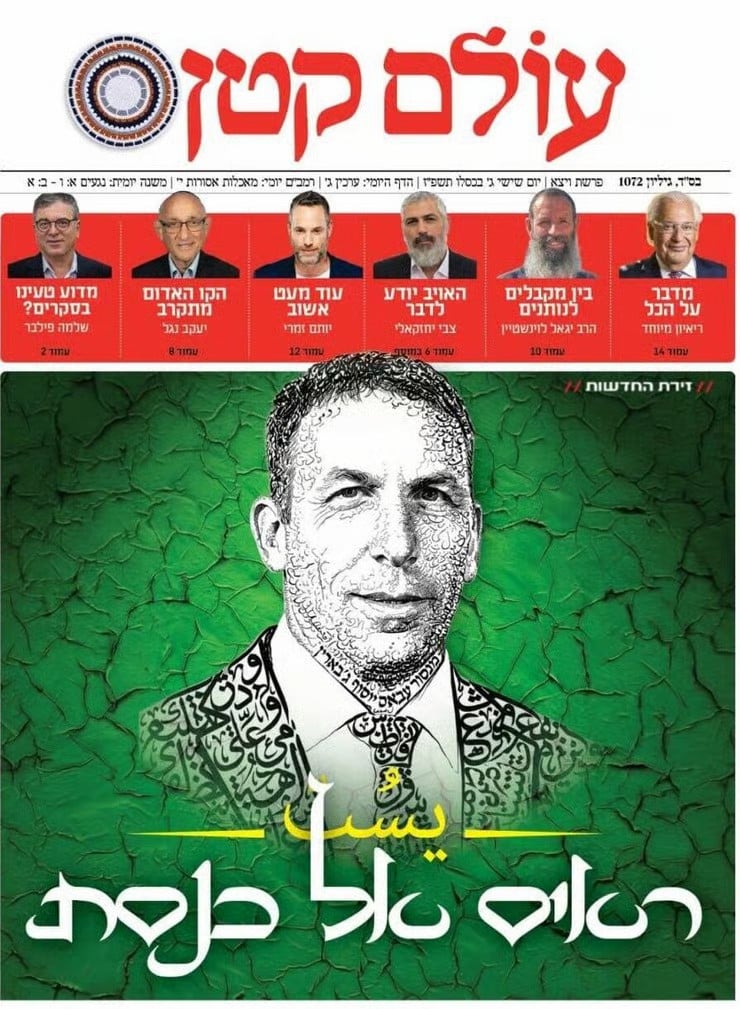
For decades, Israel and its supporters around the world have vigorously pushed back against accusations of apartheid by pointing proudly to the full citizenship and political rights of our Arab minority, and to their representation in the Knesset, the judiciary, government, and virtually every sphere of Israeli life. That has been the cornerstone of Israel’s defense against its critics—the proof that Israeli Arabs and Jews enjoy the same voting rights, and that their elected representatives participate fully in our democratic institutions.
“The only democracy in the Mideast!” was the rallying cry.
Today, we are witnessing a vicious campaign to delegitimize Arab political participation. Arab votes are being portrayed as illegitimate, Arab members of Knesset as supporters of terrorism, and Jewish politicians who cooperate with them as traitors.
The question is no longer simply how much racism Israeli society is prepared to tolerate. It is whether a substantial part of the Jewish public is prepared to abandon one of the most basic principles of democracy: that every citizen’s vote counts equally.
We are approaching a point of no return. Liberal democracy is not some optional feature of the Jewish state, or merely an ideal cherished and romanticized by part of its population. It has been indispensable to our defense and security, our extraordinary economic growth, our vibrant cultural and intellectual life, our social cohesion, and our legitimacy not only in the eyes of the world, but in our own eyes as well. Without that democratic foundation, the modern Israel we have built, with all its remarkable achievements, could never have existed.
One Outrage After Another
And then there is Shira Shapira, the mother of Aner Shapira, one of the extraordinary heroes of October 7 who died defending people sheltering from Hamas terrorists at the Nova music festival, repeatedly throwing grenades back out of the shelter where they had sought refuge. Because Shira, now a member of Knesset, supported Kahana’s election, Likud MK Amichai Chikli personally sent her a social media post accusing her, in effect, of betraying her fallen son’s memory by cooperating with Arab MKs. Shira responded with extraordinary dignity, saying she was not asking for immunity from criticism as a bereaved mother, but that there was something particularly cruel about setting a mother against her fallen son and presuming to speak in his name. Chikli did not apologize; he said he had sent the post to reflect the feelings of the national camp.
Five years ago, Benjamin Netanyahu was courting Mansour Abbas, the leader of the Arab Ra’am party. Bibi and his allies were perfectly capable of explaining why cooperation with Arab politicians was legitimate when they thought it might help them remain in power, and the web is full of video clips of them making precisely that case. The cynicism is breathtaking.
While it is emotionally satisfying to dwell on this hypocrisy, something much more dangerous is happening. The racism that Netanyahu and his political machine have been exploiting and legitimizing is already deeply rooted in Israeli society, and the evidence shows it has become considerably more widespread. An Israel Democracy Institute survey found that in 2019, 36% of Jewish Israelis supported encouraging Arab citizens to emigrate from Israel; by 2025, that figure had risen to 53%. Support among Jewish Israelis for including Arab parties in government also declined, from 35% in 2021 to 27% in 2025. Meanwhile, FakeReporter documented a staggering 428% surge in anti-Arab rhetoric in just two days following the October election. This was no spontaneous outburst. Netanyahu and his allies were among the principal drivers of the campaign, spreading baseless accusations of electoral fraud, portraying Arab citizens as enemies, and fueling demands to restrict their voting rights. Netanyahu’s own claim that the election had been stolen attracted some 1.2 million views. The online poison machine was operating at full throttle.
Netanyahu’s long-term strategy is to effectively disenfranchise Israel’s Arab citizens and thereby ensure permanent right-wing rule. Not by taking away their right to vote, but by making their votes politically illegitimate. Exclude 15–20 Arab seats from the calculation, and it is impossible for the opposition to assemble a 61-seat majority. That’s the trap.
Bibi’s Long Game: Ensuring Permanent Right-Wing Rule
The calculation is simple. A government needs a majority of 61 seats in the Knesset. But if the 15–20 Arab seats are automatically excluded from any legitimate governing majority, the center and center-left must somehow assemble 61 seats from the remaining 100–105. That makes forming an alternative government impossible. That is precisely the political trap Netanyahu and his allies are trying to create. We are watching it play out right now.
And this is no longer just about political delegitimization. Some on the right are already openly calling for restrictions on Arab voting rights. What begins as an attempt to invalidate Arab political influence could ultimately become an attempt to deny Arab citizens the vote itself.
This Didn’t Start with Bibi, and It Won’t End With Him
The Cancer of Occupation is Metastasizing
Israel’s Legitimacy Is at Stake, Abroad and at Home
This is also a disaster for Diaspora Jews. Already confronting rising antisemitism, Jews abroad face growing pressure to answer for policies they neither support nor control, while younger generations increasingly distance themselves from a country whose values they no longer recognize as their own.
Now, precisely when Israel desperately needs to rehabilitate its international legitimacy, its political leadership is undermining one of the strongest arguments we have ever made in Israel’s defense: that Arab citizens enjoy equal political rights and that their votes count just as much as Jewish votes. What are Israel’s supporters around the world supposed to say when the principle of equal citizenship is being openly challenged, when Arab political participation is increasingly treated as illegitimate, and when anti-Arab racism is becoming normalized across substantial parts of Israeli society?
No “hasbara” geniuses will be able to explain this away, because it is impossible to “spin.” This is a moral crisis of the highest order—an existential threat to Israel’s legitimacy, not only in the eyes of the world, but in our own.
The very foundations of Israel as a Jewish and democratic state are being undermined from within. We have to stop it.