
The Arabic That Wasn’t There
Israel has discovered a remarkable political danger: an Arabic word can apparently threaten the Knesset even when it is written in Hebrew. This week’s cover of the right-wing publication Olam Katan portrayed the newly elected Knesset speaker, Matan Kahana, under the title “Ra’is al-Knesset.” The phrase was written in Hebrew transliteration, while the illustration surrounded him with Arabic imagery and the names of Arab political leaders. Apparently, Arabic has become so politically dangerous that the safest way to weaponize it is to write it in Hebrew.
The joke would be harmless if it did not expose something considerably more troubling. Kahana was elected by a parliamentary majority that included Arab lawmakers. The cover presented this fact as a reason for suspicion, as though receiving votes from Arab representatives somehow diminished his legitimacy as speaker of Israel’s parliament. Kahana had declared that the Knesset belongs to all citizens and that he intended to serve the entire chamber. The response was revealing: apparently, representing everyone becomes questionable when everyone actually includes everyone.
And then came Gadi Eisenkot. On November 20, he announced that, if negotiations for a broad coalition failed, he would seek to establish a national emergency government. Such a government would likely require support or abstention from Arab parties. Yet in his lengthy statement, Eisenkot largely avoided naming those parties directly. The contrast could hardly be more instructive. One political camp turns Arab participation into an accusation. Another considers a parliamentary arrangement that may depend upon it, while remaining remarkably cautious about saying so.
Meanwhile, the Arab citizens concerned have already voted. In October’s election, Arab turnout reached an estimated 77 percent, helping Ra’am and the Joint List secure 19 Knesset seats. Those votes were not provisional. They did not arrive with an asterisk indicating that their political consequences would require additional permission from Jewish politicians. They were votes cast by citizens of Israel, participating in the same electoral procedures as everyone else.
The distinction between voting and governing matters, of course. No party possesses an automatic entitlement to join a coalition, and political leaders may legitimately reject partnerships because of policy disagreements, security positions, or incompatible constitutional commitments. But refusing a particular coalition is one thing. Presenting the very participation of Arab representatives in parliamentary decision-making as a threat to the state’s legitimacy is quite another. An election cannot simultaneously count citizens as members of the electorate and treat their parliamentary influence as an embarrassment requiring explanation.
The contradiction becomes even more interesting when we examine what Arab citizens themselves are asking for. A University of Haifa survey published on November 20 found that 59 percent of Arab respondents supported Arab parties participating in government. Their expectations were strikingly practical: increased resources for Arab municipalities, improved personal security, reduced crime, and a stronger sense of belonging. Among Jewish respondents, however, 65 percent feared that Arab participation in government might damage Israel’s Jewish character, while 60 percent expressed concerns about national defense.
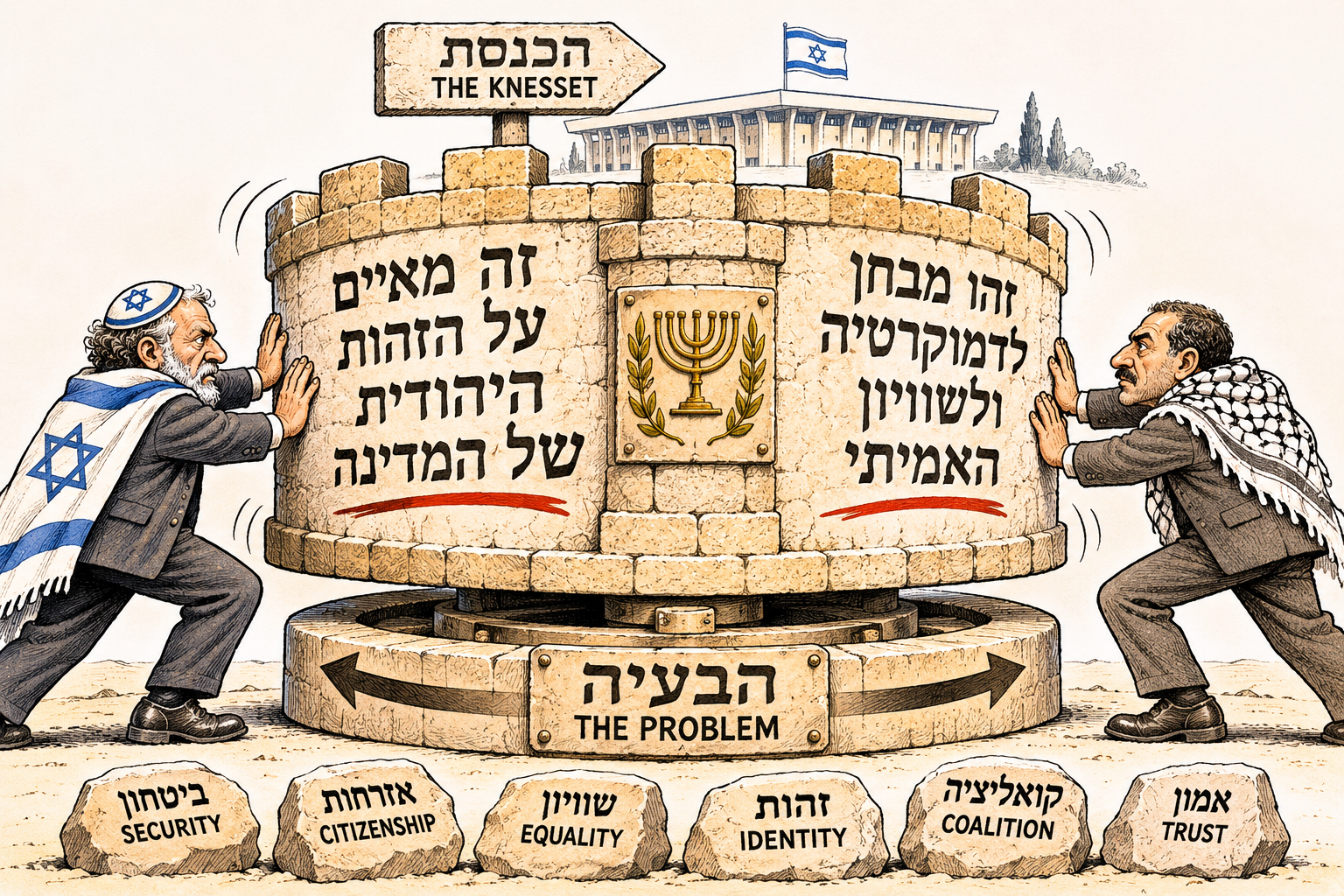
These fears deserve examination, not ridicule. Questions about security and the character of the state are politically consequential. Yet the evidence raises a question that cannot be dismissed merely by invoking those concerns: why should the participation of citizens in their own country’s government be regarded, in itself, as a threat to the character of that country? The problem becomes particularly uncomfortable in a Jewish state that also describes itself as democratic.
There is no need to pretend that the tension between these constitutional commitments can be resolved by a slogan. But neither can it be resolved by transforming an entire category of citizens into a permanent exception to ordinary political legitimacy. Israel’s Jewish character cannot be adequately defended by assuming that the political agency of its non-Jewish citizens is intrinsically dangerous. Such an argument would require explaining why citizenship confers the right to vote while rendering the practical consequences of that vote suspect.
This is where the language of the Olam Katan cover becomes more than an unpleasant political joke. Hebrew and Arabic are not merely competing political symbols. Both belong to the linguistic and cultural reality of this land. Arabic possesses a recognized status under Israeli law, and it is spoken by citizens whose families, communities, institutions, and political concerns belong to Israel itself. Writing an Arabic title in Hebrew letters does not make the Knesset less Jewish. It demonstrates only how easily political imagination can turn a language into a substitute for an argument.
There is something almost comical about a political culture sufficiently confident to debate military strategy, constitutional reform, and the future of the Middle East, yet apparently unsettled by the prospect of an Arabic expression appearing near the title of its parliamentary speaker. The problem is not that Israelis disagree about coalition arrangements. They should disagree, argue, negotiate, and scrutinize the political commitments of those seeking power. The problem begins when the identity of some elected representatives is treated as an argument against their legitimacy before anything they propose has been examined.
This is also a test for Eisenkot. If Arab parliamentary support becomes necessary to establish a government, its political significance should be acknowledged openly rather than hidden behind the vocabulary of emergency arrangements. A democratic majority does not acquire greater legitimacy by declining to name some of the citizens whose representatives make it possible. The arithmetic is elementary; the political courage required to accept its consequences appears to be considerably more complicated.
The next Israeli government may be broad, narrow, temporary, or dependent upon parliamentary support from outside its coalition. Whatever its composition, the Knesset will remain the parliament of all Israeli citizens, not merely those whose political participation causes the least discomfort. Its legitimacy cannot depend upon whether the ethnic or linguistic identity of the citizens whose representatives participate in its decisions is politically convenient.
The deepest question raised by this week’s controversy is therefore not whether Arabic belongs in the Knesset. Arab citizens already belong to the electorate from which the Knesset derives its authority. The real question is whether Israel can accept the political consequences of a citizenship it has already recognized. After all, if the Hebrew alphabet is perfectly acceptable until it begins spelling Arabic words, the problem may not be linguistic at all.
Yochanan Schimmelpfennig