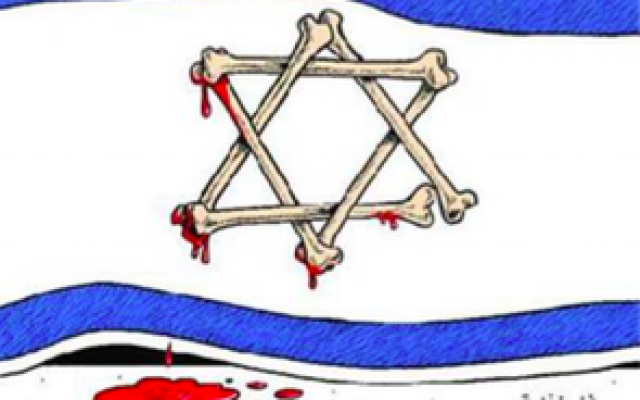
Anti-Semitism for Dummies: A Visual Guide
Termed the “longest hatred,” there are currently over five leading definitions for anti-Semitism. They exist because anti-Semitism is a virus that mutates and takes on various forms, thereby making it, at times, difficult to identify. And because there are so many designations, few can agree on one working definition.
As an educator, it is my duty to clarify the complex. As a trained literary scholar, it is my responsibility to search for literary devices (also known as tropes) in a text in order to unlock meaning. These dual aspects of my background provide a helpful tool to identify anti-Semitism.
Clashing over definitions of anti-Semitism has been, thus far, unproductive. Instead, the following is a different approach: identify leading accusations applied to Jews historically. Below are five common accusations historically waged against Jews. Each have a particular iconography, a set of visual images that are symbolic. Because the images have appeared so often, they are also tropes. They are:
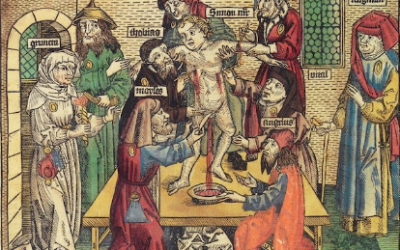
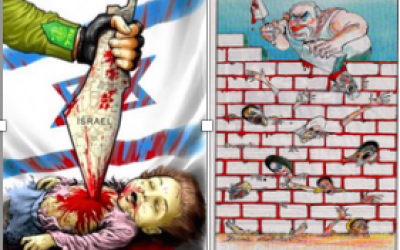
- Blood Libel: Rooted in the accusation that Jews kill Christian children for religious rituals, especially in order to make Matzah from their blood, the claim started in late 12th century with the curious case of William of Norwich, a young English boy whose gruesome murder launched one of the fiercest accusations against the Jewish people. Blood libel spread across Europe rapidly. By the 14th century, blood libel had reached Spain, Portugal, and Prussia. So powerful is this accusation that it reared its ugly head well after the advent of modernization in the sensational Beilis Affair (1913), an incident involving a Jewish man in Kiev who was accused of murdering a Christian boy for ritual purposes. Today, the libel is most prominent in Muslim-majority countries. The iconography of blood libel has a unique combination of images: a dead child (commonly a boy), blood, and a Jew. Let us take a closer look at some of these images:
- World Domination: The accusation of a conspiracy to control the world waged against the Jewish people is found in a forged document, The Protocols of the Elders of Zion, purporting to describe a secret Jewish plan for global domination. Fabricated in Czarist Russia in 1903, the accusation had far-reaching consequences that included one of the bloodiest pogroms in Russian history, the Kishinev pogrom, also in 1903. The iconography and topoi of this accusation depict Jews, usually as vermin, overpowering a globe.
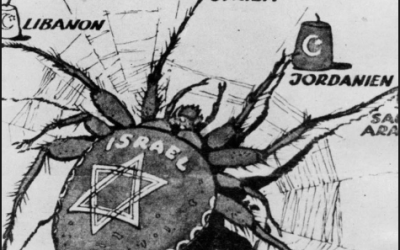
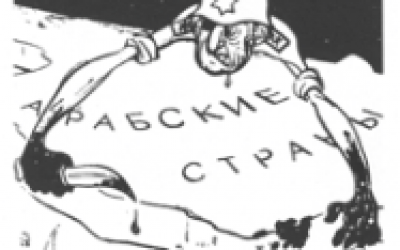
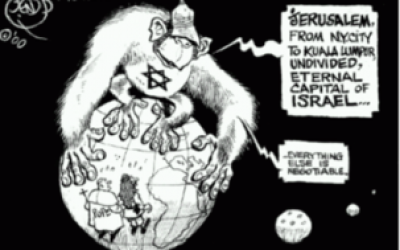
- Demonization: The claim that Jews are devils is rooted in Christian theology, wherein those who rejected Jesus were seen as detractors from the “true” religious path. Jews were often depicted as having horns and supernatural powers, relegating them to the metaphysical and evil realm of the devil. Tropes unique to demonization are insinuations that Jews are the source of all evil. Demonization, therefore, also includes equating Jews to Nazis, since Nazism is the embodiment of an evil ideology.
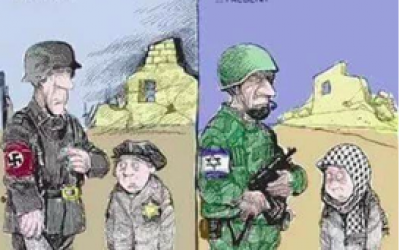
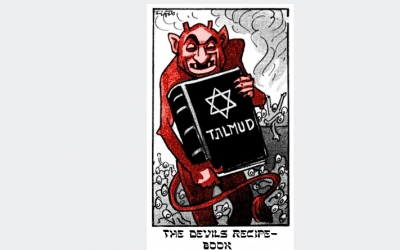
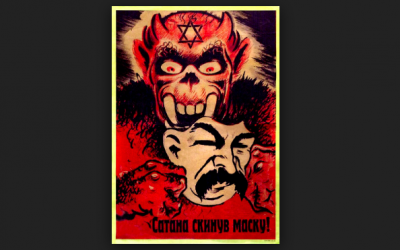
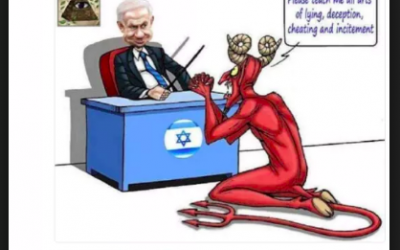
- Dual Loyalties: As with demonization and blood libel, the accusation waged against the Jewish people of being untrustworthy is rooted in Christian theology, wherein the claim that Jews betrayed Jesus developed into a full-blown ideology that cast Jews as a duplicitous nation that will betray anyone—even one of their own!—for personal gain. Tropes particular to this accusation are two-fold: first, equating Jews to a “fifth column,” a term meaning any group of people who undermine a larger group from within, usually in favor of an enemy group or nation. The activities of a fifth column can be overt or clandestine. Second, insinuating that behind all world problems, such as war and famine, Jews can be found. Most recently, U.S. Representative Ilhan Omar tapped into this age-old trope by tweeting that “Israel has hypnotized the world, may Allah awaken the people and help them see the evil doings of Israel.” Or, freshman Democratic congresswoman Rashida Tlaib’s denunciation that “They [the Jews] forgot what country they represent.” In terms of iconography, disloyalty often accompany world domination and depicts Jews as puppeteers, thereby suggesting them to be “behind the scenes” of world calamity.
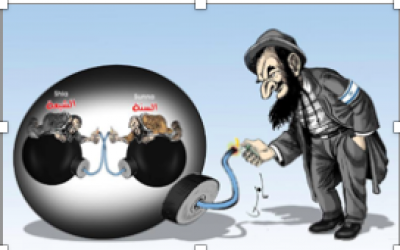
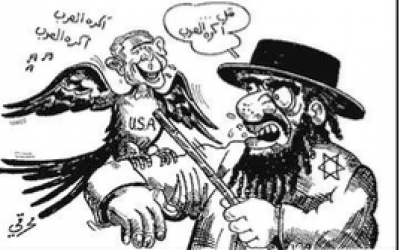
- Money: As with blood libel, demonization, and dual-loyalty, money in relation to Jews commenced in second century Christian theology. It began with the accusation that Judas, one of the twelve original disciples of Jesus Christ sold Christ for thirty pieces of silver. In Medieval iconography, yellow—the color of currency—came to symbolize Jew. As such, early icons depicted Jews cloaked in yellow. In the Middle Ages, the accusation evolved as Jews were accused of taking excessive interest from their Christian neighbors, and thus dubbed “usurers.” The accusation trailed after the Jews as once again, Ilhan Omar tweeted that “It’s all about the Benjamins baby” in relation to how much money the U.S. gives to the State of Israel. Images that accompany this accusation depict Jews and money:
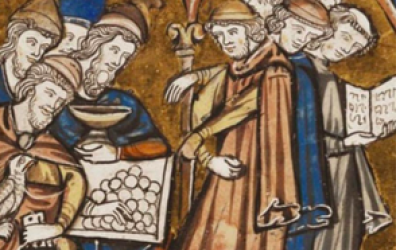
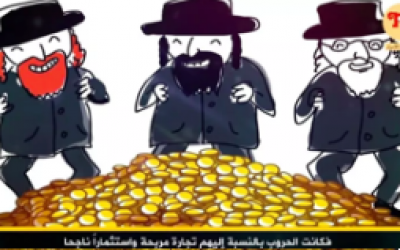

In sum, to help many identify anti-Semitism, the questions we must ask are not who is being depicted, but rather how they are being portrayed. In other words, it is unproductive to establish one definition of anti-Semitism. Instead, there are several visual and verbal symbols and/or themes that systematically demonize Jews, and more recently, the ancestral homeland of the Jews, Israel. If anything, these tropes show that anti-Zionism is, anti-Semitism, for in the depiction of, say, an Israeli flag drenched in blood, we have a clear example of the blood libel trope applied to the only Jewish country in the world.