
A Liberal Atheist Who Supports and Studies Israel
Anti-Zionism and the Inverted World: Recasting Jews as Colonial Villains

Tel Aviv, Israel. © Unsplash. Free to use.
What happens when theory collides with history, data, and lived Jewish experience—and loses.
I used to be an anti-Zionist. I wasn’t militant about it, but I agreed with most of the arguments. They struck me as serious and morally grounded. I first held these views while attending Boston University—hardly a place lacking Jewish presence or debate—and, in a characteristically Boston moment, I even spoke with one of my former heroes, Noam Chomsky. He’s not pro-Israel, to put it mildly.
At the time, I was in graduate school studying philosophy and religion. Wanting to better understand Judaism and Jewish history, I took courses at Hebrew College, studied under Jewish professors, and spoke with rabbis. This was, after all, the university of Elie Wiesel. The irony is that alongside my study of Buber and Frankl, I was also learning post-colonial theories that denied Israel’s right to exist as a state. To complicate matters further, some of the anti-Zionism I encountered came from Jewish scholars. Naively, I assumed they represented at least a significant portion of American Jews.
—I wasn’t on the fence: I had come to see Israel’s unjustified existence as a fait accompli.
After October 7—and the study that day compelled—I began to reassess my ideas about Israel. The tragedy itself mattered deeply, but what forced the issue was how suddenly anti-Zionism became ubiquitous. The responses that followed made it impossible to look away, especially when they came from people and movements I recognized. Anti-Zionism was suddenly everywhere. There was the “academic” version, with figures like Chomsky at the podium; then the aggressive kind who shouted “Globalize the Intifada” and “From the River to the Sea” outside synagogues; and the softer, ostensibly “reasonable” middle path, embodied by figures like Mayor Mamdani, whose calm progressive tone cast a wide and inviting net.
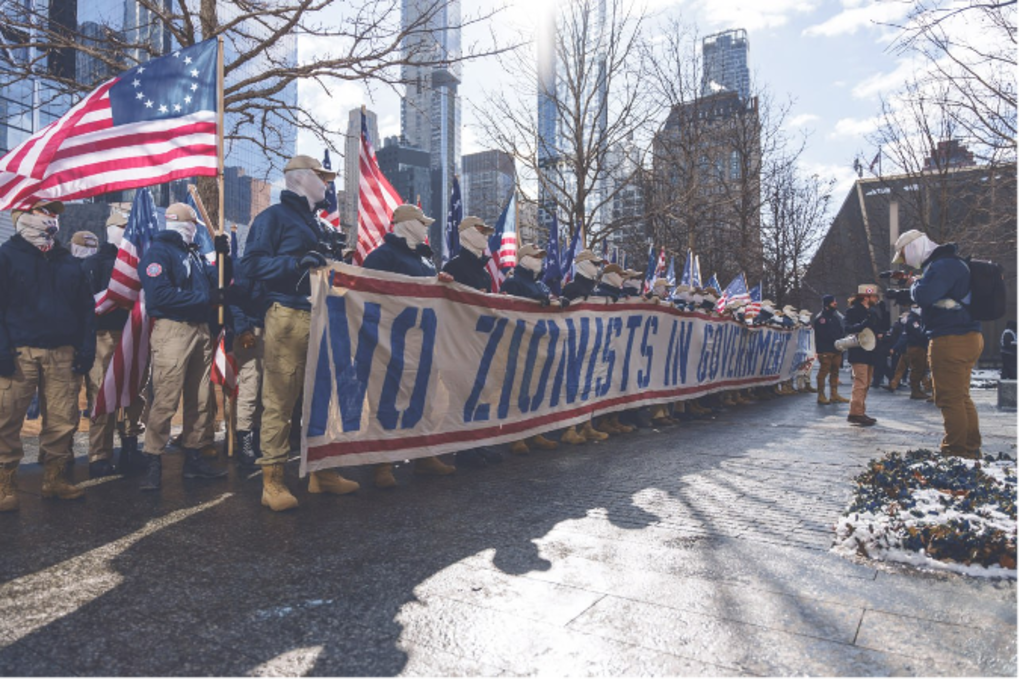
What struck me as most telling was the collective fury directed not at the massacre itself, or the taking of 251 hostages and the murdering of 378 innocent concert-goers, but at Israel’s response to it. However it was framed, the core claim didn’t change. I was hearing it from Russia, Iran, and Iraq; from Hezbollah, Houthis, and Hamas; and echoed by neo-Nazi groups like accelerationist’s, the Goyim Defense League, and the Patriot Front. From the soil of Gaza to the snow of Iceland, to the professors who once instructed me, the convergence was unreal—and inescapable.
Israel was not treated as a flawed state among others, but as uniquely illegitimate. No other country is judged this way. When Turkey wages war against the Kurds, China represses Uyghurs, Saudi Arabia devastates Yemen, we condemn the actions—not the state’s right to exist. Even Russia’s invasion of Ukraine has not led to calls for Russia’s dissolution. With Israel alone, it seems, violence becomes a referendum on statehood.
While anti-Zionists consider themselves as merely voicing a political critique—what they think is within the scope of reasonable discourse about the Israeli government—I had the sense they had a much grander take. It seemed like an entire mythology people inhabited. Adam Louis-Klein understands where my mind went. He had a similar experience. He writes that “while anti-Zionism introduces itself as a ‘political opinion,’ I came to see that it was something else entirely…Anti-Zionism, like antisemitism, is an entire cosmology.” This “cosmology” is what I was thinking about. A whole world of villains and heroes; a fantasy of fetishistic exaggeration. And this world was inverted. The Jewish people were colonizers, and groups like Hamas were the resistance. Jews no longer were the scattered diaspora of an ancient tribe, persecuted by almost all historical Empires; they were the conquering fulcrum of power in this bizarre cosmos.
“In the same way in which antisemitism once cast the Jew as the world’s metaphysical enemy,” Louis-Klein writes, “anti-Zionism now casts Israel and its supporters in the same role.” He found that anti-Zionism “functioned as a symbolic system, its force drawn from recurring metaphors—genocide, settler-colonialism, apartheid—ritually deployed not to clarify but to accuse, forming a closed circuit of moral judgment.”
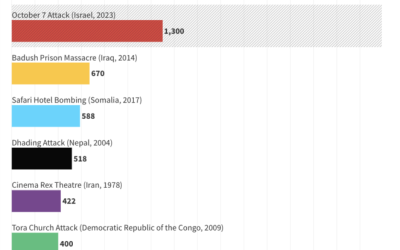
This fits with the ubiquity I was seeing. The outrage made sense once Israel was no longer treated as an ordinary state attempting to rescue its citizens held hostage by a terrorist group. Neither were they responding to the deadliest day for Jews since the Holocaust—which had the third highest number of fatalities in a terror attack since 1970—to execute judgment on Hamas. No, that would describe how we talk about other countries. Instead, the Israeli state, as something uniquely malevolent, embodied all that is unholy and unleashed it’s wrath upon innocent victims. Depicted in this way, the endlessly repeated and hypnotic terms I mentioned before, makes sense—they weren’t analytical tools, they were moral signifiers.
On top of this world-building projectionist insight, another reason for my shift came from listening to Jews in the aftermath of October 7th. One of my closest friends, Jeremy, an Ashkenazi Jew, spoke candidly with me about what the world looked like for him after Hamas’ attack: the silence of former friends, the resurgence of guilt-free antisemitism, and the way Jewish safety suddenly became something up for debate. Watching someone thoughtful and measured, become morally suspect simply for being Jewish, was shocking. It didn’t sit right with me. Friends and self-described “allies” accused him of obscenities. Some openly justified the Nova Festival massacre, denying the rapes and sexual assaults, or insisted that condemning them made Jeremy guilty of “colonization” and “genocide.” In an instant, he ceased being a musician, a friend, or a neighbor: he became a “supporter of genocide” and a “colonizer.” To be very clear: this is only because he’s Jewish. I saw this move happen to many Jews I know. Just ask their fellow kin, I bet they tell you a similar story.
Anti-Zionism is often framed as a principled moral position: opposition to injustice, solidarity with the oppressed, and an ardent refusal to excuse State violence. Nothing wrong with those, right? In practice, it rarely remains that way. Criticism of Israeli policy routinely slides into a broader claim—that Jewish sovereignty is the root problem, that a Jewish state shouldn’t exist, and that those who defend its existence must provide reasons why. Once the argument moves from what a state does to whether a people deserve a political existence, we are no longer engaged in ordinary critique.
Much of this derives from anti-Zionism itself. It often relies on a simplified post-colonial approach that divides the world into binaries: colonizer and colonized, oppressor and oppressed, violence and resistance, domination and liberation. The term “colonial” is repeatedly invoked, not only in reference to some of Israel’s policies, but to the origin of its statehood. Theories, like those of Patrick Wolfe, view Israel as a foreign import, constructed by systems of power and oppression, with Theodor Herzl utilizing “settler colonialism” to enact a plan of slowly replacing the native population. I regularly, almost hypnotically heard, “Zionism is a settler-colonial movement” (Lorenzo Veracini), “Zionist colonization” (Fayez A. Sayegh), “Zionists are colonial settlers” (Raef Zreik), and “Zionism is foremost a settler-colonial movement” (Joseph Massad). These repeated motifs were always read in concert with Edward Said, Frantz Fanon, and Homi K. Bhabha.
—Zionism is read backward from outcomes rather than forward from conditions. Once Jews become agents of history rather than its objects, the framework shifts from explanation to indictment.
History, however, can be stubborn. Zionism didn’t emerge as merely an extension of European imperialism. It arose from a dilemma for an entire people: Jews were without political protection in a world organized as nation-states. Jewish indigeneity to the land of Israel is not some ethereal dream; it’s a material fact. Hebrew is a native language of the region. Jewish political and religious life developed there. The Jewish Temple stood in Jerusalem. Roman authorities renamed Judea Syria Palaestina explicitly to erase their connection to the land.
Their presence in the region never disappeared, even after numerous pogroms. The “Old Yishuv,” Samaritan Jews, and Jews in Hebron, Galilee, Tiberius, and Gaza, had a continued presence in the land, so much so that by the mid-19th century, Jewish residents constituted the largest religious group in Jerusalem, decades before the First Aliyah (the large wave of Jewish immigrants). These kinds of historical facts don’t fit the “settler colonial” arch.
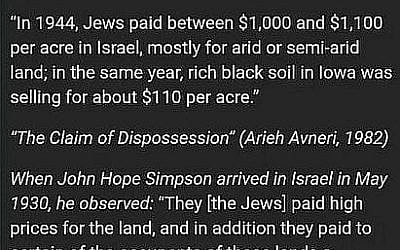
The claim that Jews are “European colonizers” collapses once one looks beyond Europe. Most Israeli Jews descend from Mizrahi and Sephardi communities—from Iraq, Iran, Yemen, Morocco, Egypt—many of whom were expelled or forced to flee Arab and Muslim countries. These groups made up most of Israel’s Jewish population by the 1970’s. Contrary to what some imply, Ashkenazi Jews in the late Ottoman and Mandatory times, got land legally purchased from private Arab and absentee owners, not by conquest. The early communities in Jezreel Valley, Damascus, Tel-Aviv, and the Coastal Plane are a few examples of this.
Jews came as refugees and immigrants, fleeing persecution in Russia, Poland, and Lithuania, seeking to begin their lives anew. They did not arrive as agents of empire; they had no army. As Alan Dershowitz rightly points out, “this type of benign immigration simply cannot, in good faith, be called ‘colonialism.’ To make such a false charge is to ignore history, blink reality, and impose a double standard.” This distinction mattered most in 1947, when the Jewish Agency accepted the UN partition plan, while Arab leaders and the Arab Higher Committee rejected it outright. Within hours of the vote, Arab gunmen ambushed Jewish buses in Lydda, killing several, and attacks against civilians in Jerusalem and Haifa began. The war followed. To describe the Jews as colonizers, then, is not merely inaccurate; it is historical revision.
—Suggesting, as some do, that exile nullifies indigeneity is a standard applied to Jews—and to Jews alone. We would never apply that logic to other displaced peoples.
While I had previous learned from a post-colonial way of viewing the world, I couldn’t reconcile their certitudes: the image of a persecuted, forcibly exiled people—historically native to the land—somehow being foreign agents, felt misplaced. They weren’t just any kind of “foreign” either, they were viewed as white, Western, European. Once again, quoting Louis-Klein: “Anti-Zionism erases the Jewish story by casting Jews as foreign oppressors…by this logic, Jews—now cast as symbols of whiteness, empire, and Western dominance—are excluded in advance.” With post-colonial thought, Israel was seen in that exact light. They’re a permanent villain, a Western implant in the Middle East, and Zionism is the cosmically sinister ideology produced to justify their foreign occupation.
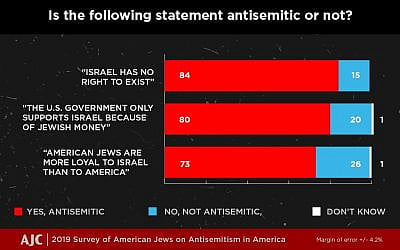
Anti-Zionism also consistently ignores what Jews say. Polls show that roughly 80% of American Jews report that caring about Israel is an important part of their Jewish identity. Approximately 70–80% feel emotionally attached to Israel, including those who strongly oppose Israel’s policies. 84% of American Jews believe “Israel has no right to exist” is antisemitic, which goes up to 89% among British Jews. These are not fringe views of extremists; it’s mainstream Jewish opinion. To treat how most Jewish people view Israel as self-delusion or entitlement—or something nefarious—dismisses history and their lived experiences. I’ve decided not to do that.
This is where Natan Sharansky’s framework of the “3D’s of antisemitism”—demonization, delegitimization, and double standards—becomes useful. Contemporary anti-Zionism frequently exhibits all three. Israel is demonized as monstrously evil, delegitimized as a State that should not exist, and judged by standards no other country is asked to meet. War, borders, refugees, and civilian casualties are tragic occurrences elsewhere: with Israel, they are proof of a deliberate and strategic colonialism.
After October 7th, antisemitic incidents in the United States increased by over 300%. Jewish schools added security. Synagogues were protested. “Zionist” became even more of a pejorative. When Jews look around and see calls for their death, Israel stops appearing as some idea “out there,” and starts to resemble something like insurance—which makes you ask: if they are colonizers, why don’t they fit the description of one?
Why hasn’t Hebrew been forced on others? Why aren’t shekels currency elsewhere? Foreign invaders are sent by a ruling power, what ruling power sent them? They are sent by an order, decree, or mandate, where are those? Colonizers leave their homeland to conquer–what homeland did they leave from? Usually, colonizers pillage, plunder, and extract resources, what resources did they extract? Unlike colonizing Empires, this group had no “metropole”—that is, the parent-state of a colony.
October 7th was not an academic debate. Hamas’ actions—mass murder, rape, the taking of hostages, while celebrating—were not hard to interpret. They were displayed and broadcast. Hamas explicitly aims at Jewish eradication, no matter how many times they say “Zionist” instead of “Jew.” Yet in the aftermath, protests erupted not against Hamas, but against Israel’s existence. Hostage posters were torn down. Sexual violence was re-framed as resistance. If anti-Zionism were merely a critique of policy, responses like this make no sense. There is also a practical question anti-Zionism avoids: what does dismantling Israel entail? States don’t disappear without consequences. Abolishing Israel wouldn’t produce equality; it would start a civil war, instability, and displacement. Calling for the destruction of a State without explaining how ten million people survive the process is not moral courage, it’s patently absurd.
None of this requires thinking Israel is perfect. Israel is a messy, polarized democracy, often deeply flawed. But it’s a democracy, nonetheless. Roughly 20% of its citizens are Arab, with parliamentary representation and legal protections not available in much of the region. Druze citizens serve in government and the military. LGBTQ rights exist in ways that would be unheard of in neighboring states. When these facts are raised, anti-Zionism often shifts the goalposts: Israel isn’t just flawed, it’s illegitimate. At that point, the argument goes back to Sharansky’s 3D’s.
When you single out one country for destruction, you try to justify or hide being selective. You no longer see Israelis, or Druze, or Palestinian Christians, you see an evil empire. The silences that followed October 7th, the reluctance to condemn Hamas or any other Muslim extremist group, and the broader passivity towards regimes like Iran, makes sense within anti-Zionism. The result is a posture more concerned with managing Western guilt than opposing repression—one in which Jews are again expected to absorb the consequences. Anti-Zionism promises justice and liberation, but when examined closely—through history, data, and lived Jewish experience—it resembles a position that permanently indicts one people and one State.
Listening to mainstream Jewish voices, acknowledging their people-hood, and accepting that Israel exists—and will continue to exist—is not a moral failure. It’s the starting point for any conversation that seeks to improve lives rather than merely call for destruction. History doesn’t show a foreign empire descending by force; it shows people returning by law, work, buying land, building towns, and reviving a language where their civilization was born. It also shows that many never left. To slip into anti-Zionism, and call for the destruction of the state of Israel, is to sound an awful lot like the imperial force incorrectly attributed to a persecuted group seeking self-determination.
Related Topics