Anti-Zionism Bestows Rank Without Achievement
Why People Join the Movement Against Israel: What It Gives Them Has Little to Do with Palestine
Ask what the movement against Israel gives the people who join it, and for many of them the answer has little to do with Palestine. But a movement is also a supplier, and this one hands out significance, belonging, and moral rank to people who never had to earn any of them. That, more than any dispute over borders or policy, explains why it behaves the way it does.
Two thinkers who never wrote about Israel explain the deal.
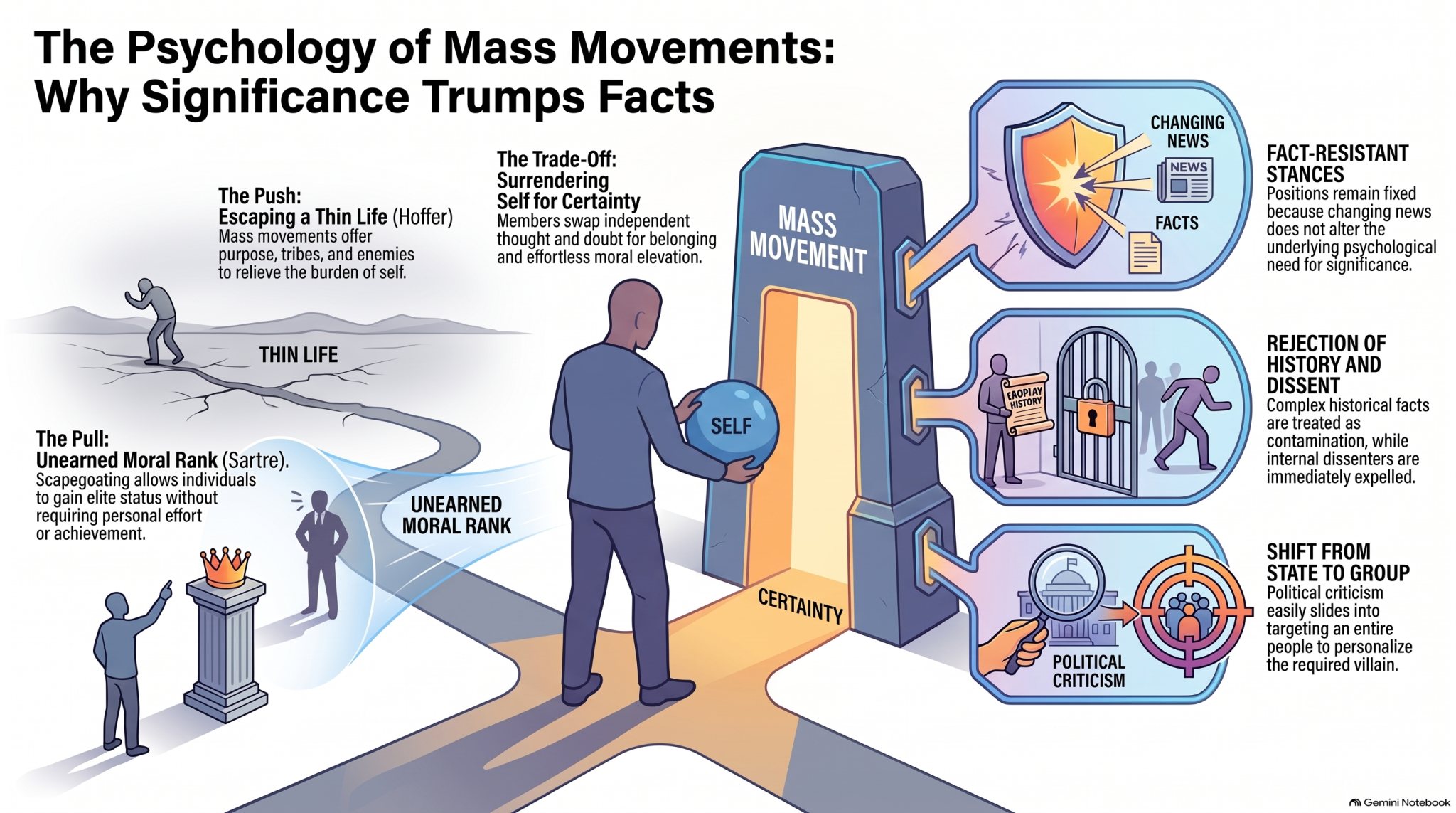
Eric Hoffer was a San Francisco longshoreman who taught himself philosophy and published The True Believer in 1951. He found that mass movements fill up with people whose own lives feel thin. They experience the self as a burden and the future as small. A movement lifts the weight by offering a purpose, a tribe, an enemy, and a script. The price is the self, which dissolves into the crowd along with its doubts. That is why Hoffer saw believers hop from one cause to another without losing any fervor. The cause was never the point. The fervor was.
Jean-Paul Sartre supplied the other half in Anti-Semite and Jew. Antisemitism, he argued, is a passion, not an opinion. The antisemite wants rank without achievement. By standing against the Jew, he joins an aristocracy whose standing is guaranteed by whom it excludes. In Sartre’s account it is an elite of the mediocre, open to anyone with nothing else to be proud of. The conclusion comes first, and the arguments are decoration.
Put the two together. Hoffer explains the push: a thin life wants significance. Sartre explains the pull: a scapegoat supplies it for free. Join, and you stop being an anonymous person with an ordinary life. You become one of the righteous, defined against a villain, and the dues are a slogan. You don’t need the history, because the cause doesn’t ask for it. You don’t need to do anything for anyone, because the stance is the credential. And you can never doubt, because doubt would give back the self you came to lose.
What the model explains
This explains four things that otherwise puzzle.
First, why positions stay put when the facts move. A ceasefire changes the news, but it does not change what the stance does for the person who holds it. A hostage release, a shift in the military situation, or a new diplomatic opening alters the facts on the ground. The believer’s need for significance is untouched, so the position survives every development.
Second, why the Jewish story is treated as a threat rather than as information. The Holocaust, the expulsion of Jews from Arab lands, and the Mandate period are not weighed as evidence. They are handled as contamination, because each one complicates a cause whose value lies in its simplicity.
Third, why dissenters are expelled rather than answered. An argument might win, and a movement that exists to supply certainty cannot afford to lose even one. So the Jewish student who raises a question, or the activist who notices an inconvenient fact, is removed from the circle instead of being engaged.
Fourth, why hostility slides so easily from a state to a people. A villain needs a face, and the nearest one is a Jew. That is why a protest against a government’s policy so reliably ends with a synagogue vandalized or a kosher restaurant harassed. The movement never decided to target Jews. It simply needed a villain with a face, and that is the one it found.
The obvious objection
This is not an argument that everyone who criticizes Israel is a Hoffer-style true believer. Many people are moved by real horror at civilian suffering, and they hold their views the way people hold any views, open to evidence and willing to revise. Hoffer himself distinguished the movement’s core from its ordinary sympathizers. Nor does the psychology refute any particular claim. A policy is wrong or right regardless of why its critics adopted their opposition. Motive is not a rebuttal.
And Hoffer’s model is not confined to one side. Any movement, including those that defend Israel, can attract people who want a tribe and an enemy. The test is behavioral. Does the person’s position move when the facts do? Does he engage the strongest counterargument or expel it? Does the stance require him to know anything or do anything? A person who can answer those questions in a way that shows doubt, learning, and constructive effort is not the person described here.
But the test also tells us where to look. The movement’s most recognizable features, such as fixed positions, hostility toward history, ritual expulsion of dissenters, and drift from state to people, are the signature of a movement serving its members’ needs rather than its stated cause. Those features are what the model predicts, and they are what we observe.
What follows
If this is right, the usual response to the movement is aimed at the wrong target. We answer with facts, timelines, and legal arguments, as though the problem were a shortage of information. For the true believer, information was never what was being purchased. The fervor was, along with the significance it delivers.
That means the movement will not fade when the war ends, or when a settlement is signed, or when a better argument is made. It will shift to the next villain or stay on this one, because it was never about the territory. The response, then, has to begin with honesty about what is being offered. A movement that gives its members rank without effort, belonging without cost, and certainty without doubt cannot be out-argued by people who offer only the truth. We have to say plainly what the stance gives, and what it costs everyone else, including the Palestinians it claims to serve and who gain nothing from it.