
Anti-Zionism – The Cheapest Moral Currency
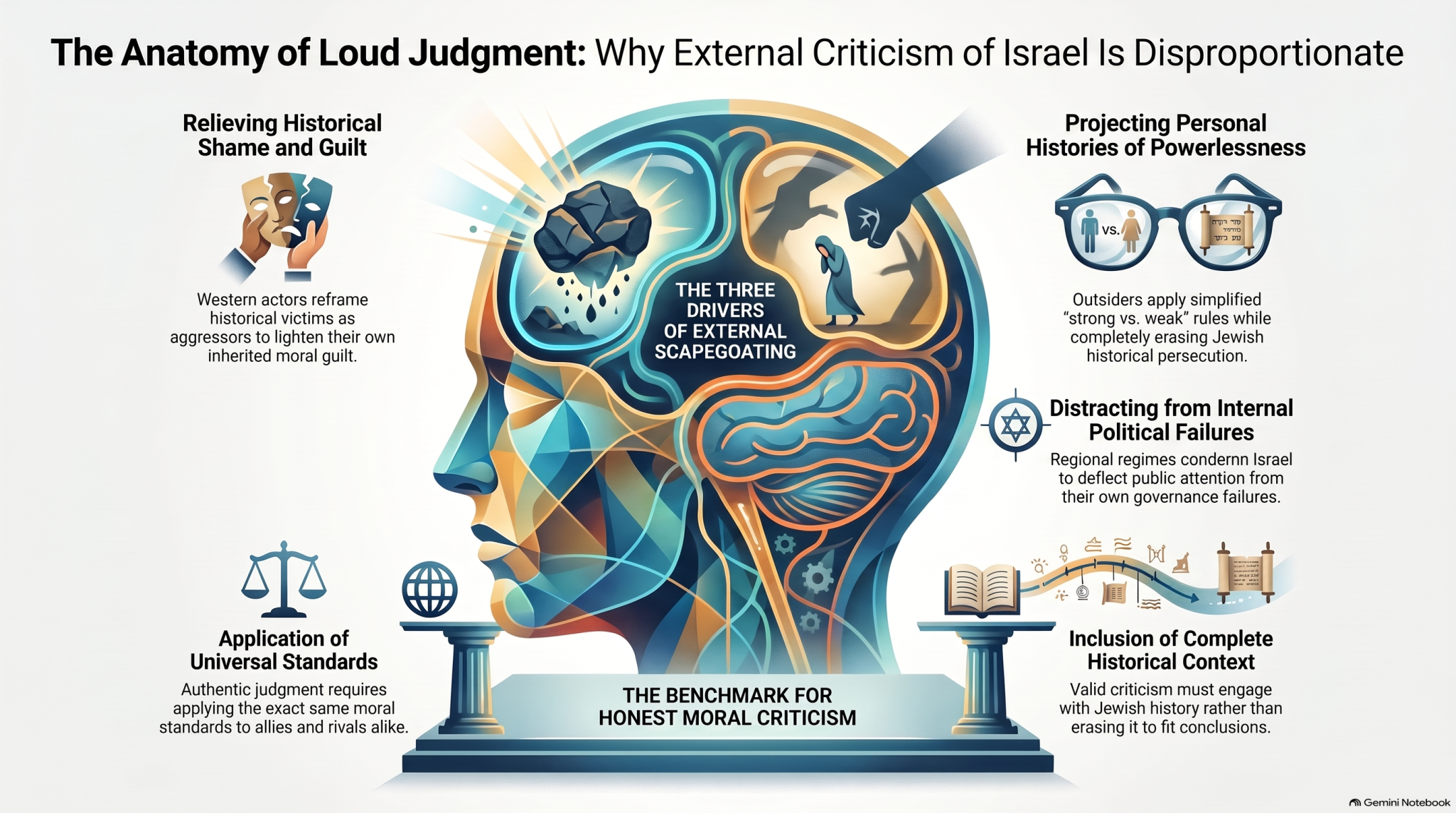
The people who judge Israel most loudly are rarely those with the cleanest hands. Their anger comes from one of three places: shame, powerlessness, or the need to change the subject.
Some carry guilt they can’t put down. Some carry a grievance they can’t turn into power. Some rule countries they have failed and need someone else to blame. In every case the judgment is a bargain. Condemning Israel costs nothing and buys a sense of moral standing. That explains why the voices are so loud and so out of proportion. It doesn’t prove Israel is right, and Israel’s conduct deserves honest scrutiny like any country’s. This week the Nobel committee gave its peace prize to the jurist who chaired the UN inquiry that found Israel responsible for genocide in Gaza. It is a good moment to ask where such judgment comes from.
Start with the shamed. There is an old line, attributed to the Israeli psychoanalyst Zvi Rix, that the Germans will never forgive the Jews for Auschwitz. It is a joke with a long face. A people who carry the Holocaust would be relieved to learn that the Jews have become Nazis too. Then the Nazis weren’t special, the guilt gets lighter, and the memory stops pointing a finger. The comparison is false and obscene, which is exactly why it lasts. It does a job for the one who uses it. The same relief is on offer across Europe. For centuries the Church taught that Jews killed God, and Christian Europe expelled them, burned them, and herded them into ghettos. Britain ran the Mandate and drew the lines. Now Europe can tell itself the colonizers are the Jews, in a land they supposedly came to from nowhere. That story only works if you forget that roughly half of Israel’s Jews descend from the 850,000 pushed out of Arab and Muslim countries, and that most of the rest came from the wreckage of Europe.
Then there are the powerless. Not everyone who hates Israel is guilty of something. Some were wronged themselves. The Irish remember conquest and partition. South Africans remember apartheid, and the ANC and the PLO were comrades. Looking at Palestinians, they see their own history, and many see it honestly. But look at what they have to leave out. The Holocaust disappears. So do the Jewish refugees from Baghdad, Cairo, and Casablanca. So does the fact that the Jews were fighting the British Empire too. Yitzhak Shamir took his underground name, Michael, reportedly after Michael Collins, the Irish revolutionary. Instead the Jews are recast as the empire’s heirs. When you feel small, moral rank is the one thing within reach, and the rule that the weak are right and the strong are wrong is easy to apply. Jews are a persecuted people who also hold a state with an army. That doesn’t fit the rule, so the persecution gets dropped. Palestinians under occupation and blockade have real grievances, and none of this is aimed at them. It is aimed at outsiders who borrow their suffering to feel important.
The new laureate shows why this has to be argued carefully. Navi Pillay is a South African lawyer who fought apartheid at home before serving as the UN’s human rights chief, and she was a judge in the Rwanda tribunal that delivered the first international genocide conviction. That record is real, and it earns her a hearing. I make no claim about what moves her, and the argument here doesn’t need one. But the same record includes her comparisons of Israel to apartheid South Africa, and her dismissal of antisemitism complaints about her commission as “lies”. Her commission did call the October 7 attacks brutal war crimes, and its reports also held Hamas responsible for war crimes. Still, the verdict at the center of its work was genocide, a charge Israel rejects and legal scholars dispute. The word was coined to name what was done to the Jews. Applying it to the Jewish state is an argument that has to be made with Jewish history in the room, not outside it. Does it engage with the Holocaust, with the Arab-world expulsions, with a country that went to war after 1,200 of its people were murdered in a day? That is the question, not who she is.
Then there are the rulers, who need no psychology, only a motive. For seventy years, regimes across the Middle East have found Israel a handy distraction. Arab scholars themselves have written, in the UN’s own Arab Human Development Reports, about how little freedom, knowledge, and opportunity their societies offer. It is safer to shout about Israel than to answer for that. Watch what they don’t shout about. Kuwait threw hundreds of thousands of Palestinians out in 1991. Lebanon has kept Palestinian refugees stateless for generations, locked out of many jobs. Syria and Iran have killed their own people by the thousands and still find breath to denounce the Jewish state. The same lopsidedness shows up at the UN, where the Human Rights Council keeps a permanent agenda item for Israel alone.
An honest argument has to deal with the cases that don’t fit. Poland, the Baltic states, Taiwan, and India have all known occupation, and all are friendly toward Israel. My guess is they have no need of the bargain. They have their own achievements and their own enemies. Germany shows that guilt can produce loyalty as easily as hatred. And some of Israel’s toughest critics are Israelis and Jews, some with survivors in the family. Nobody should pretend to read their minds. Criticism of Israel is not antisemitism, and this argument doesn’t say it is.
So here is a simple test. When someone condemns Israel, ask whether they apply the same standard to everyone else, including their own friends. Ask whether they admit that Jews have a history too, and whether that admission changes anything they say next, or sits at the top of the speech doing nothing. If the argument only works when the Jewish story is erased, it is a conclusion in search of facts.
There are two ways to judge another people. One speaks from inside your own history: we did this, it cost us this, and it troubles me to see it again. The other speaks from above it, as if you had no past. The first has to be earned. The second is free, which is why it is so crowded, and why prizes, panels, and commissions are so easily collected by those who offer it. The Torah saw this coming. It tells us to love the stranger because we were strangers in Egypt, so that memory of suffering becomes a reason for humility, never a license to preach. The loud ones aren’t wrong because they are loud. They are loud because the judgment is cheap, and the world keeps paying for it.