
Antisemitism, Demystified: It Starts with an Instinct
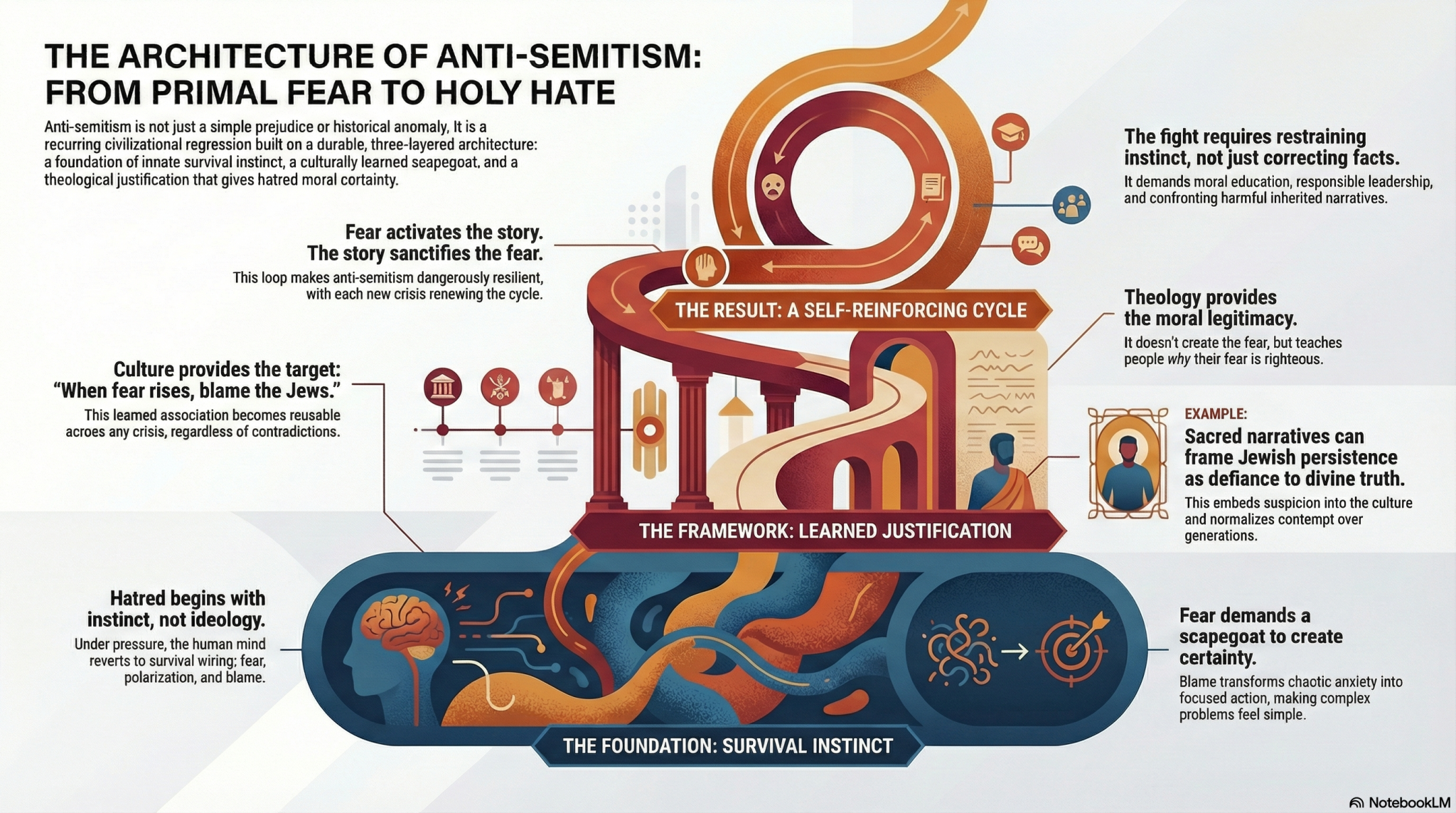
Antisemitism, Demystified: It Starts With an Instinct — and Religion Sometimes Teaches It a Name
Hatred begins in fear, but it endures when theology turns fear into moral certainty
Antisemitism is often treated as a historical mystery or a uniquely irrational obsession. We explain it through theology, politics, economics, nationalism, or conspiracy thinking — and all of those matter.
But if we want to understand why antisemitism keeps returning, even in radically different societies and eras, we have to begin one level deeper.
Antisemitism starts with an instinct.
The survival brain and the search for blame
Human beings did not evolve for tolerance. We evolved for survival.
For most of human history, survival depended on rapid threat detection, tight group loyalty, and suspicion of outsiders. Under pressure — famine, plague, war, economic collapse, social upheaval — the human mind reliably regresses to this older wiring. We simplify. We polarize. We look for an enemy.
Fear alone, however, is unstable. To become socially useful, fear needs a story. It needs blame.
Blame transforms anxiety into action. It converts chaos into certainty and helplessness into direction. Complex explanations are unsatisfying; scapegoats are efficient.
This is the first layer of anti-Semitism: inherited survival psychology — fear, suspicion, and the need for a target.
But fear does not point naturally to Jews. That assignment is learned.
The learned layer: when culture supplies the scapegoat
The survival instinct is content-neutral. It simply demands an “other.”
Anti-Semitism becomes durable because societies repeatedly learn — and transmit — the same assignment: when fear rises, blame the Jews. Once installed, this association becomes reusable across crises. Each generation inherits it ready-made.
That is why anti-Semitism is so often contradictory and yet persuasive. Jews are accused of mutually exclusive crimes — too powerful and too weak, globalist and tribal, capitalist and communist, disloyal insiders and alien outsiders. These contradictions do not weaken the mechanism; they strengthen it. They make Jews available as an explanation for any fear.
Fear supplies the energy.
Culture supplies the target.
But this still does not fully explain anti-Semitism’s endurance. Many societies experience fear. Many groups are scapegoated. Few hatreds are as persistent, adaptable, and morally justified as anti-Semitism.
For that, we need to add a third layer.
When theology sanctifies instinct
Christianity and Islam did not invent anti-Semitism. The survival instincts that drive it are older than both religions. What these theologies sometimes provided — historically and structurally — was something more dangerous than hatred itself: moral legitimacy.
Theology does not create fear.
It teaches people why the fear is righteous.
In Christianity, the theological break from Judaism created a profound problem: how could the people who received God’s covenant fail to recognize its fulfillment? Over time, the answer hardened into supersessionism — the belief that Judaism had been replaced, rendered obsolete, or spiritually blind.
This reframed Jewish continuity not as fidelity, but as defiance. Jewish survival became a theological embarrassment — even an accusation. Once that framing took hold, instinctive resentment acquired sacred meaning. Jews were no longer merely different; they were wrong, obstinate, or guilty within the religious story itself.
Islam developed a different but parallel structure. Judaism is recognized as an authentic earlier revelation — but one that is portrayed as incomplete or distorted. Jewish refusal to accept Islam’s final message becomes evidence of moral failure. In periods of stability, this framework could coexist with tolerance. Under stress, it could harden quickly into hostility.
In both traditions, theological anti-Judaism did not require constant violence to be effective. It normalized contempt. It embedded suspicion into sacred narratives. It taught generations to see Jews not merely as neighbors, but as symbols of resistance to divine truth.
This is the second half of the dual structure of anti-Semitism:
- Survival instinct supplies the fear
- Theology supplies the justification
Together, they form a self-reinforcing loop. Fear activates the story. The story sanctifies the fear. Each crisis renews the cycle.
Why intolerance has a head start
This is the uncomfortable truth modern pluralism often avoids: intolerance is easier than tolerance.
Suspicion is fast. Acceptance is slow. Fear is instinctive. Moral restraint is aspirational.
Tolerance requires capacities that do not arise naturally under threat: empathy, complexity, ethical self-restraint, strong institutions, and leaders willing to resist the political utility of scapegoating. These capacities belong to what we might call the aspirational side of human nature — the part that can override survival wiring, but only with effort.
Anti-Semitism exploits this asymmetry. It does not need to persuade deeply. It needs only to activate fear and supply a familiar explanation — now reinforced not just by culture, but by sacred meaning.
Demystifying anti-Semitism changes the fight
If anti-Semitism were merely a set of false beliefs, education alone would defeat it. But anti-Semitism is not powered primarily by ignorance. It is powered by fear seeking moral cover.
That means combating it requires more than facts. It requires strengthening the forces that restrain instinct:
- religious voices willing to confront their own inherited narratives
- leaders who refuse the cheap unity of a scapegoat
- institutions that protect minorities before fear becomes policy
- moral education that teaches complexity and responsibility, not tribal righteousness
Most importantly, it requires recognizing that anti-Semitism is not an aberration of history. It is a regression of civilization — a collapse from aspiration back into instinct, often aided by theology that forgets its own ethical limits.
The conclusion we must face
Anti-Semitism does not begin with Jews.
It begins with fear.
But it endures when fear is taught that it speaks in God’s name.
To demystify anti-Semitism is not to excuse it. It is to see clearly what we are up against: an ancient survival reflex, a learned scapegoat, and — at its most dangerous — a sacred story that tells people their hatred is holy.
Hatred has a head start.
Scapegoating is emotionally efficient.
And religion, when it abandons moral restraint, can become fear’s most powerful amplifier.
The task of resisting anti-Semitism, then, is not only political or historical. It is moral and theological: to ensure that our oldest instincts do not masquerade as divine judgment — and that God-language is used to restrain fear, not baptize it.
That task is never finished.
But without it, fear will always find a scripture — and Jews will keep being taught to hear their own names in its echo.