President, Hadassah Louisville, Hadassah Physicians Council, Hadassah Writers' Circle
Antisemitism in American Health Care: Praying With Your Voice and Your Feet
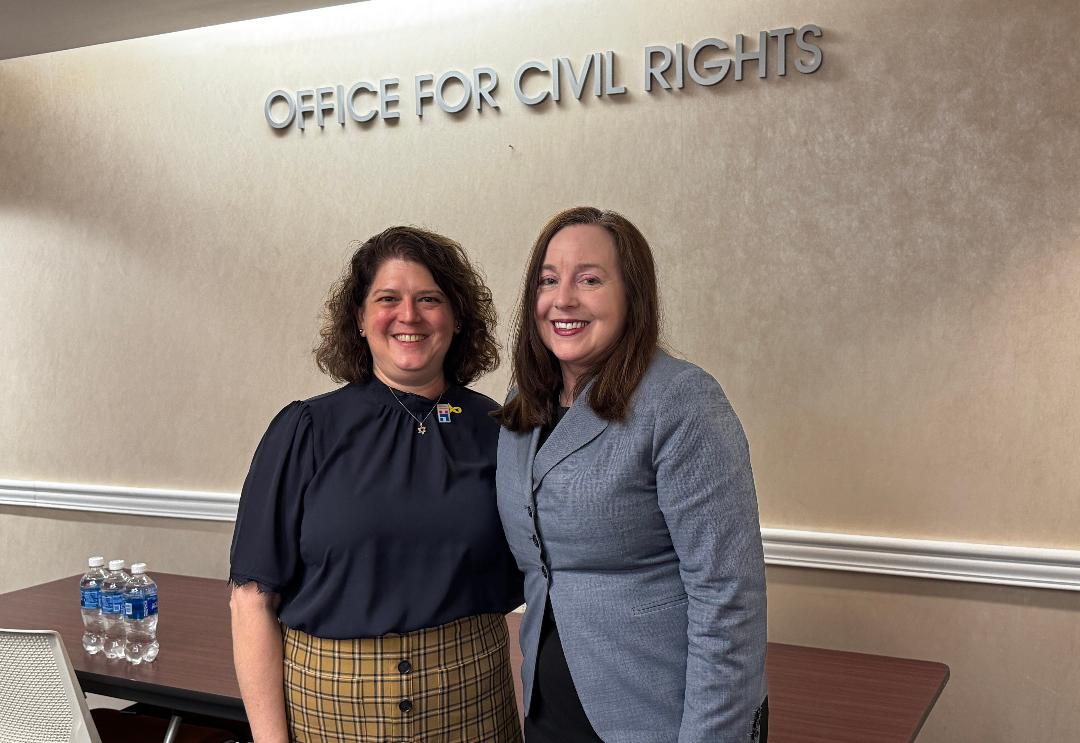
The author pictured with Paula M. Stannard Director of the Office for Civil Rights (OCR) at the U.S. Department of Health and Human Services (HHS). Photo courtesy of the author.
This is the third column in a multi-part series by the author on “Antisemitism in the Medical Field.”
From biblical times when “there rose a king who knew not Joseph” (and all the good he did for Egypt) and began enslaving the Israelites, throughout the medieval era when Jews were expelled from Spain, leaders have feared the presumed power of the Jews.
Although they were often restricted to professions of trade, moneylending and medicine, the public resented their success. When times turned difficult due to plague, famine or political instability, they made the Jewish community their scapegoat.
The era that included Maimonides, the Jewish physician whose oath many medical professionals recite today, inevitably ended when Jews were no longer useful to their rulers and lost their precarious protections.
We saw this pattern repeat during the Holocaust when German Jews, who thought themselves well integrated into society, suddenly were “othered” and deemed unacceptable. They were not simply exiled; they were slated for extermination.
German physicians were complicit in legitimizing the Nazi plan, buying into the belief that the nation’s health was more important than the rights of individuals. They began by expelling Jewish physicians from hospitals, universities and professional societies; eventually, they stopped caring for Jewish patients.
What we are witnessing today is this same pattern of excluding Jewish physicians from medical conferences, publications and professional societies. Jewish patients are being publicly shunned, especially on social media, where the medical term “going viral” has been bastardized. Ideology is replacing medical ethics and those “pesky” oaths.
This discrimination and exclusion of Jews is especially painful considering how involved Jewish professionals were in ensuring civil rights for other minorities, particularly during the Civil Rights movement. Jewish physicians helped create inclusive, socially conscious medical institutions that became leaders in the profession. Now these same movements are excluding Jewish practitioners, following the same pattern of history, claiming that Jewish civil rights are incompatible with their social justice warrior mentality.
When I returned from my first trip to Israel the summer of 1987, with a second earring in my left ear (something considered “rebellious” back in that decade), my friend nudged me and whispered, “Did she notice?” And I naively replied, “No, she hasn’t said anything!” To which my mom slyly interjected, “Just because I didn’t say anything doesn’t mean I didn’t notice.” As a 17-year-old rule follower trying to break some rules, I couldn’t decide if I was glad or hurt that she didn’t comment.
Now, almost 40 years later, I am repeatedly reminded that if I see something, I should say something. We are told this after experiencing 9/11, school shootings and, most recently, the massacre in Israel on October 7. If only the worst thing was a second pierced ear, instead of such hatred against my Jewish tribe, which cuts like a knife through my heart.
As I wrote in my previous essays on this topic of Antisemitism in Healthcare, the problem is both on individual and professional levels. As a public health professional, I know that it takes a multi-level approach to restore safety, equity and trust. It is time to escalate the public health crisis of antisemitism to the institutional level, with the intention of instituting change within the system itself. To paraphrase our revered theologian Rabbi Abraham Joshua Heschel, who marched with Martin Luther King Jr., “It is time to pray with our feet.”
As a co-chair of the Hadassah Physician’s Council, I was invited to represent Hadassah at a meeting of Jewish organizations at the Department of Health and Human Services’ Office of Civil Rights (OCR). The meeting was a follow-up to a discussion last summer regarding antisemitism in the healthcare space at The Louis D. Brandeis Center of Human Rights Under Law with OCR Director Paula Stannard and her team. For this second meeting, several other Jewish organizations, including Hadassah, were invited to share examples of the breadth and depth of the problem across multiple medical spheres.
While others addressed the institutional aspects of the problem, I spoke from personal experience. I described how devastating it was to feel personally attacked by my colleagues when I brought up my Jewish trauma, and how worried I am about the future of the profession as current medical students are permitted to discriminate against certain kinds of patients, namely Zionists and Israelis. Our “asks” from the meeting included utilizing the government framework to investigate potential civil rights violations, both by individuals and institutions, and to look into the possibility of broader policymaking to combat antisemitism in the healthcare field.
Although I grew up outside Washington, DC, I have not lived in the area for over 30 years. As a result, much of my legislative advocacy has been at the state level, encouraged by Hadassah’s “Date with the State” Advocacy Program and the American Academy of Pediatrics (AAP)’s Legislative Advocacy training.
When this year’s Hadassah on The Hill: Day of Impact was scheduled in tandem with the AAP’s annual meeting, I felt compelled to return to my old stomping grounds and make a difference at the federal level. After all, I have a master’s in public health and not only do I think in terms of population health, but I am also determined to implement interventions on a higher scale when able. With so much of my energy spent fighting Jew hatred, the timing of this opportunity felt serendipitous. Like in the story of Purim in our biblical Book of Esther where Mordecai tells his niece Queen Esther that perhaps she was chosen as queen “for such a time as this”– to save the Jewish people – this was the right time for me to build on what I had been doing to fight antisemitism – to bring our message to the next level up — to the US Congress.
Walking around the capitol grounds, humming about “mother freedom ringing her bell” with the majestic Statue of Freedom watching over our entourage, felt powerful. Meeting with each legislator to advocate for the support of Hadassah Hospital, the US-Israel partnership and women’s health legislation felt tangible.
As we expressed our concerns over antisemitism in healthcare and I conveyed my personal experience with my medical colleagues and the AAP, we sensed an instant connection from the legislator who was also a pediatrician. I related how the AAP successfully addressed my complaint against a colleague who violated the professional code of conduct by employing antisemitism to personally attack those who dissented with his view.
When so many other professional organizations are caving to the trend of institutionalizing antisemitism, the AAP at least acted in a way that showed how “Do no harm” is not a sound bite.
Rachel Goldberg-Polin, the mother of slain hostage Hersh, reminds us that “Hope is mandatory.” I find myself using her mantra as I watch the very system that Jews helped to build being distorted and used against us. Pirke Avot, a compilation of Jewish theological and ethical teachings and maxims from Rabbinic Jewish tradition, reminds us that “It is not your duty to finish the work, but neither are you at liberty to neglect it.” Today, the Jewish people have the means to fight back and change the trajectory of this conspiracy of hate.
Back when I was a little girl and my dad worked at the Department of Labor, I used to sit on his office couch playing with My Friend Mandy and Jenny dolls. Now I was sitting at the table, coming full circle.
A while ago, a college friend who is now the curator at the Capitol Jewish Museum in Washington, D.C,. had requested my dad’s professional papers to record the Jewish professional experience in Washington. When I visited with that same friend while on the Hill with Hadassah, she asked for my handwritten notes, scrawled in blue ballpoint pen on white lined paper, to put in the museum archives. I felt proud that what I had written mattered as much for the archives as my dad’s writings!
Someday, when I get the Hebrew tattoo specifically designed for me, which quotes the biblical prophetess Deborah, asking us to awaken and speak out, my mom will see the colored ink and not stay silent – because this message will be too bold to ignore.
Related Topics
Related Posts