May You Live in Peace, שלום and سلام.
Philadelphia: The City Of Brotherly Love, Unless You’re Jewish
Penny S. Tee, at the Times of Israel Blogs
Philadelphia is known worldwide as the City of Brotherly Love. Yet, as we approached the 88th anniversary of Kristallnacht, the Night of Broken Glass, a disturbing question arose: Does that brotherly love extend to everyone?
In November 2026, a left-wing group calling itself Philly Bike on Your Left announced a “Boycott Ride” targeting Jewish-owned and Israeli-owned businesses. On their flyer below was:
“THESE ZIONIST ESTABLISHMENTS MUST GO!
NOT IN OUR CITY!”
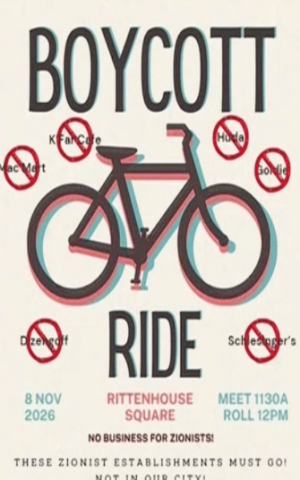
Whatever one thinks about the Israeli-Palestinian conflict, targeting businesses because they are Jewish-owned or Israeli-owned crosses a line that should concern all of us. Criticism of Israeli government policies is legitimate and should be part of any democratic discussion. But when that criticism becomes hostility toward Jews collectively, when Jewish businesses are singled out, or when the Jewish people’s right to exist is denied, we are no longer engaged in political debate. We are witnessing age-old Jew-Hatred.
The Nazi campaign to annihilate European Jewry began long before the ovens and crematoria. Years earlier, Jewish businesses were marked and boycotted, and Jews were stripped of citizenship, denied basic rights, and excluded from schools, universities, professions, and jobs. They were increasingly treated as strangers in their own country. Their homes and businesses were seized and often transferred to others. Jewish newspapers and organizations were suppressed as Jewish life was systematically dismantled.
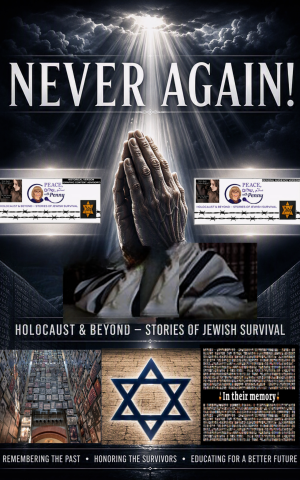
As I prepare for the upcoming release of HOLOCAUST & BEYOND — STORIES OF JEWISH SURVIVAL, I find myself drawing connections between the past and the present in ways I never anticipated.
One of the people I will soon be interviewing is Luda Isakharov of the ADL’s Ratings & Assessments Institute. Their State of the Arts Initiative documents growing reports of exclusion, marginalization, and discrimination directed at Jewish artists, performers, writers, and cultural professionals.
Listening to the findings reveals troubling echoes of prohibiting participation, discrimination, and the gradual erosion of society’s resistance to antisemitism. What I hear is a warning: PAY ATTENTION.
According to ADL’s research, activist networks have organized campaigns to pressure cultural institutions, including major museums, to exclude Jewish and Zionist artists and disrupt their work. Sometimes the threat of protest alone is enough. A performance is canceled. An invitation is withdrawn. An institution hoping to avoid controversy ends up doing the extremists’ work for them. Extremists need not prevail through persuasion because institutions too often surrender first. By yielding to pressure, institutions may inadvertently accomplish the goals of those seeking to marginalize Jews.
Many Jews desperately tried to escape to other countries, only to encounter closed borders and rejection. Some were turned away and forced back into the very country where their lives were in peril, and they were ultimately murdered by the Nazis.
Reflecting on Jewish history, I cannot help but think about displaced Palestinians. Acknowledging Palestinian suffering does not diminish Jewish misery. Compassion is not a finite resource. We should be able to mourn innocent civilians caught in conflict while remaining honest about the forces that created that pain.
The Jewish values of Tikkun Olam (repairing the world), Tzedakah (righteous giving), and Chesed (loving-kindness) helped inspire an unprecedented response to the needs of displaced Israelis. They reflect a longstanding Jewish commitment to improving society, helping those in need, and leaving the world better than we found it.
Thinking about this brought me back to my much younger Hebrew school days, when metal Tzedakah (charity) cans were passed around to collect donations to help “Save Soviet Jewry.” We understood that helping one another was part of who we were. Jewish communities have long supported those in need, both within our own people and far beyond.
Israel, too, has repeatedly sent humanitarian and rescue teams to assist people around the world following devastating disasters. When earthquakes strike and buildings collapse, Israeli search-and-rescue professionals bring experience gained, tragically, from years of responding to attacks and destruction at home. Their work reminds us that distress should never be measured by nationality, religion, or politics.
But kindness alone is not enough. People need leaders, institutions, and communities willing to shoulder responsibility for their future. One cannot help wondering why so many Palestinians remain trapped in uncertainty, generation after generation, with no lasting solution in sight.
And that leaves me with a troubling question. Palestinians continue to suffer displacement, uncertainty, and hardship. Who is ensuring that their long-term welfare, security, and future receive the same sustained attention and commitment? Civilians should never be left dangling indefinitely between war and hope.
When generations grow up amid displacement, instability, poverty, and radicalization, the consequences should surprise no one. A future built on hopelessness is fertile ground for extremism. The world has a responsibility to offer something better. As a global community, can we not do better than perpetuate a cycle of despair?
Much has been written about displaced Palestinians, and their suffering is real. Less frequently discussed are the tens of thousands of Israelis who were also forced from their homes near the Gaza and Lebanese borders due to rocket fire, missile attacks, and security threats. Many spent months, and in some cases years, living in temporary accommodations while waiting for conditions safe enough to return.
What struck me was not only the misery, but the response from our own communities. Unlike so many Jewish refugees of the past, this time Jews at home in Israel as well as throughout the world stepped up to help. The Israeli government, local municipalities, nonprofit organizations, volunteers, and ordinary citizens mobilized to help those uprooted. Housing was found. Children were enrolled in schools. Mental health services were provided. Communities reorganized themselves around the needs of those who had lost the safety of home.
This is not to say that Israelis didn’t need help. As the full scope of the October 7 atrocities became known, scholars and human-rights advocates proposed a new term to describe one of the attack’s most horrific dimensions: kinocide, the deliberate weaponization of families. According to researchers cited in the Times of Israel, the attack repeatedly exploited familial bonds to maximize trauma. It included:
- Killing family members in front of one another.
- Eliminating entire families.
- Taking multiple members of the same family hostage.
- Forcibly separating parents and children.
- Using victims’ phones or social media accounts to broadcast violence to relatives.
- Destroying homes and the family environment itself
Investigations and eyewitness testimony documented acts of sexual violence, torture, mutilation, and the murder of entire families. The details that emerged in the weeks and months that followed challenged the limits of what many people believed human beings could do to one another. As I’ve described previously, this was not warfare; this was evil.
Perhaps nothing illustrated the moral depravity of the attack more clearly than a phone call played before the UN Security Council by then-Israeli Foreign Minister Eli Cohen. In the recording, a Hamas terrorist boasted to his parents about the number of Jews he had killed while they praised and encouraged him:
“Look how many I killed with my own hands! Your son killed Jews!”
According to reports and translations of the recording:
- His father praises him and says, “Allahu Akbar.”
- His mother is reported as saying, “I wish I was with you.”
- The terrorist tells her, “Mom, your son is a hero.”
Yet today, on college campuses and across the world, their actions are described as mere resistance and continue to be celebrated and encouraged to spread with the cries of “Globalize the Intifada!”
Diaspora Jews heard the call and responded in record-breaking financial and volunteer help. Reported in the Forward, The Jewish Federation itself raised $850 million dollars. The Israel’s Diaspora Affairs Ministry reported a broader total─ $1.4 billion which were used for housing, transportation, food, childcare, education, mental health support, and family assistance.
They also reported that approximately 58,000 volunteers traveled to Israel after October 7 to help with agriculture, aid evacuees, and support victims. That took real courage. After learning even a fraction of what occurred on October 7, would you have packed your bags and gone to help? Tens of thousands did.
And thank Hashem that the Diaspora came through. Many Israelis and supporters of Israel sharply criticized UN Women and other prominent women’s-rights organizations for what they viewed as a delayed and inadequate response to reports of sexual violence committed during the October 7 attacks. Later the UN took out the part condemning HAMAS and just asked for the release of the hostages! Unconscionable.
The hashtag#MeToo_UNless_UR_A_Jew emerged amid widespread frustration that prominent women’s-rights organizations had been slow to publicly address reports of sexual violence committed during the attack.
But why did these organizations seem to be dragging their feet?
One measure of prejudice is whether we apply the same moral standards to everyone. Had women of almost any other group been subjected to such reported atrocities, immediate condemnation likely would have been universal and unequivocal. Many Jews looked at the hesitation, equivocation, and silence that followed October 7 and asked a painful question: Why were Jewish women treated differently? The silence was not merely offensive. It sent a message that some victims deserve less outrage than others. That is not only unjust. It is dangerous.
According to the United States Holocaust Memorial Museum, during Kristallnacht, rioters destroyed more than 1,400 synagogues and prayer rooms throughout Germany, Austria, and the Sudetenland. They burned prayer books and sacred Torah scrolls. More than 7,000 Jewish businesses were damaged or destroyed, and approximately 30,000 Jewish men were arrested and sent to concentration camps. The Daily Telegraph correspondent Hugh Greene described the violence as a government-sanctioned orgy of destruction.
For Jews, publicly identifying and targeting Jewish businesses is never simply another political statement. It carries painful historical echoes. We know where such campaigns of marginalization and intimidation can lead.
It is a story that refuses to end, so old it seems to have no beginning. Today, antisemitism often appears under different banners and uses different vocabulary. Sometimes it hides behind political activism and the language of Palestinian solidarity.
For decades, Soviet propaganda helped popularize the portrayal of Zionism as racism, colonialism, imperialism, and fascism. Those narratives continue to circulate in different forms today.
So what is a Zionist? At its core, Zionism supports the right of the Jewish people to national self-determination in their historic homeland, Israel. For Jews, having a homeland is not an abstract political concept. It is deeply connected to thousands of years of history, faith, culture, persecution, and survival. After centuries of being expelled, persecuted, and murdered simply for being Jewish, the need for a place where Jews can determine their own future is hardly difficult to understand.
The Philadelphia protest was planned for the eve of the 88th anniversary of Kristallnacht, a night remembered for shattered windows, burning synagogues, and terrorized Jewish communities. But those events did not begin on November 9, 1938. They were preceded by years of exclusion, discrimination, and the gradual erosion of society’s resistance to antisemitism. Long before glass littered German streets, Jews were pushed out of professions, marginalized in schools and universities, and increasingly treated as outsiders in their own country.
That is why the reaction to the proposed Philadelphia bike ride matters.
This time, public officials did not simply dismiss the targeting of Jewish businesses as a political disagreement. Governor Josh Shapiro, who is Jewish, Mayor Cherelle Parker, Attorney General Dave Sunday, and other leaders publicly condemned the effort and raised concerns about antisemitism.
Thank you for speaking up!
Ordinary citizens also responded in a meaningful way. Rather than joining the boycott, many chose to patronize the targeted businesses. Long lines formed outside their doors. What could have become another story of Jewish businesses being isolated became, instead, a demonstration of solidarity.
The story was no longer just about antisemitism. It was also about whether a community would recognize it, confront it, and speak out publicly.
Imagine the outrage if businesses belonging to another minority community were singled out and threatened in this fashion. The same standard of dignity, protection, and respect must apply to everyone.
NOT IN OUR CITY!
Hatred produces perpetrators, but it also depends on bystanders. One of the most enduring lessons of Kristallnacht is not only what the Nazis did, but how many people watched, remained silent, or looked away.
Indifference does not shatter windows or set synagogues ablaze, but it creates the conditions that make such acts possible.
The lesson of Kristallnacht is that danger does not begin with the final, horrific act. It begins with the smaller acts that precede it: the isolation, the intimidation, the dehumanizing language, the boycotts, and the willingness to look the other way.
And that brings me to a question: What is our responsibility as Jews, and as human beings?
Jean Houston, my beloved teacher who recently passed on, often spoke of “response-ability” ─ our ability to choose how we respond. I love the hyphen because it reminds us that responsibility is not merely an obligation. It is a choice.
The lesson of Kristallnacht is that hatred is not sustained only by perpetrators. It also depends upon indifference. It grows when good people decide that speaking up is inconvenient, when institutions choose comfort over principle, and when society begins to treat prejudice as normal.
When universities, cultural institutions, nonprofits, and politicians accept outside funding, they assume a responsibility that extends beyond balancing budgets. They must ask whether today’s donation could become tomorrow’s leverage. Every institution should periodically examine whether any source of support carries expectations that would require compromising its mission, principles, or moral integrity. Financial dependence should never excuse ethical surrender.
We cannot undo the tragedies of the past. We cannot promise that hatred will disappear. But we can refuse to normalize it. We can teach the truth. We can stand beside those who are targeted, even when they are not members of our own community. We can choose courage when silence would be easier.
Indifference is another form of complicity. Response-ability is its antidote.
Some relatives ask why I concentrate so often on the subject of Jew-hatred. Why immerse yourself in humanity’s inflamed detritus?
It’s a fair question. But my answer is simple: How could I not?
I have only one voice, but I’ll be damned if I won’t use it to make people aware of the reality Jews are facing in 2026. We didn’t get it right the last time. We know what happened when the world failed to respond. And today, we are confronted not only with renewed antisemitism, but also with Holocaust denial, distortion, and the alarming reality that many young people are not being adequately taught this history.
Last year, I wrote a TOI Blog titled “A Tearful Shabbat Shalom” following the firebombing of the Adass Israel synagogue in Melbourne. I ended with the words “Never Again!” But those words are only meaningful if we recognize a threat while it is still unfolding. That was last year, yet the attacks keep coming.
That conviction is one of the reasons I created HOLOCAUST & BEYOND — STORIES OF JEWISH SURVIVAL. The theme song for the series, NEVER AGAIN!, reflects a simple belief: remembrance is not merely about honoring the past. It is about recognizing warning signs in the present and responding before history repeats itself.
Then, on December 14, 2025, another devastating antisemitic terrorist attack struck Bondi Beach in Australia. As approximately 1,000 Jews gathered to celebrate Hanukkah, a father and son opened fire, killing 15 people and injuring dozens more.
It would be easy to place that attack in the past, to file it away as yesterday’s news. But hatred does not end when the cameras leave. In the days leading up to this writing, we learned that a 90-year-old Holocaust survivor who had been shot in the legs during the attack had succumbed to her injuries.
That death is a reminder that the consequences of terror continue long after the headlines fade. The victims are not abstractions. Their distress is not philosophical. Their families continue to live with the aftermath, sometimes for months, sometimes forever.
And so, as I reflect on Kristallnacht, Philadelphia, Melbourne, Bondi Beach, and the countless reminders that antisemitism is not merely one chapter in a history book, but a whole library of volumes, I return to the question that matters most: What kind of world are we creating through our actions, our words, and our silence?
We cannot undo the tragedies of the past. We cannot promise that hatred will disappear. But we can refuse to normalize it. We can teach our children the truth. We can stand beside those who are targeted, even when they are not part of our own community. We can disagree without dehumanizing, defend our own without denying others’ humanity, and choose courage over indifference.
Perhaps that is the greatest tribute we can offer to those who perished: not simply to remember them, but to live in a way that honors their lives. May we have the courage to recognize hatred, the wisdom to choose compassion, and the strength to stand together when it matters most.
Our resilience shines with the light of Hashem that resides within each of us. Jewish tradition teaches that the soul is “the lamp of God.” Every one of us carries a divine spark capable of illuminating darkness.
May we all find the humanity in one another, and may the day come when neither our differences nor our identities are ever again used as reasons to hate.
May you live in peace, שלום and سلام.
Related Topics