
Director of the Center for Law and Antisemitism, Striks Faculty of Law
“Antisemitism Is Dead”: Revisiting 1990s Optimism
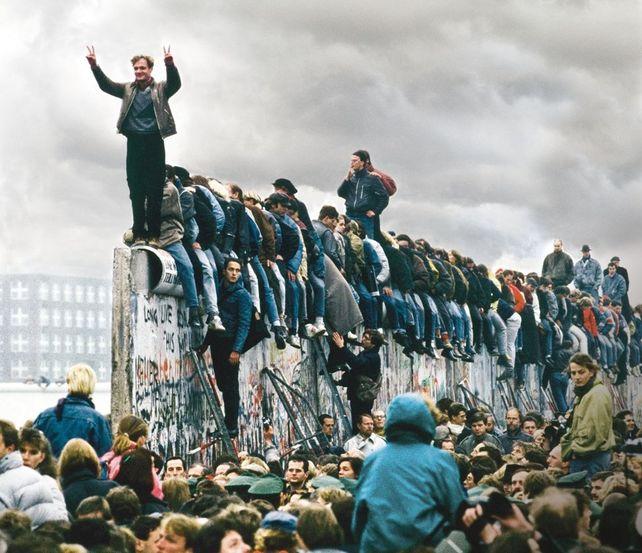
People standing atop the Berlin Wall during its fall in November 1989, marking the beginning of a new era of optimism and political change. Photo: Vietinghoff / Wikimedia Commons (CC0 1.0, Public Domain).
In 1996, the Jewish American legal scholar Alan Dershowitz declared that “antisemitism is dead.” Yes, the very same Dershowitz who has become one of the most prominent voices in the fight against BDS and campus antisemitism in recent years. He even recounted that he regularly repeated this declaration in his lectures, much to the dismay of older audience members. Three decades later, especially in light of the October 7 massacre and the wave of antisemitism that followed, it is easy to regard his statement as evidence of almost unimaginable naivety.
But what was the basis for such optimism? Surveys conducted by the Anti-Defamation League (ADL) indicated a decline in the proportion of Americans holding strongly antisemitic attitudes, from 20 percent in 1992 to 12 percent in 1998. Scholars sought to explain this trend, and in 2000 Spencer Blakeslee published his book The Death of American Antisemitism. The world itself also looked different: the Soviet Union had collapsed, liberal democracy appeared to have emerged victorious from the Cold War, and in this spirit Francis Fukuyama published his famous book The End of History and the Last Man in 1992. The UN resolution equating Zionism with racism was revoked in 1991, while the Middle East peace process inspired new hopes. This optimism was not confined to the United States. In Israel, Prime Minister Yitzhak Rabin declared in 1994: “The world is not against us. The world is with us.”
Of course, antisemitism did not die. One need only look at what is happening in the United States today: in 2025, the ADL recorded 6,274 antisemitic incidents, the third-highest figure since it began tracking them in 1979. Dershowitz clearly went too far in his conclusion. But does the fact that antisemitism subsequently resurged negate the significance of the decline recorded during the 1990s?
We tend to judge Jewish hopes in light of the disasters that followed them. German Jews’ faith in integration and emancipation is sometimes portrayed as naive in retrospect, given the Holocaust. Similarly, the Zionist hope, at least in some of its forms, that Jewish sovereignty would solve the problem of antisemitism is often presented as a naive expectation that proved mistaken. Yet German Jews did achieve equal rights and become integrated into society, while Zionism fundamentally transformed the political condition of the Jewish people. Viewing history solely through the lens of subsequent catastrophes risks obscuring the significance of such achievements. The failure of an absolute hope does not negate genuine progress.
This brings us to the central question: if every decline in antisemitism is retrospectively dismissed as an illusion, partly because of the perception that antisemitism is an eternal phenomenon, an “eternal hatred of an eternal people,” what would success in combating it actually look like? Why do we invest in research, monitoring, legislation, education against antisemitism, and Holocaust education? After all, these efforts are intended, at least in part, to change reality. One need not believe that antisemitism can be eradicated entirely to believe that its prevalence, legitimacy, and harmful consequences can be reduced. And if that is our goal, why should we not study periods of decline as seriously as we study outbreaks of antisemitism?
As someone who teaches about antisemitism and law, I see just how possible such change can be. When teaching history, I examine the laws that, over the centuries, restricted where Jews could live, the occupations they could pursue, and the rights they could enjoy, culminating in the Nuremberg Laws. But when we reach the post-Holocaust period, the discussion of Western democracies changes dramatically: instead of focusing primarily on how the law was used to discriminate against Jews, I teach how it has been used to protect them and combat antisemitism. These protections are far from perfect, and restrictions affecting Jewish life still exist today. Nevertheless, from a long-term historical perspective, this represents an enormous transformation. The continued existence of antisemitism does not diminish its significance.
So what can we learn from the 1990s? Perhaps the dominance of liberal democracies reduced the public acceptability of prejudice. The far right had not disappeared, but in many major countries it was further removed from the centers of political power. The Soviet bloc’s institutionalized anti-Zionist propaganda had lost its apparatus of dissemination. On the other hand, radical Islamism was already active: Hamas, whose 1988 charter contained distinctly antisemitic themes, carried out deadly terrorist attacks. This was by no means a decade free of hatred, but it was marked by different historical conditions whose effects deserve investigation.
The question of university campuses is particularly interesting. Radical anti-Zionism had developed within the New Left as early as the late 1960s, partly under the influence of Soviet propaganda, and Jewish students faced hostility during the 1980s as well. At Berkeley, demonstrations held in 1995 and 1996 featured expressions of support for Hamas and even praise for suicide bombers who had murdered Israelis. These events bear certain similarities to the celebrations of, and justifications for, the October 7 massacre heard on some campuses. Yet an ADL report from 1997, which documented those very incidents, concluded that anti-Zionism had largely lost its central place on campuses, partly against the backdrop of the peace process and growing sympathy for Israel. In other words, even when extreme expressions of anti-Zionism and antisemitism occurred, they did not necessarily reflect the broader atmosphere on campus. What can we learn from this, and what has changed since then?
Israeli policy may also have played a role in shaping the international climate. The Madrid Conference in 1991, the Oslo Accords in 1993, and the peace treaty with Jordan in 1994 strengthened hopes for a regional settlement. This does not mean that Israel bears responsibility for antisemitism. A Jew in Paris, London, or New York is not responsible for the actions of a government in Jerusalem, and the very fact that Jews may be attacked because of those actions constitutes a moral distortion. Nor is there any justification for demanding that the Israeli government shape its policies according to the potential reactions of antisemites. Nevertheless, it is worth asking whether an Israeli willingness to pursue peace makes it more difficult to portray Israel as a country inherently opposed to any political settlement. After all, even Yitzhak Shamir’s government participated in the Madrid Conference. Perhaps this weakened some of the arguments used to justify hostility toward Israel, even if the underlying antisemitic roots certainly did not disappear.
In Israel, it is sometimes easy to declare that we do not need the world and that we should become accustomed to living as “a people that dwells alone.” But it is worth remembering that in 1993, Madonna, Michael Jackson, and Guns N’ Roses all performed here. Three of the world’s biggest musical acts in a single year. Some of these concerts preceded Oslo and therefore cannot be regarded as a direct result of the agreement, but they illustrate the atmosphere of openness that characterized the period. Israel should not compromise its security or abandon its principles in order to gain international approval. Nevertheless, independence does not require isolation, and “a people that dwells alone” need not be a political vision. A Jewish, secure, and sovereign state that is also part of the wider world is a worthy aspiration in its own right.
We are accustomed to asking why antisemitism increases. We should ask with equal seriousness why it declines, and what we can learn from those declines. The mistake of the optimists of the 1990s was to believe that antisemitism had died. Our mistake today would be to forget that, in important respects, it had indeed weakened.
Related Topics
Related Posts