
Russian-American-Israeli Palestinian. Palestine is Israel.
Antisemitism Without a Name
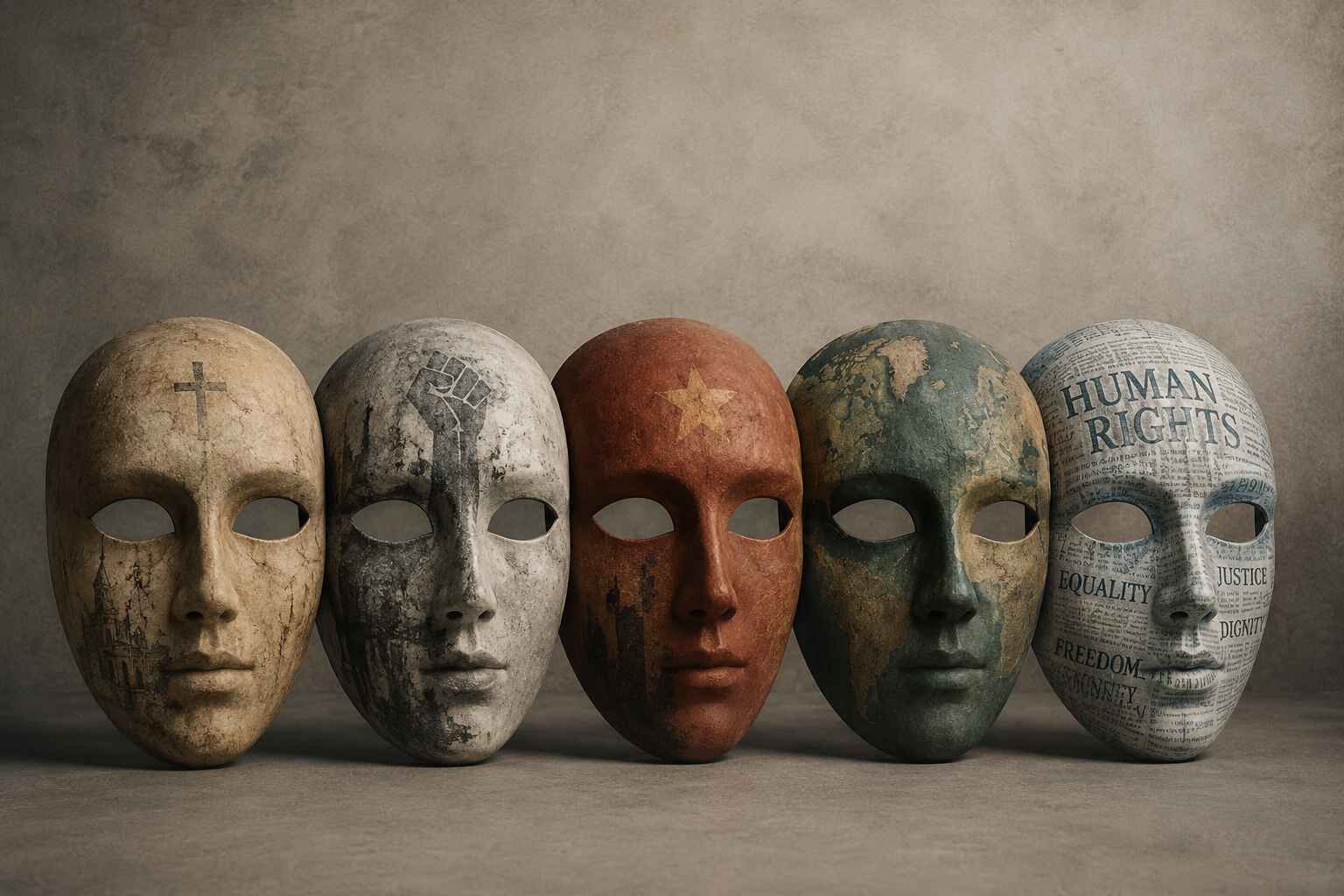
The surface changes, but the underlying pattern remains. Antisemitism adapts to changing times, appearing behind different masks. Image © Ivan Bassov, 2026. Licensed under CC BY 4.0.
The Vocabulary Changes, the Target Does Not
One question keeps returning, in one form or another:
Who is behind all this?
Is it the universities? The media? The UN? The political Left? Islamists? Activists? NGOs? Social media? Foreign governments?
In public discourse, the list often becomes more specific: certain governments are named, particular media networks are accused, major universities are singled out, and international organizations are portrayed as coordinated actors.
My answer is always the same:
Yes—and no.
Those institutions may amplify the phenomenon, but they are not the phenomenon itself.
The temptation is to search for a mastermind, a headquarters, a conspiracy. But history suggests a simpler and more disturbing explanation. The hatred directed at Israel today is not fundamentally new. It is very old. It is antisemitism wearing contemporary clothing.
Only eighty years have passed since the Holocaust. In historical terms, that is a blink of an eye. Entire generations are still alive whose parents or grandparents witnessed, participated in, enabled, excused, or survived the greatest antisemitic catastrophe in human history. Why should we assume that a hatred cultivated for centuries simply vanished in a few decades?
We shouldn’t.
What we are witnessing today is the largest global surge of hostility toward Jews and the Jewish state since World War II. The slogans have changed. The vocabulary has changed. The targets have shifted from “the Jew” to “the Zionist.” But the obsessive fixation remains remarkably familiar. Israel is judged by standards applied to no other nation. Jewish self-defense is treated as uniquely illegitimate. Jewish sovereignty itself is placed on trial.
This is why I often use the term Ziophobia rather than antisemitism.
Some readers of my earlier essay, Ziophobia and Antisemitism: Time to Draw the Line, may conclude that I am arguing these are fundamentally different phenomena.
I am not.
Quite the opposite.
As I explained in that article, the distinction is primarily analytical and rhetorical. Ziophobia helps identify hostility directed specifically at the Jewish state, regardless of whether it originates from classic Jew-hatred, ideological anti-Zionism, or some combination of the two.
In practice, however, I believe much of modern Ziophobia is simply antisemitism that has learned new rhetoric.
The problem is that antisemites have spent decades building defenses against the charge of antisemitism. They have prepared responses, slogans, talking points, and indignation. Accuse them of antisemitism and the discussion immediately shifts away from their behavior and toward their denial.
Ziophobia bypasses that defense.
It forces the conversation back to observable reality: the obsessive hostility toward the world’s only Jewish state.
Of course, I have no illusion that this advantage will last forever. Given enough time, Ziophobes will develop rhetorical defenses against the charge of Ziophobia just as earlier generations developed defenses against the charge of antisemitism.
They will invent new distinctions, new slogans, and new ways to evade responsibility.
Perhaps one day they will insist that Israel is perfectly acceptable while finding new reasons why Jews themselves are somehow the problem. I have no doubt about their creativity.
Today, they insist they are not against Jews, only against Israel. Tomorrow, that distinction may be reversed with equal ease.
The narratives will evolve. The rhetoric will evolve. So will our response.
For now, however, Ziophobia is the word.
Whether expressed as traditional antisemitism, modern Ziophobia, or some future variation yet to be invented, the pattern itself remains impossible to ignore.
The deeper roots of this phenomenon are not primarily political. They are metaphysical.
As I argued in The Metaphysical Root of Antisemitism and Ziophobia, centuries of supersessionist thinking created a worldview in which Jewish continuity became an inconvenience. Christianity and Islam both developed doctrines claiming to inherit or replace Israel, its covenant, its prophets, and its spiritual role in history. Whether consciously or unconsciously, these narratives left a lasting imprint on civilization.
The continued existence of the Jewish people presents a problem for replacement stories.
The existence of the Jewish state presents an even bigger one.
A people that was supposed to disappear did not disappear.
A nation that was supposed to remain in exile returned.
A civilization that was expected to become a relic became modern, sovereign, and successful.
That reality creates profound discomfort for those invested in narratives of Jewish replacement, whether religious or secular.
But naming universities, politicians, activists, media organizations, or international institutions as “the culprit” misses the larger picture.
They are not the disease.
They are symptoms.
The disease is a recurring civilizational phenomenon that repeatedly finds new hosts, new language, and new justifications.
In one era it spoke the language of theology.
In another, race.
Then nationalism.
Then anti-colonialism.
Today it often speaks the language of human rights.
The vocabulary changes. The institutions change.
The target does not.
This is why I do not believe there is a single culprit to expose.
The name of the phenomenon is already known.
It is antisemitism.
Or, in its modern political form, Ziophobia.
The challenge before us is not merely to defeat bad arguments. It is to recognize that we are engaged in a broader war of narratives—a battlefield of meaning itself. Our adversaries are creative. They constantly invent new terminology, new accusations, and new frameworks through which to delegitimize Jewish existence and Jewish sovereignty.
We must be equally creative.
Not because words alone will win the battle.
But because every war begins with language.
And every attempt to erase a people begins by renaming reality.
—
See Also
Related Topics
Related Posts