
An aging academic thinking about aging
Featured Post
The time my mother bought me an antisemitic book
Is it too much to ask editors, retailers, or even an AI program to flag books that are unabashedly, blatantly promoting Jew-hatred?
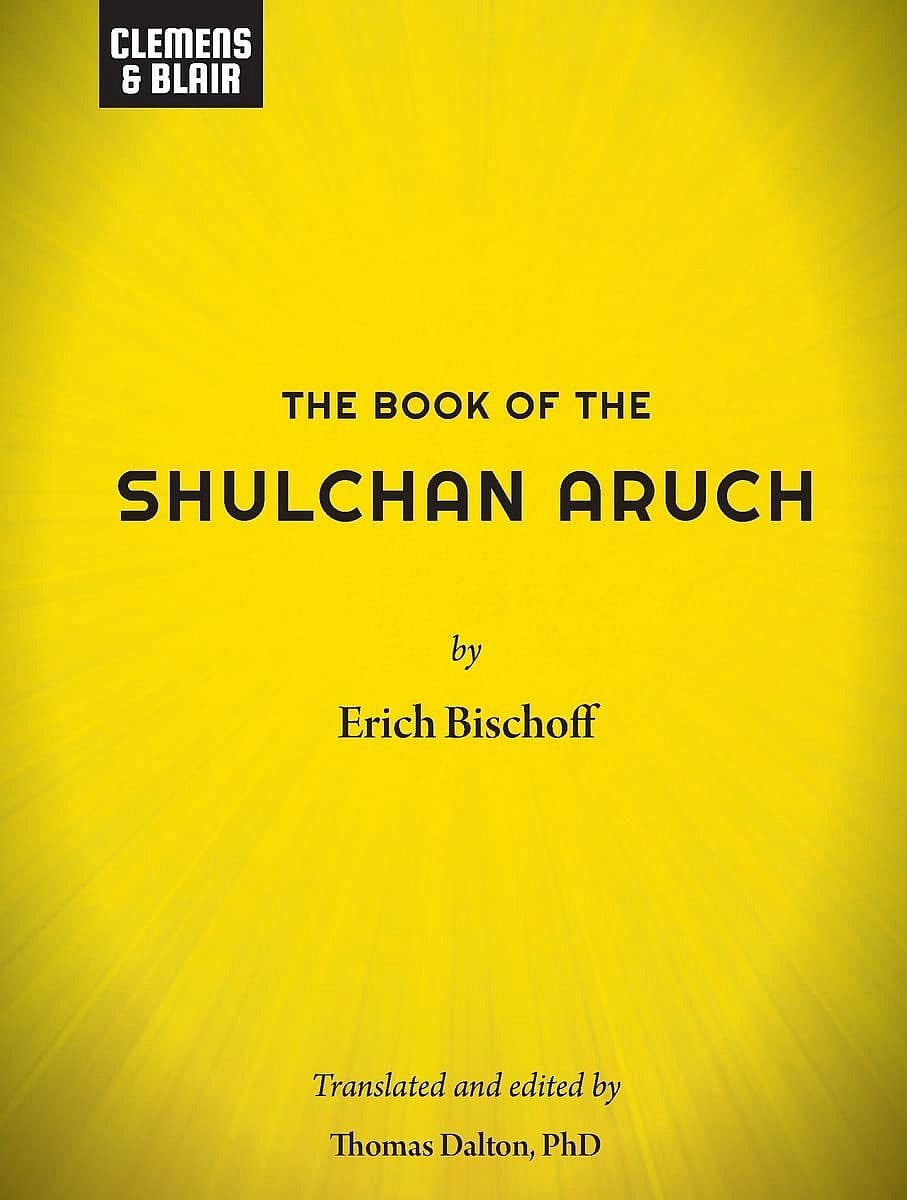
From the deceptively simple cover of Erich Bischoff's 'Book of the Shulchan Aruch.'
My mother knew I was interested in Jewish law and took the trouble to order a translation of the Shulhan Aruch from Amazon. She sent me Erich Bischoff’s The Book of Shulchan Aruch, translated by Thomas Dalton (Clements & Blair-Castle Hill Publishers, 2023).
She didn’t notice the book jacket’s claim of exposing “the dark corners of the Jewish religion.” As the jacket goes on to say, “The laws of Judaism hold Gentiles in very low regard; they can be cheated, lied to, abused, even killed, if it serves Jewish interests.” Once you open the book, a look at the publishers note shows the company the book keeps. Books from the publisher include Passovers of Blood and Political Cartoons of Der Stürmer, and the translator is the author of The Jewish Hand in the World Wars. Comments on the Amazon website for the book suggest readers might also like Freemasonry and Judaism: Secret Powers Behind Revolution.
A philologist, Bischoff published Das Buch vom Schulchan Aruch in 1929 just before his book on “The Jews and Blood of Christians.” Starting in 1900, he served as an expert witness arguing against Jewish groups who brought legal cases against German antisemitism. He used his translation to support growing antipathy to Jewish life in Germany. According to the Encyclopaedia Judaica, “his work misinterpreted Jewish sources and was fully exploited by the Nazis.” Bischoff’s German translation and commentary went viral for that period, running through four editions. The final version appeared in 1942.
The original German and current English translations are selective and tendentious. One example will speak for many: in the Dalton translation, Yoreh De’ah 158, 2 supposedly supports Jewish murder of gentiles. “The heretics, and those who practice idol worship [literally: worship of the stars], or who do sins for the sake of provocation, even one who ate forbidden foods or wore shatnez in order to provoke, this person is a heretic; and those who do not believe in the Torah and in the Jewish prophecy, it is commanded to kill him.”
Sefaria renders the passage this way: “The heretics, and those who practice idol worship (literally: worship of the stars), or who do sins for the sake of provocation, [and] even one who ate carrion flesh, or wore shatnez in order to provoke, behold, this person [has the status of] a nonbeliever. And the heretics, and those who deny the Torah and Jewish prophecy – they had the custom during the times of the Holy Temple to kill them.”
Notice the difference? The passage actually refers to a practice from the Temple period. Further reading shows that it refers to Jewish apostates. Also, other commentaries argue for leniency. If an apostate repents, the community is counseled not be stringent, “as it is difficult to break free from [idolatry], and there is a concern that he will return to his apostasy [if he is subjected to disgrace].”
In fact, the translator suggests readers consult Sefaria and other sources on the translation but does not seem to have followed his own advice.
I am not a scholar of Jewish law or antisemitism, but anyone can identify this sort of fake scholarship with even minimal sleuthing. For example, you can check the list of books “customers also bought and read” on the Amazon site. Unfortunately, these algorithmically generated recommendations can be hard to distinguish from respected scholarship on the same webpage.
I am grateful that people bamboozled by the book took the trouble to write critical reviews. One writes, “If you’re the sort of person who might read Mein Kampf for educational purposes, you might also read this, but I was enraged. I got through 50 pages and was even more enraged. I’m asking for my money back.” Another wrote, “I’m ashamed but unsurprised that it’s even listed for sale here.” I spare you the praise the book received from other readers.
People should be free to write (and translate) whatever drivel they like. And there’s no law against spending money for such drivel. But is it too much to ask an editor, or a retailer, or an AI program to flag books unabashed in their anti-Jew racism? Take this passage from the introduction to the book: “What should we do about these Jews? Their deeply embedded misanthropy, combined with their evident wealth and power, make for an extremely serious social problem – arguably the greatest problem faced by humanity today. We can be grateful that Erich Bischoff chose to compile this text; it may yet serve a greater purpose than he could ever have imagined.” I wonder what purpose our translator has in mind.
Can tech whiz kids develop an AI model for scoring publications for Jew hatred? I am interested to hear about any AI models that are already out there. These may be useful for people looking to buy a book.
Related Topics