A Moroccan Journalist
Arabs in Israel are counted, but never accounted for
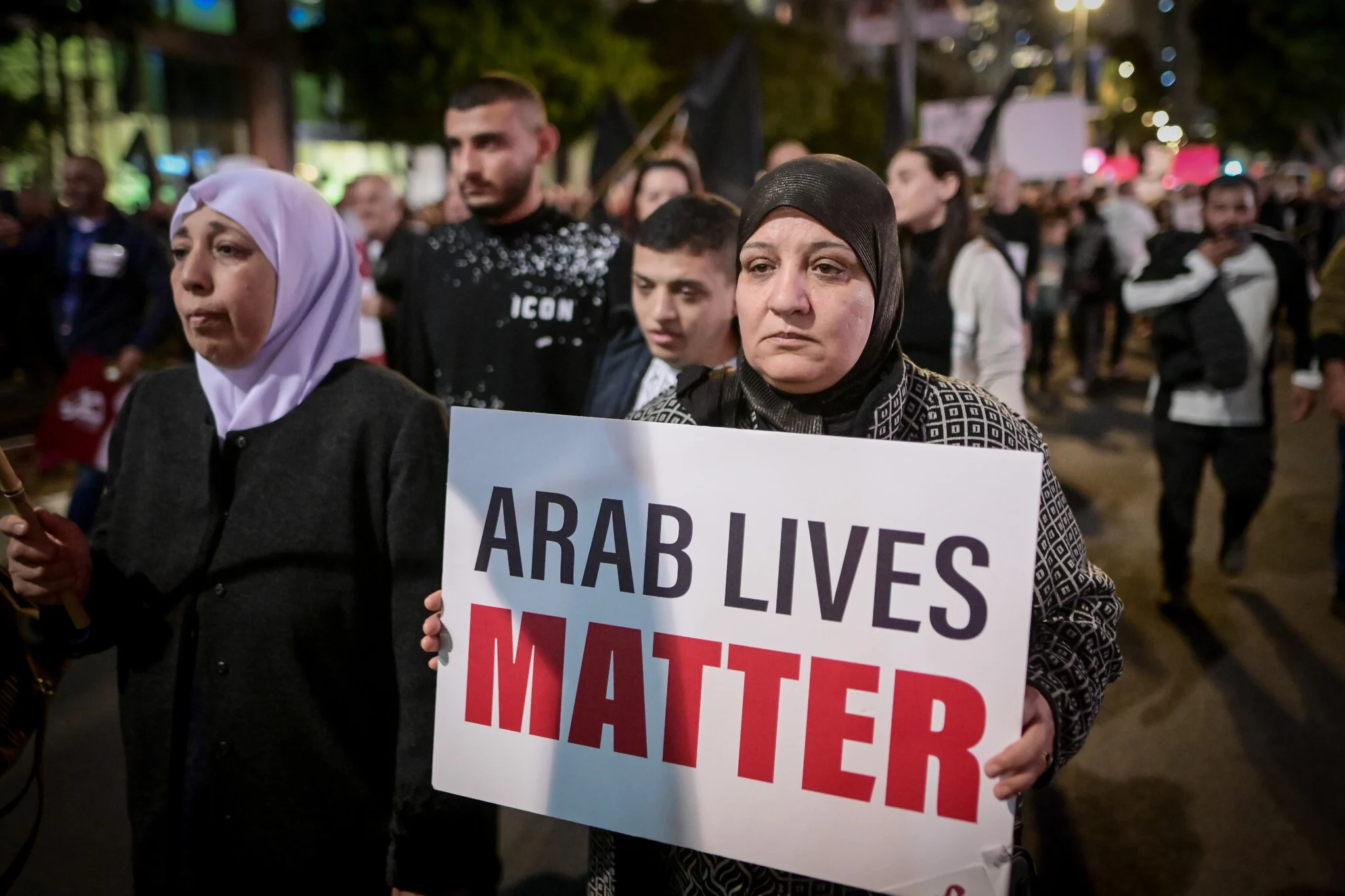
Thousands rallied in Tel Aviv on January 31, 2026, protesting organized crime in the Arab community and urging the state to take decisive action to end the violence. (Yonatan Sindel/FLASH90)
There is a concept in political philosophy that Giorgio Agamben borrowed from Roman law and made unbearable: homo sacer – the figure who can be killed but not sacrificed, whose death registers neither as murder nor as martyrdom, but as something the sovereign order simply absorbs without disruption. For decades, scholars applied this framework to Palestinians under occupation. Almost nobody thought to apply it to Arab Palestinian citizens of Israel.
That is precisely where the analysis must begin, because the violence devouring Arab communities inside the Green Line is not a policy failure or a cultural pathology – it is the lived expression of a citizenship that was never meant to function as citizenship at all.
It is the slow, bureaucratic production of expendable life within a state that has perfected the art of democratic performance while sustaining what Achille Mbembe would call a necropolitical gradient: a system in which the right to live, truly live, is distributed unevenly not through explicit decree but through the accumulated weight of what is not done, not built, not enforced, not imagined.
The Israeli state did not design the murder epidemic in Lod, Umm al-Fahm, or the Negev. It did something far more sophisticated – it designed the conditions under which murder would become inevitable, then classified the result as an internal Arab affair, a communal dysfunction, a cultural riddle too exotic for the state’s institutional grammar to parse.
This is the architecture of abandonment dressed in the language of complexity. Johan Galtung called it structural violence: harm embedded so deeply in the organization of society that no single actor needs to pull a trigger for people to die.
The trigger is the absence itself – the absence of serious policing infrastructure, the absence of urban planning that treats Arab towns as places where futures are built rather than zones where populations are warehoused, the absence of an economic sovereignty that would make crime an irrational career choice rather than the only rational one available.
When Israeli officials speak of “clans,” “internal disputes,” “emergency,” “collapse,” “organized crime,” “family feuds,” and “illegal weapons,” they are performing a discursive operation that Frantz Fanon diagnosed seventy years ago in colonial Algeria: the colonizer attributes the violence of the colonized to the nature of the colonized, thereby laundering the colonial structure that manufactured it.
The Arab citizen becomes ontologically violent – not a subject deformed by systemic exclusion, but a carrier of disorder who must be contained or pitied, never genuinely enfranchised.
This is why billions of shekels announced in government plans evaporate into bureaucratic delay: because the institutional unconscious of the state does not recognize Arab citizens as part of what Hebrew political discourse calls ha-kolektiv, the collective self whose pain activates the full machinery of response.
At its simplest, ha-kolektiv means the group as a whole rather than the individual – society over the self, “we” over “I.” In Israel, however, it usually refers to the Jewish national collective: the imagined moral and emotional body of the state, shaped by Jewish history and trauma, the Zionist narrative, national security logic, and shared memories of the Holocaust, wars, and October 7.
When Israelis say “this harms the collective,” they usually mean it threatens Jewish social cohesion, legitimacy, or survival. This is why Jews are seen as inside the kolektiv by default, while Arab citizens are often treated as outside it, or at best, adjacent.
As a result, Jewish pain becomes collective trauma, Arab pain a sectoral problem; Jewish security is framed as existential, Arab security as administrative. Violence in Arab communities is thus discussed as “crime in a sector,” not as a wound in the collective body. In essence, ha-kolektiv in Israel is not just society – it is the moral circle of those whose lives, fears, and deaths are felt as “ours,” while everything outside that circle is managed rather than mourned.
The proof is comparative and devastating. When violence struck Jewish communities – when organized crime touched figures within Jewish society – the state responded with dedicated units, emergency legislation, prosecutorial ferocity, and public grief that saturated the national consciousness.
When Arab citizens are murdered at rates that would, if transposed onto the Jewish population, constitute a national emergency requiring military-grade intervention, the system produces committees, pilot programs, and five-year plans that expire before they are funded. This asymmetry is not incidental. It is constitutive.
It reveals what the Israeli sociologist Sammy Smooha once tried to soften with the phrase “ethnic democracy” – a regime that extends formal rights while reserving existential belonging for one ethno-national group, consigning the other to a permanent liminality where they are counted but never accounted for, present but never fully there in the sovereign imagination.
The Koenig Memorandum of 1976 articulated this logic with a candor that subsequent decades learned to disguise: Arab citizens were to be managed demographically, contained geographically, and fragmented politically. The weapons trade flooding Arab towns today, the protection rackets operating with near-impunity, the contractors extorted, and the teenagers recruited – all of this grows in the ecological niche that management-without-belonging creates.
Where sovereignty is withheld, para-sovereignty emerges, and para-sovereignty is always violent because it lacks the one thing that distinguishes a state from a gang: legitimacy. Arab communities are not experiencing a crime wave. They are experiencing the consequences of being suspended for seventy-eight years between inclusion and exclusion, between a citizenship that grants a ballot and a nationhood that withholds a soul.
Until Israel confronts not its security doctrine but its civic doctrine – until it decides, at the level of institutional reflex rather than parliamentary rhetoric, that an Arab child shot in Rahat is exactly as intolerable as a Jewish child shot in Ra’anana – the violence will continue, not because Arabs are violent, but because the void where a state should be will keep being filled by those who profit from its absence. And that is the question Israel cannot answer at a press conference: not how to stop the killing, but whether it has ever truly decided that these lives belong to the body it swore to protect.
Related Topics
Related Posts