A Moroccan Journalist
What Does It Mean to Be a Palestinian Israeli?
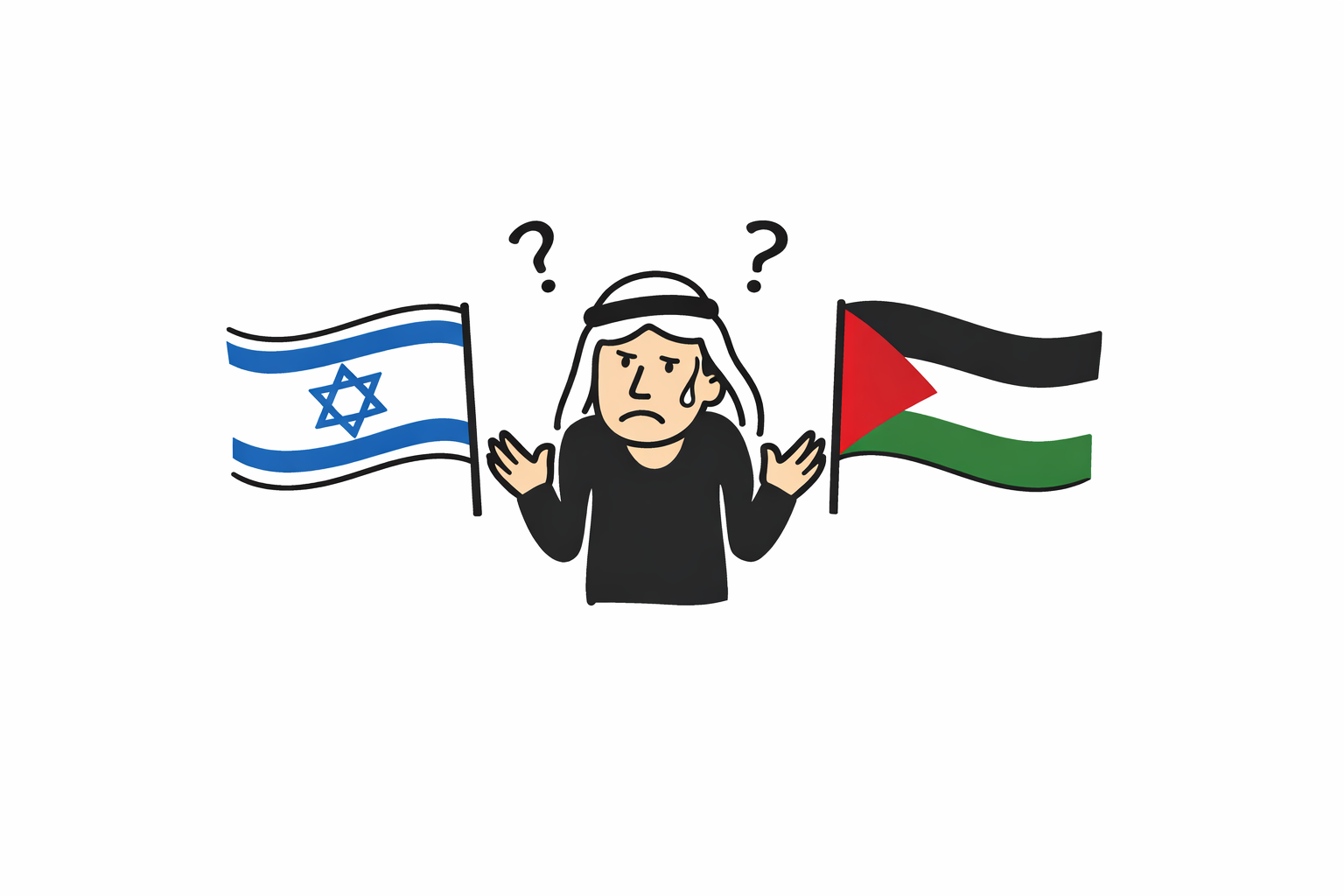
Trapped between two flags, Arab Israelis walk a tightrope of belonging. One flag represents the state that governs their lives; the other, the nation of their heritage. They are neither fully embraced by Israel’s Jewish majority nor wholly trusted by Palestinians across the Green Line. Identity becomes not a place of comfort, but a site of daily negotiation. (AI-generated)
They carry Israeli passports and vote in Israeli elections, yet many will tell you their soul is Palestinian. The Arab citizens of Israel – about one-fifth of the country’s population – live in a perpetual negotiation of identity. Sociologists often describe their condition as a double marginality: insiders in the Israeli civic system, yet outsiders to its dominant Jewish narrative; members of the broader Palestinian people, yet with a very different life experience from Palestinians in the West Bank, Gaza, or diaspora.
This dynamic breeds a subtle, constant identity dilemma. An Arab Israeli grows up studying Hebrew in state schools and interacting daily with Jewish Israelis, but at home hears stories of the Nakba of 1948 and the loss endured by their grandparents. They see the Israeli flag on public buildings, even as the Palestinian flag – symbol of their kin – is rendered seditious; indeed, merely waving it inside Israel can invite punishment.
Little wonder that many Arab Israelis describe feeling as if they inhabit two worlds at once, belonging to both and fully to neither. Their identity is a careful balancing act, one they perform every day in the corridors of a state that calls itself Jewish and the streets of towns that still feel palpably Arab.
Within this community, responses to the identity question span a broad spectrum. At one extreme are those who emphatically identify as Palestinian and view themselves as living under occupation from within. For them, the Israeli ID card and passport are purely administrative conveniences – “just a piece of paper,” not a definition of who they are.
In their view, they are Palestinians who never left their homeland, the steadfast ones who endured and remained when so many others were displaced. At the other extreme, one finds individuals (often younger, urban, and upwardly mobile) who have come to identify more with Israel as their country. This latter group might note that Israel’s schools educated them, its hospitals healed them, and that they have largely grown up in a Hebrew-speaking milieu. Especially for those from towns or families that have enjoyed better socioeconomic conditions – away from the poverty and violence that plague some Arab localities – the civic aspect of being Israeli looms larger than the ethnic or national one.
Between these poles lies a large middle: people who refuse to be pinned down solely as one or the other. Many juggle a layered identity, seeing themselves as both Palestinian and Israeli to varying degrees, or just living life without overthinking labels. Their day-to-day priorities revolve around work, studies, and family more than grand notions of nationalism. Yet even they cannot escape the context entirely; politics has a way of intruding, forcing choices or declarations at charged moments (a war in Gaza, an election, a police shooting) when the hyphen in Palestinian-Israeli suddenly feels like a fault line.
History set the stage for this identity crisis. In the 1948 Arab–Israeli War, amidst mass displacement of Palestinians, a small minority – about 160,000 people – managed to stay within the newly formed state of Israel. They and their descendants became Israel’s Arab citizens, today numbering over 1.5 million. For the first two decades, these people lived under military administration, isolated from the Arab world and often separated from relatives across borders.
The state referred to them as “Israeli Arabs,” a label that deliberately muted the word “Palestinian” in an effort to detach them from their nation’s broader story. In turn, Arab countries and the Palestinian movement were deeply ambivalent about them. Were these Arabs who held Israeli citizenship to be trusted? Or had they survived by acquiescing to enemy rule? In the wider Arab discourse, they were sometimes called “Arabs of ’48” or “Arabs of the interior” (al-dākhil) – terms emphasizing that they were the Palestinians who remained inside what became Israel. At times, they faced outright scorn.
A famous example unfolded at a youth festival in 1950s Europe: upon seeing Arab Israelis march under the Israeli flag, some Lebanese delegates angrily denounced them as traitors. The shocked Arab Israelis responded by asserting that an Israeli passport did not make them less Arab. One Palestinian Israeli intellectual wrote in an open letter to his Arab brethren: “We are the remainder of the Palestinian people, your neighbors in tents… Your delegation called us ‘traitors.’ If only you knew how much these ‘traitors’ cheered” for every Arab victory, sharing in the collective hopes of the Arab nation. Such moments poignantly captured their predicament: distrusted by fellow Palestinians for being Israeli, and regarded with suspicion by Israeli Jews for being Palestinian. Caught in between, they had to carve out an identity in a liminal space.
Naming has always been political in this context. Over the years, what to call the Arab citizens of Israel became a matter of identity itself. Israel’s official terminology – “Israeli Arab” – treats them as a minority defined solely by ethnicity within the Israeli state, glossing over their Palestinian national consciousness. Many of the people themselves reject this term, seeing it as an erasure of their historical identity. On the other hand, identifying simply as “Palestinian” can feel both overly broad and, frankly, risky: open assertion of Palestinian nationalism inside Israel has sometimes been met with hostility or even legal penalties.
The compromise emerging in both academic and popular usage is “Palestinian citizen of Israel,” which acknowledges their Palestinian peoplehood while recognizing their citizenship in Israel. Still, no single label has won consensus – tellingly, even surveys find a split in self-identification. In one recent poll, only a small minority of Arab citizens (single-digit percentages) chose “Palestinian” as their primary identity, while nearly half opted for “Arab-Israeli,” and a significant remainder preferred hyphenated or ambivalent terms like “Palestinian-Israeli”. A notable share – about 23% – even responded that they are “Israeli” plain and simple. Such data underscore that this community is anything but monolithic.
Identity here is contextual and highly individual. It can hinge on how the question is asked, on current events, or on the particular mix of experiences each person has had. An elderly villager in the Galilee who remembers the Israeli military rule of the 1950s may call himself Palestinian first; a young tech engineer from Haifa who mingles with Jewish colleagues might lean towards a more Israeli civic identity. Both live a nuanced reality that defies neat categorization.
What drives an Arab Israeli to tilt more toward one identity or another? Social scientists point to several factors. Geography and community play a role: those in predominantly Arab towns, especially ones suffering from state neglect, discrimination, or high crime rates, often feel alienated from Israeli society and bolster their identity with Palestinian solidarity as a form of resistance. In contrast, those from mixed cities or who attend integrated universities rub shoulders daily with Jewish Israelis; proximity and shared routines can foster a sense of Israeli-ness or at least a vested interest in Israel’s society functioning well.
Economic integration is another factor – a professional working in a Jewish-majority workplace, speaking Hebrew most of the day, may develop a civic affinity with Israel that someone in an insular Arab community might not. Then there are the Bedouin Arabs of the Negev, a distinct subgroup with their own identity dynamics. Many Negev Bedouin serve in the army and identify in part with the state, valuing stability and services, yet they also face severe socioeconomic marginalization and grapple with land disputes that mirror the broader Palestinian struggle. Their identification can be more local and tribal, adding another layer to the complex identity mosaic of Arab Israelis.
Religious and cultural backgrounds matter too: Muslim, Christian, or Druze Arabs each have unique historical relationships with the state and the Palestinian cause. For instance, the Druze community’s formal loyalty to Israel (including mandatory IDF service) sets it somewhat apart, though even among Druze there are those who assert a Palestinian identity. In short, how an Arab citizen of Israel sees themselves – Palestinian, Israeli, both or neither – is the product of personal history intersecting with larger social currents.
These identity choices are not made in a vacuum; they are keenly observed (and sometimes judged) by others. To the Jewish Israeli majority, an Arab citizen’s loyalty is often a point of anxious speculation. Right-wing voices have long cast doubt on Arab Israelis’ patriotism, branding them a “fifth column” or demographic threat. On the left, they were historically romanticized as an oppressed minority naturally allied with Palestinian nationalism. Both views flatten the diversity of real attitudes on the ground.
Meanwhile, to Palestinians in the West Bank and Gaza, or in the refugee camps of Lebanon and elsewhere, the Arab citizens of Israel have often occupied an ambiguous place in the imagination: at times admired as the guardians of Palestinian lands who “stayed behind”, and at other times resented or vilified as people who somehow managed to live (relatively) normal lives under the Israeli flag while others suffered statelessness and occupation. In the harsher renditions, they are deemed “traitors” or at least insufficiently committed to the cause, and they are often asked to prove their Arabness. Such accusations deeply wound many Arab Israelis, who see them as unfair. After all, they ask, what choice did we have?
Born into an Israeli state, they did not choose the citizenship imposed on them at birth – yet they chose to remain on their ancestral lands when others were expelled. In their narrative, they are the true steadfast Palestinians, clinging to their villages in 1948 against all odds, whereas the refugees (through no fault of their own, of course) departed.
This sensitive divergence in historical memory means a Palestinian from Nablus and an Arab from Nazareth might eye each other with a hint of mutual incomprehension shaped by decades of living utterly different realities. And yet, those same two individuals, when meeting abroad, might feel an immediate kinship in the face of a world that often misunderstands the subtleties of each of their predicaments.
Indeed, outside of their homeland, Arab Israelis face an almost comic predicament when asked that simplest of questions: “Where are you from?” Legally, their nationality is Israeli – that is what their passport says, and on paper they are as Israeli as any Jewish citizen of the state. Yet to say “I am Israeli” often invites mistaken assumptions that erase their Arab-Palestinian story. Some will answer, “I’m Palestinian,” which is true ethnically and culturally – but then leads to explanations about holding Israeli documents and citizenship. Others settle on a hyphenated “Palestinian-Israeli” or a phrasing like “Palestinian from Israel,” trying to encapsulate a dual identity in a breath.
It is a delicate self-introduction, often requiring a mini history lesson for foreign interlocutors. And it mirrors their internal negotiations: they carry both identities together, even when no single term neatly conveys it. This very dilemma – having to justify or explain who you are – only reinforces the sense of an unresolved identity, a feeling of being perpetually misunderstood by friend and stranger alike.
Is there a way out of this identity bind? Over the years, there have been shifts that suggest a gradual reframing. As Israel’s Arab citizens become more assertive in the public sphere – from city halls to the Knesset – there’s a growing discourse that their struggle is not a separatist one but a civil rights struggle within Israel. In this view, embracing a Palestinian identity need not contradict loyal citizenship: one can demand equal rights as an Israeli citizen while proudly affirming one’s Palestinian peoplehood.
This perspective gained traction especially after events like the 2021 inter-communal unrest and the subsequent inclusion of an Arab party in an Israeli governing coalition for the first time. The participation of Mansour Abbas’s Ra’am party in government marked a watershed: it signaled that a segment of Arab society was willing to work within the system and “integrate, not separate,” in exchange for tangible benefits for their community. Many observers saw this as a coming-of-age moment for Arab Israeli politics – a pragmatic turn that acknowledged Israel as their state, even while maintaining their Palestinian narrative.
As one Arab public figure, Mohammad Darawshe, insightfully noted, “Our identity as Arab citizens is not the same as other Israelis. It’s not the same as other Palestinians either. It’s an identity emerging to be something new… moving further into Israelization, but still carrying the weight of Palestinian and Arab identity.” In his view, Arab Israelis are a “community in progress,” not yet settled in their unique identity, which continues to evolve with each generation.
Anthropologists studying this community often observe that their identity is fluid and context-dependent, rather than fixed. It is not a zero-sum game. Many Arab Israelis have learned to hold multiple identities in tandem, switching emphasis depending on context – a form of cultural bilingualism, as it were. In surveys, for example, large majorities will integrate both Israeli civic identity and Palestinian national identity into their self-description if given the chance to choose hybrid terms.
As Darawshe quipped, adding up those percentages can exceed 100, which “leads me to say: Who says that identity is a zero-sum game? Identity is more like circles that overlap.” This overlapping-circle metaphor captures it perfectly: one can be 100% Palestinian and 100% Israeli in different dimensions of life. Far from a neat split, their lives exemplify a both/and form of identity.
The “crisis” of identity among Arab Israelis, then, is not a sign of confusion so much as a reflection of a complex reality. It is the lived paradox of an indigenous people who became a minority in their own homeland, who are citizens of a state that often defines itself in opposition to their kin across the border. It is a testament to human adaptability: rather than choose one side of the ledger and erase the other, many Arab Israelis embrace the ambiguity, however uneasy it may feel.
They insist on writing their own narrative, one that accommodates the duality of their existence. In doing so, they challenge the expectations of both societies – pushing Israel to accept that one can be a loyal citizen and proudly Palestinian, and reminding fellow Palestinians that their struggle for identity and rights is no less valid because it unfolds within the framework of Israeli citizenship.
For the outside world, understanding their predicament requires shedding simplistic binaries. As one delves deeper, one cannot help but be impressed by the resilience of Arab Israelis in forging an identity that, though laden with contradiction and occasional angst, could ultimately serve as a bridge. In a land often divided into stark black and white, they live in the gray spaces – and perhaps therein lies a hope that identities need not always be clashing; they can also be reconciled, nuanced, and enriched by one another.
The story of Arab Israelis is a profound sociological case study of identity under duress, but also an inspiring human story of finding selfhood amid conflicting currents. It is, in the end, an ongoing journey – a work in progress – and the world would do well to listen to it in all its complexity and depth.
Related Topics