
Founder, Advisor, Writer, Applied Optimist
Are Independent Voters the New ‘Bipartisan’ in US-Israel Relations?
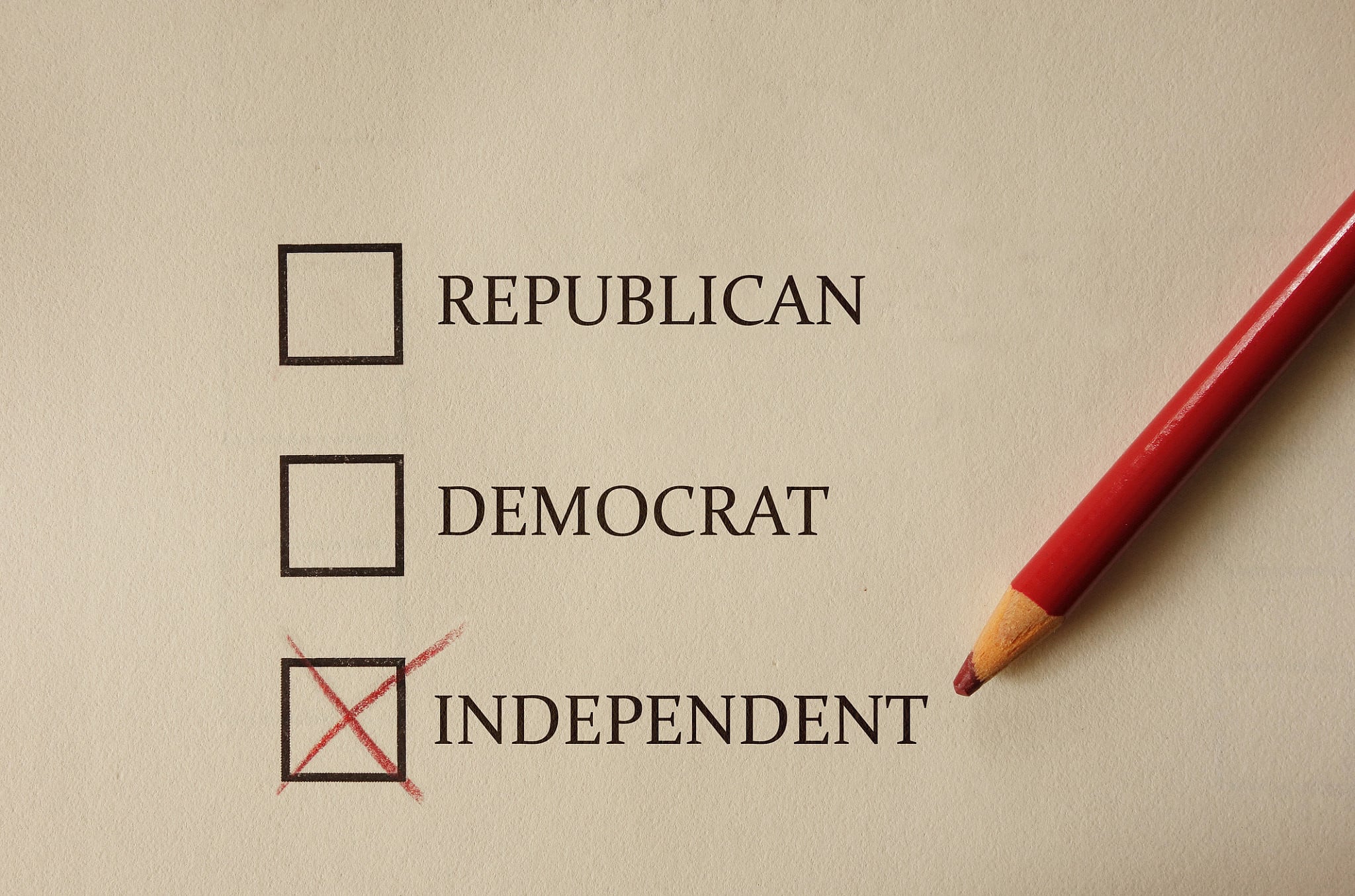
Voting Slip with Republican/Democrat/Indpendent Selection
Not too long ago I was explaining to one of my children what American bipartisanship looked like, particularly when it came to Israel. He said I sounded a bit nostalgic. It was true, I did. He also said I sounded a bit worried. I am.
But I am optimistic too.
For decades, the political playbook for advancing (or at the very least, preserving) the relationship between the United States and Israel has been written within the comfortable, if increasingly narrow, confines of America’s two-party system. Engaging congressional partisans, connecting with emerging state leaders, and ingratiating itself with the leadership of the executive branch has all been part of the playbook. Success has been measured by the prevailing winds in the halls of Congress and the pressure (or lack of pressure) from the White House. The contours of the coalition have changed over years, but the landscape of political engagement related to the U.S.-Israel relationship has been grounded in the idea that the alliance is a bipartisan issue, waxing and waning based on party leadership, but partisan nonetheless.
But what happens when Americans not only reject bipartisan consensus around Israel, but they reject partisan politics entirely?
New data released this month serves as a stark reminder that the political ground beneath American’s feet has not just subtly shifted; it is reforming based on a set of tectonic shifts in both domestic political attitudes and global realities. Based on recent polling, Gallup found that a record-high 45 percent of Americans now identify as political independents, while the Democratic and Republican parties have withered to a mere 27 percent each. This isn’t a temporary fad or a protest vote either – the newest data confirms it is a trend that has accelerated over the past 15 years, cutting across all generations and demographics, particularly among younger generations.
With respect to these emerging generations that will make up the bulk of the American electorate for the next half century, Gallup found that majorities of Gen Z adults and millennials identified as political independents. Gen X isn’t far behind, with more than four in 10 Gen X adults also identifying as independent. This data confirms recent findings by the Independent Center, a U.S.-based organization supporting the independent voter movement over the past year. As younger generations become more politically conscious, they also find themselves politically homeless, creating an alternating sense of despair and disengagement with the current state of affairs both at home and abroad.
Despite the eye-opening numbers, these shifts in attitude will do little to break the political duopoly in American politics immediately. In fact, if anything, the 2026 elections are positioned to be as deeply partisan as any other in recent memory (with Israel once again likely being an area of partisan division). Nonetheless, the data, as well as anecdotal insights from across America’s battleground states, indicate a growing transformation from the traditional binary nature of U.S. politics to one that is more fragmented, more fluid and more frustratingly unpredictable. As this transformation accelerates, so will the impact on American elections and their outcomes.
For advocates of a strong US-Israel relationship, the latest Gallup figures should serve as a wake-up call to policymakers, activists and philanthropists alike. They can no longer afford to build a strategic house solely on the sand of a two-party system that most Americans are actively abandoning. In other words, by continuing to view political advocacy through a purely partisan lens, allies of the US-Israel relations are competing for the attention of a shrinking minority while ignoring the very center of gravity where American policy will be decided for the next generation.
Many younger Americans see the U.S.-Israel relationship as a relic of a partisan era they never asked to join. Even more so, they feel that supporting a strong U.S.-Israel relationship might result in adopting a partisan identity they have already rejected. At the same time, they are exposed to media narratives they don’t always trust, and oftentimes defer to the individual voices they trust the most, whether that is a friend, a colleague, an online influencer, and perhaps even a particular candidate. But a political party? For many in 2026, that is now a hard pass.
So what can be done? A lot actually. But the clock is ticking.
First, the shift toward an independent electorate allows for the de-escalation of the “Israel as a partisan football” dynamic that has proven so damaging. When the relationship is tied too closely to the fortunes of a single party, it becomes vulnerable to the inevitable swings of the political pendulum. By engaging a growing number of independent voters, a consensus can be built that is insulated from the hyper-volatility of the two-party system. This approach, which focuses more clearly on communicating how Israel is an American-allied center of innovation, technological partnership, and the shared values of open societies, will inspire voters without the baggage of a partisan litmus test.
It’s also time to take a fresh look and response to how politics is now being communicated in America. The traditional media outlets that shaped macro-narratives about Israel (good and bad) are being replaced by always-on nano-influencers armed with memes and reels. But unlike the bulk of the effort over the past decade that has been driven by both Israeli policymakers and Jewish and Christian American philanthropists alike, it’s not just social influencers with the big followings that need to be engaged. In this new era, independent voices who can speak authentically to their peers about why the US-Israel relationship matters for American interests and global security beyond. In this sense, allies of the US-Israel relationship can’t just trust political candidates to embrace and express views via a “policy paper.” Rather, they must relentlessly but persuasively engage in the messy, pluralistic debate that defines the modern independent voter.
While the challenges facing the US-Israel alliance in 2026 and beyond are real, there is a profound reason for optimism. The rise of the independent voter may represent a return to a more pragmatic, less dogmatic form of American politics. Independents, in poll after poll, identify as people who value results over rhetoric. If they can be convinced that a strong U.S.-Israel relationship delivers tangible benefits for security, medical innovation, and democratic stability, we will find a receptive audience in the new American center. In other words, I am optimistic that we are not witnessing the decline of American engagement with Israel, but rather the birth of a new, more resilient model of that engagement.
The U.S.-Israel relationship has always been strongest when rooted in the heart of the American people. In 2026, the heart of the American people is independent. Finding a way to meet them as a new type of voter is the best way to ensure that this vital alliance remains a pillar of our shared future for generations to come.
Related Topics
Related Posts