
Professional Indian author and strategic affairs writer.
The Strategic Web of I2U2 and the Free Trade Push
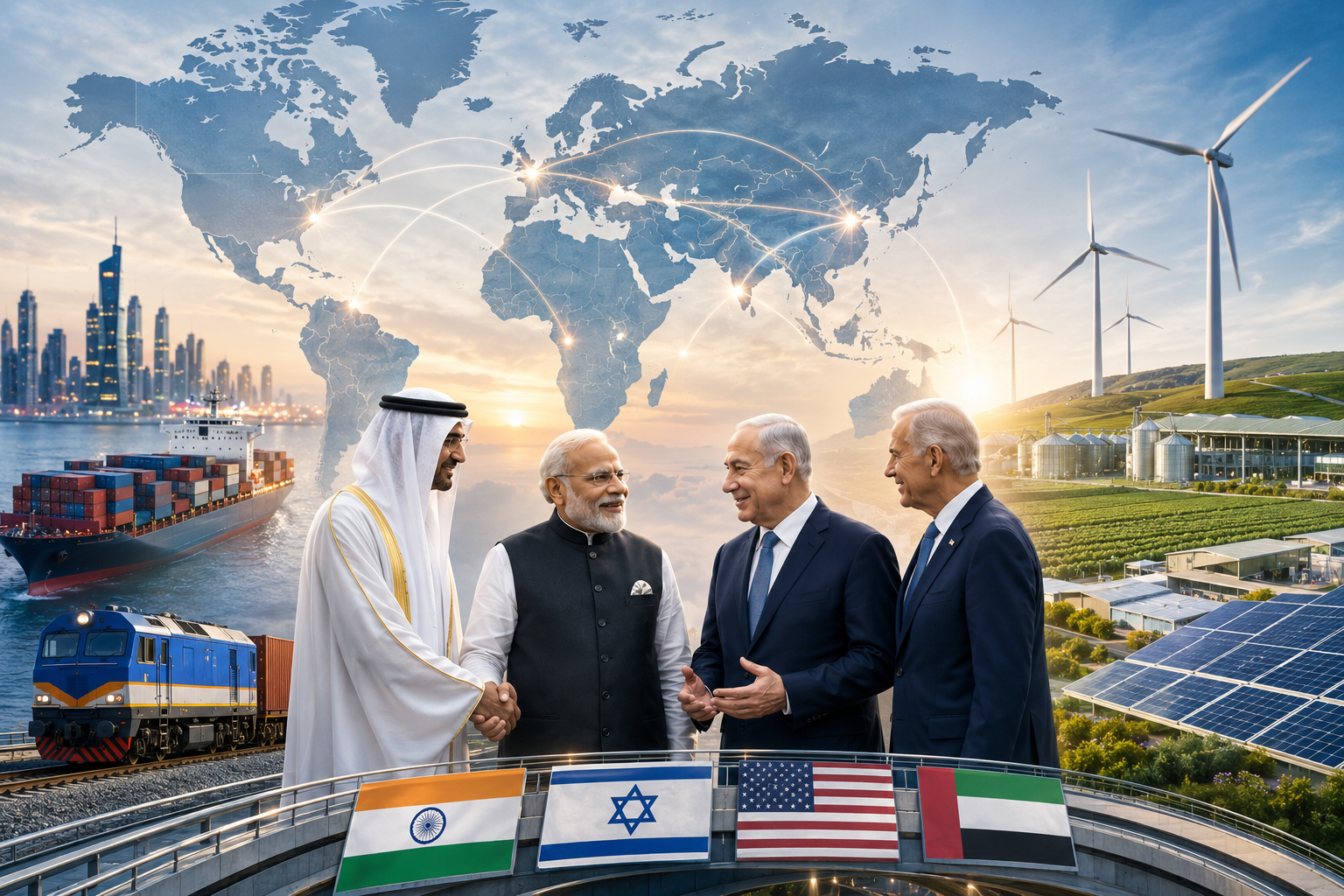
Conceptual illustration: Leaders from India, the UAE, Israel, and the United States stand before a digitally connected map linking the Indo-Pacific, Middle East, and Europe, surrounded by cargo ships, rail networks, renewable energy infrastructure, and modern agricultural facilities. The image represents the convergence of the India-Middle East-Europe Economic Corridor (IMEC), the I2U2 partnership, and emerging free trade agreements aimed at strengthening supply chains, expanding cross-regional commerce, and enhancing India's role as a strategic bridge between Asia, the Middle East, and Europe. Image: AI generated (Google).
India is fundamentally rewriting Middle Eastern diplomacy. The era of relying exclusively on isolated bilateral agreements has ended. New Delhi is now aggressively leveraging minilateral frameworks, specifically the I2U2 coalition comprising India, Israel, the United States, and the UAE, to secure its geopolitical interests. This highly focused coalition was designed to finance critical infrastructure projects, including renewable energy and food security corridors across West Asia.
This diplomatic pivot is anchored by a synchronized and highly aggressive new trade strategy. During the 16th India-EU Summit in New Delhi on January 27, 2026, India and the European Union successfully concluded their historic Free Trade Agreement. Frequently branded by diplomats as the “mother of all deals,” this monumental pact secures unprecedented preferential access for Indian exports across 97 percent of European tariff lines. In return, it eliminates tariffs on 96.6 percent of EU goods entering India. This agreement essentially locks in the critical western anchor for transcontinental commerce.
Immediately following that success, New Delhi turned its attention to the Mediterranean bridge. India and Israel launched the first round of their own Free Trade Agreement negotiations in New Delhi, spanning from February 23 to February 26, 2026. These intensive discussions were intentionally scheduled to coincide with Prime Minister Narendra Modi’s state visit to Israel on February 25 and 26. During that visit, the two nations elevated their relationship to a “Special Strategic Partnership for Peace, Innovation & Prosperity.”
The timing of these negotiations reveals a highly coordinated master plan. Total merchandise trade between India and Israel already stands at a robust $3.62 billion for the 2024 to 2025 financial year. A finalized FTA will serve as a massive catalyst to expand that bilateral trade while providing long-term predictability to businesses navigating currently volatile global supply chains. By securing an FTA with Europe and actively negotiating an identical framework with Israel, India guarantees that the physical logistics infrastructure built under the India-Middle East-Europe Economic Corridor will eventually reach its maximum commercial potential.
To understand how this operates in practice, you have to look at the financial engine driving the diplomacy. The I2U2 framework provides the capital and the strategic alignment required to make these corridors operational. A prime example is the flagship $2 billion UAE investment in integrated food parks located in Gujarat and Madhya Pradesh. This specific initiative flawlessly combines UAE capital, Indian implementation, Israeli agricultural technology, and US diplomatic coordination.
Combining the physical infrastructure of the economic corridor, the financial muscle of the I2U2 coalition, and the frictionless trade enabled by consecutive free trade agreements brings the entire geopolitical picture into sharp focus. Each agreement functions as a vital organ in a much larger transcontinental body.
India has evolved past simply navigating the geopolitical currents of the Middle East. It has aggressively positioned itself as the lead architect of a new regional economic structure. This interconnected strategy grants India unprecedented strategic autonomy in West Asia, insulating its vital supply chains from regional conflicts while cementing its permanent role as the indispensable bridge between the Mediterranean and the Indo-Pacific.
Related Topics