
99.6% Ashkenazi + .4% Viking = 100% Zionist
Are We Still Talking About a Two-State Solution?
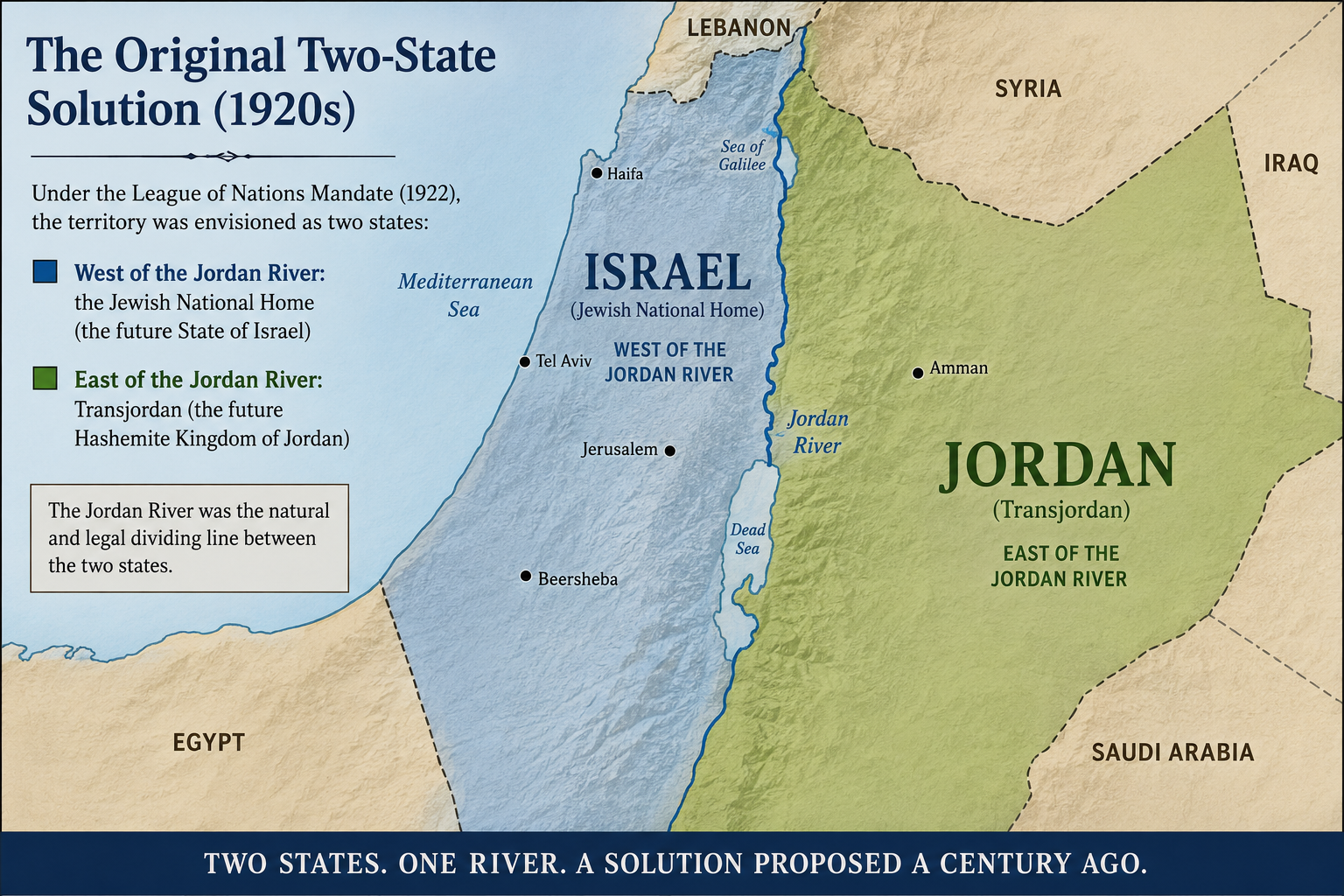
AI-generated image of the 2-state solution
Few diplomatic phrases are repeated more often than the two-state solution.
Politicians invoke it almost daily. Journalists write it as though everyone agrees on what it means. Yet today’s “two-state solution” is not the original “solution”. Somewhere along the way, the definition changed – but almost no one noticed.
In fact, over the past century, the phrase has been quietly redefined, and more than once. Each time the goalposts moved, the new definition replaced the old one as though it had always meant the same thing. Some call it political sleight of hand. I call it bullshit.
To understand today’s debate, let’s take a quick look at yesterday.
Following World War I, the League of Nations entrusted Great Britain with the Mandate for Palestine. The Mandate recognized “the historical connection of the Jewish people with Palestine” and called for the establishment of a national home for the Jewish people while ensuring the civil and religious rights of the area’s existing non-Jewish communities.
Simple enough. So far so good.
However, even before the Mandate was formally adopted back in 1922, Britain had already separated the territory east of the Jordan River. Under Article 25 of the Mandate, Britain administered that territory differently, and it would ultimately become the Hashemite Kingdom of Jordan – or simply Jordan – in 1946.
If you examine maps from the early 1920s, the picture is striking. The Jordan River formed the dividing line. To the east lay Transjordan (today’s Jordan). To the west remained the portion of the Mandate in which the Jewish National Home – Israel – was to be established.
Simple enough. So far so good.
In practical terms, the first “two-state” solution had already taken shape: an Arab state east of the Jordan River and the future Israel west of it.
That original understanding is rarely acknowledged today.
By the time the United Nations proposed partition in 1947, Jordan already existed. The debate was no longer about creating one Jewish state and one Arab state from the Mandate territory. It was about creating an additional – third – Arab state west of the Jordan River alongside the existing Arab kingdom east of it.
Wait, what?!
The meaning of “two states” changed. The proposal was now two states west of the Jordan river.
What happened to the original two states: Israel and Jordan? The Arab states “pressured” Britain and the UN. They acquiesced. The proposed Jewish Homeland was to be divided… again. Never mind that Jordan comprised roughly 75% of “Palestine.”
The Jewish leadership actually accepted the UN Partition Plan despite the painful territorial compromises it required.
The Arab Higher Committee rejected it.
The surrounding Arab states rejected it.
That two-state solution never moved past the proposal stage.
War followed.
When Israel declared independence on May 14, 1948, neighboring Arab armies invaded with the stated objective of preventing the establishment of the Jewish state.
The resulting war produced immense human suffering.
Approximately 700,000 Palestinians became refugees through a combination of warfare, expulsions, choice, and displacement. Their tragedy remains central to Palestinian national identity.
Far less discussed is the parallel story. Roughly 800,000 Jews fled or were expelled from Arab countries where many of their communities had existed for centuries. Most were absorbed into Israel rather than remaining refugees for generations.
Both histories deserve to be remembered.
The evolution of the “two-state solution,” however, did not end in 1948.
Now what?!
Over the next several decades, Palestinian leaders were presented with multiple opportunities to establish an independent state. The proposals differed in important ways and required compromises from both sides. They included the Camp David negotiations in 2000, the Clinton Parameters later that year, the Taba discussions in 2001, and Prime Minister Ehud Olmert’s proposal in 2008, among others.
Several envisioned a Palestinian state encompassing nearly all of the West Bank, all of Gaza, and territorial land swaps to compensate for areas retained by Israel.
Each proposal was rejected.
Supporters and critics continue to debate why. Some argue the offers did not adequately address issues such as Jerusalem, refugees, settlements, or security.
Others see a deeper pattern.
History is full of failed negotiations. One rejection proves little. Two may suggest bad luck. But after decades of proposals, counterproposals, summits, land swaps, and repeated refusals, reasonable people are entitled to ask a difficult question:
Is the disagreement really about where to draw a border – or whether one of the states should exist at all?
At some point, reasonable people are entitled to ask whether the obstacle has always been the details – or whether, for too many leaders, the obstacle has been the existence of a Jewish state in any borders.
That question becomes even more compelling when viewed through another historical lens.
Modern political discourse frequently describes Israel through the framework of settler colonialism. Yet remarkably little attention is paid to one of history’s largest imperial expansions: the Arab conquests beginning in the seventh century.
Emerging from the Arabian Peninsula (hence the word Arabs), Arab Muslim armies conquered vast regions stretching from the Levant across North Africa and eventually into Europe. Over succeeding centuries, many indigenous peoples gradually adopted the Arabic language and Arab culture while retaining much of their ancestral heritage.
History rarely remembers empires equally. Some are universally recognized as colonial powers. Others have become so deeply embedded in the modern landscape that their conquests are scarcely discussed at all.
This is not a moral judgment. It’s a historical observation.
English spread through the British Empire.
Spanish spread through the Spanish Empire.
Portuguese spread through the Portuguese Empire.
French spread through the French Empire.
Arabic likewise spread across much of the Middle East and North Africa through conquest, governance, migration, and centuries of cultural transformation.
Today there are more than 20 Arabic-speaking states stretching from the Atlantic Ocean to the Persian Gulf.
There is one Hebrew-speaking state.
Hebrew was born in the hills of Judea thousands of years ago. After surviving centuries primarily as the language of prayer and scholarship, it was revived as the living national language of Israel.
That fact alone should give pause before casually describing Hebrew as foreign to the very land in which it originated.
The world often speaks of the “1967 borders.” Yet Israel had no internationally recognized eastern border in 1967. It had the 1949 Armistice Lines – temporary military cease-fire lines that all parties understood were not intended to become permanent political boundaries.
How did temporary armistice lines become the world’s preferred blueprint for permanent peace?
When did Jordan disappear from the two-state conversation?
When did the phrase “two-state solution” stop meaning what it originally meant?
Perhaps the tendency to begin this story in 1967 – or even in 1948 – is itself part of the problem. The land, and its Jewish citizens, has passed through countless hands over the past two millennia: Romans, Greeks, Persians, Assyrians, Byzantines, Arab caliphates, Crusaders, Mamluks, Ottomans, and the British all ruled it. Yet through every empire and every conquest, one constant remained: the Jewish people’s historical, religious, and cultural connection to the land never disappeared, nor did its people. Long before there was a British Mandate or a Roman province renamed Syria Palaestina, there was Judea – the homeland from which the Jewish people derive their very name.
None of this answers every question about borders, security, sovereignty, or peace. Nor does it deny the aspirations of Palestinians for self-determination.
But words matter and history matters.
Every argument about the Middle East begins with an invisible decision: where to begin the story.
If we begin in the wrong chapter, we shouldn’t be surprised when we misunderstand the plot.
Before demanding a “two-state solution,” perhaps we should first agree on what those words originally meant – and when they came to mean something else.
Only then can we have an honest conversation about whether we are seeking a new solution… or simply redefining an old one to satisfy current political rhetoric.
Related Topics