
99.6% Ashkenazi + .4% Viking = 100% Zionist
Are You Opposed to the Gulf of America But Want to Free Palestine?
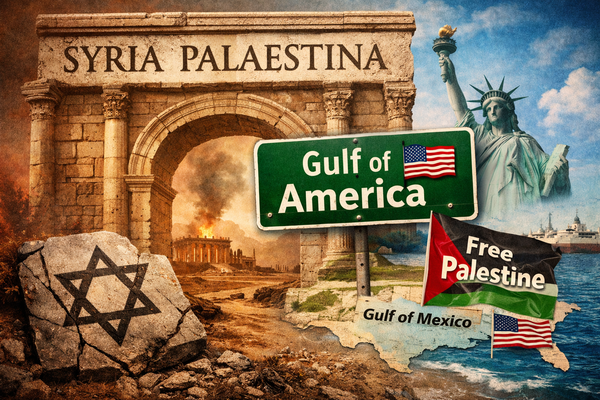
AI-generated Image
Let me take a guess.
You oppose the idea of renaming the Gulf of Mexico to the “Gulf of America.”
You see it as political, heavy-handed, and a superpower flexing its influence to reshape geography for its own purposes. And to be fair, there’s a reasonable argument there.
After all, the Gulf borders more Mexican coastline than American – roughly 49% compared to about 46% for the United States. The name “Gulf of Mexico” didn’t appear overnight. It reflects history, usage, and geography over time.
So the objection isn’t absurd. But here’s where things get… complicated.
Because many of the same voices rejecting that renaming are also the loudest in another arena – chanting “Free Palestine,” embracing the term as both identity and history, and in some cases going even further… questioning, or outright rejecting, the Jewish connection to the very land from which that name ultimately emerged.
And that’s where the inconsistency begins.
Nearly 2,000 years ago, the Roman Empire – arguably the dominant global power of its time – crushed a Jewish revolt in the land known as Judea.
Their response went beyond military victory. They renamed the region.
Judea became Syria Palaestina.
This was not a neutral administrative tweak. It was a calculated act, widely understood by historians as an attempt to sever the Jewish people from their land, even linguistically. The name itself drew from the Philistines, a long-extinct people, and was imposed by an empire seeking to make a statement:
You resisted, you lost, and your identity no longer defines this place. In other words, a superpower reshaped geography – not just physically, but symbolically.
Fast Forward to Today
Today, “Palestine” is used freely – often passionately – without acknowledgment of how that name came to be.
More strikingly, it’s sometimes paired with claims that the Jewish people are outsiders to the land… that their connection is secondary, recent, or even fabricated.
And yet, in the same breath, the idea of renaming a body of water – one that doesn’t even belong exclusively to a single nation – is condemned as offensive overreach.
So which is it? Is renaming geography an abuse of power? Or is it acceptable – so long as the name aligns with the narrative you prefer?
This Isn’t About the Gulf
To be clear, this isn’t really about whether the Gulf should be renamed. You can oppose that change and make a perfectly rational case for doing so.
The issue is consistency.
If the principle is that powerful nations shouldn’t impose names to assert dominance or rewrite identity, then that principle doesn’t begin in 2026. It stretches back, way back.
And it forces a more difficult acknowledgment: One of the most widely accepted geographic names in modern discourse: “Palestine”, originated from exactly that kind of imperial imposition.
Each name tells a story.
The question is not whether names change. They always have.
The question is whether we apply our principles consistently – or only when they align with our preferred narrative. Because if renaming geography by powerful nations is wrong today…
It was wrong 2,000 years ago too.
And recognizing that doesn’t settle modern political disputes. But it does demand something more uncomfortable: Intellectual consistency. And perhaps a little historical humility.
Some might argue that history is simple: To the victors go the spoils.
Rome conquered Judea. Rome renamed the land. History moved on.
If that’s the standard, then conquest determines legitimacy.
But that would raise another uncomfortable question. If victory confers the right to rename geography… What about 1948?
When Israel emerged after war and independence, was that not also a moment where history reset? Where names, borders, and identity reflected the outcome of conflict, just as they have throughout history?
On the other hand, if Rome’s renaming was arrogant, vindictive, and illegitimate…
Then perhaps the older names – Judea and Samaria – deserve renewed consideration.
Either way, the principle should not shift depending on who benefits. Because consistency isn’t just intellectually honest.
It’s historically honest… and in debates shaped by centuries of competing narratives, that may be the most difficult, but important, standard of all.
Related Topics
Related Posts