
Middle East Analyst
Out-Hawking the Hawk: Why the Israeli Opposition Has No Iran Strategy
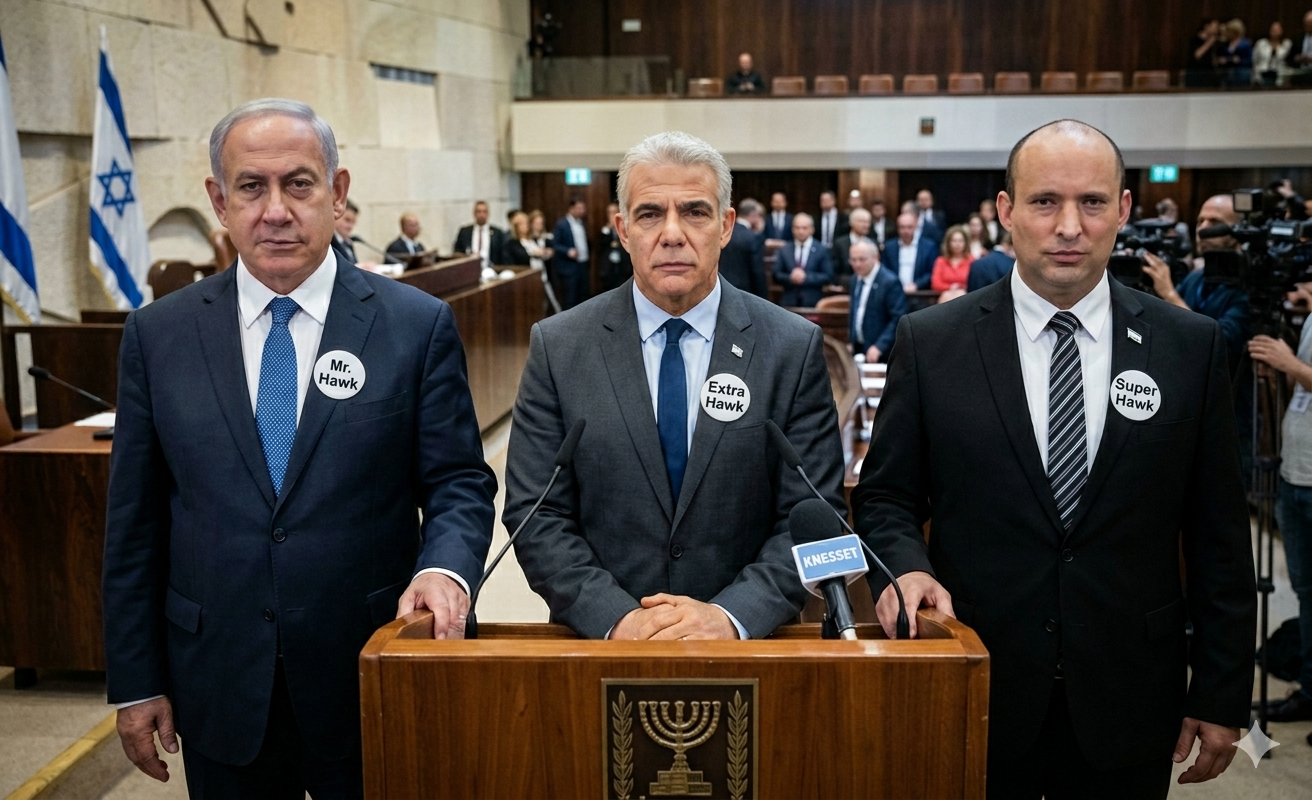
by author (AI)
The Familiar Political Temptation
Israel’s opposition is pursuing a familiar political strategy. Faced with an electorate shaped by the failures of October 7, the Gaza war, and the 2026 Iran War, it is attempting to position itself as tougher, more determined, and more strategically competent than the government it hopes to replace.
From a campaign perspective, the logic is obvious. Security dominates Israeli politics. Any opposition leader perceived as less aggressive than the incumbent risks being dismissed as weak before the debate even begins.
The problem is that hawkish rhetoric is not a strategy.
When Yair Lapid condemned the US-Iran ceasefire as a political disaster and Naftali Bennett argued that Israel failed to capitalize on historic opportunities created by the war, both were making a political argument. The implication was clear: a different government would have achieved more. What remains unclear is what that “more” actually looks like and how it would have been achieved.
That ambiguity is not accidental. It is the foundation of the opposition’s narrative.
The War Already Tested the Theory
The February 28 operation was, in many respects, the ultimate test of the assumptions now embedded in opposition rhetoric. The campaign achieved significant military successes. Senior Iranian leaders were killed. Strategic facilities were struck. Iran’s military and political leadership was severely disrupted. Most dramatically, the Supreme Leader himself was removed. Yet the political outcome that many advocates envisioned never materialized. The regime survived.
Within days, the system reconstituted itself. Mojtaba Khamenei emerged as Supreme Leader. President Pezeshkian stabilized the government and positioned Iran for negotiations. The Islamic Republic was battered but intact. This should force a reassessment of some of the assumptions now driving Israeli political debate.
If the combined military power of the United States and Israel could not produce regime collapse under these circumstances, what exactly is the opposition proposing to do differently? Thus far, no convincing answer has been offered.
The Assets That Do Not Exist
The opposition’s implicit promise is that greater determination would have produced a different outcome. The problem is that determination cannot substitute for missing strategic assets.
The first missing asset is American willingness to sustain a large-scale ground commitment in Iran. Whatever ambitions may have existed at the outset of the war, Washington ultimately sought an exit rather than an occupation. That was not simply a Trump decision. It reflected political realities that have existed since Iraq and Afghanistan. No plausible American administration appears willing to undertake the type of military commitment historically associated with successful externally imposed regime change.
The second missing asset is a credible indigenous partner capable of facilitating a transition. For years analysts pointed to Kurdish groups as a potential northern lever against Tehran. The difficulty is that repeated American abandonments of Kurdish partners have left a profound trust deficit. Building such a partnership would require years of political effort and credibility that currently does not exist.
Both problems are serious. Neither, however, is the most important obstacle.
The Gaza Problem
The most fundamental weakness in the opposition’s narrative is its assumption that widespread dissatisfaction with the Islamic Republic can be translated into support for regime change.
That assumption deserves scrutiny. Many Iranians dislike the regime. Many resent corruption, repression, economic decline, and international isolation. But disliking a government is not the same thing as trusting the alternative.
For years, advocates of regime change have tended to treat popular dissatisfaction as though it were a strategic asset waiting to be activated. The experience of Gaza suggests the issue is far more complicated.
Many Gazans opposed Hamas long before the war. Yet what followed the destruction of Hamas’s governing authority has not become a compelling advertisement for externally supported political transformation.
Across the region, populations watched Gaza endure devastation, starvation, displacement, appalling living conditions in rubble, and Israeli obstruction to reconstruction and Palestinian governance. They also watched Israeli officials openly discuss population relocation schemes involving destinations ranging from Somaliland to South Sudan. Whether such proposals were realistic is less important than the fact that they were publicly debated. Now Netanyahu is signaling the goal is simply reoccupation.
The lesson most regional audiences drew was not that Hamas deserved to survive. The lesson was that removing a hostile governing authority and producing an acceptable political order afterward are entirely different challenges.
That matters in Iran.
When opposition politicians speak as though regime change is a realistic objective, they implicitly assume that sufficient numbers of Iranians would be willing to take enormous risks in pursuit of that outcome. Yet those same Iranians can observe the only major contemporary example of an Israeli campaign aimed at removing a hostile governing authority and ask a simple question:
Are we the next Gaza? At present, no convincing answer exists.
A Narrative Without a Strategy
This does not mean the opposition’s criticism of Netanyahu is entirely wrong. There were legitimate questions about war aims, planning assumptions, maritime security, and the management of relations with Washington. The government made decisions that deserve scrutiny.
The problem is that the opposition’s alternative increasingly resembles a political narrative rather than a strategic framework. Its central claim is that a tougher, more competent government could have achieved objectives that the combined military power of the United States and Israel failed to achieve. Yet when examined closely, those objectives depend upon conditions that do not presently exist: American willingness to occupy Iran, trusted local partners, and a credible post-regime political vision capable of attracting popular support.
The opposition rarely discusses those requirements because discussing them would expose how difficult they are to create. Instead, it speaks the language of missed opportunities, unfinished missions, and strategic hesitation. That may be effective politics. It is not a strategy.
Conclusion
The Israeli opposition is caught in a trap of its own making. To challenge Netanyahu, it must imply that the war’s outcome reflected failures of leadership and execution rather than structural realities. But the more forcefully it makes that argument, the more it commits itself to outcomes for which no credible path currently exists.
The result is a political narrative built around a promise that cannot be clearly articulated and a strategy that cannot be clearly explained.
That may be enough to win votes. It is unlikely to be enough to change Iran.
Related Topics
Related Posts