Art as a Breath of Freedom
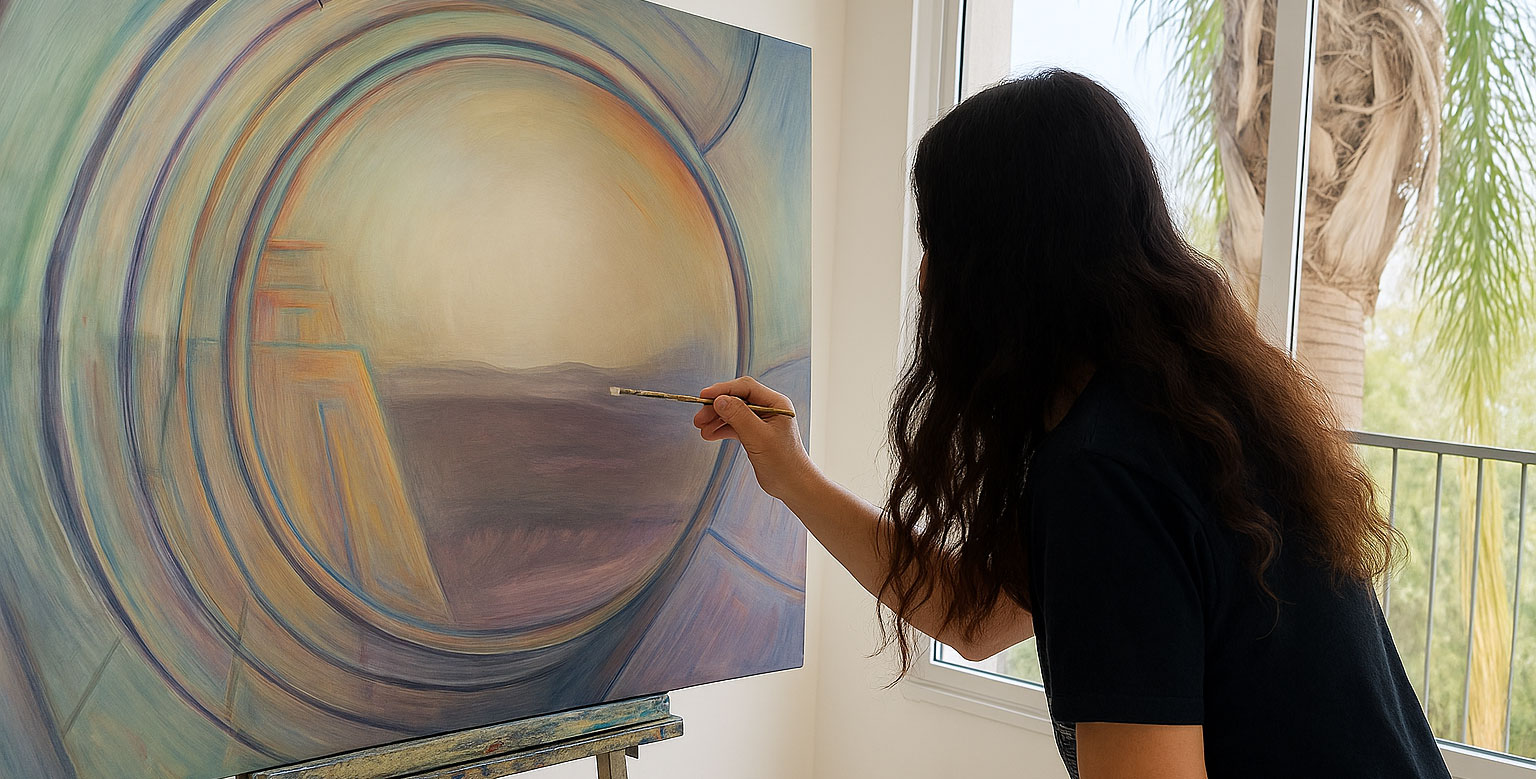
From my days as a Soviet underground artist to my new life in Israel, art has always been my breath of freedom — a way to turn silence into color and resistance into beauty.
For some, art is decoration. For others, it is therapy. For me, art has always been something deeper: a breath of freedom. From co-founding the underground art movement The Green Triangle in Soviet Kazakhstan to finding a second wind in Israel, painting has been my way of turning silence into color and resistance into beauty.
A Hippie with a Paintbrush
In the 1980s Soviet Union, conformity was the rule. But I looked and lived differently. I had long hair, ripped jeans, a sweater worn inside out, badges, and trinkets hanging from my clothes. I was a hippie in a place where hippies weren’t supposed to exist. For me, Love, Art, Music, Freedom wasn’t just a slogan — it was a way to breathe.
Together with other kindred spirits in Alma-Ata, I co-founded The Green Triangle. We were more than an art group; we were a declaration of independence from the grey culture around us. We painted, wrote poetry, listened to forbidden Western music, and lived as though another world was possible.
The Green Triangle and Perestroika
In the early years, we showcased our art in secret — in small apartments and backyards, hidden from the authorities. Every canvas was a quiet act of defiance.
However, during the years of Perestroika (1988–1991), a window of opportunity opened. Kazakhstan allowed slightly more space than Moscow, and private galleries began to appear. The Green Triangle seized the moment. For the first time, we exhibited our works publicly — bold abstractions, geometric forms, mysterious figures — everything that had been unthinkable in the years before.
Our group was also tied to activism. Kazakhstan carried the scars of the Semipalatinsk nuclear testing grounds, one of the most poisoned landscapes of the Soviet Union. Alongside our art, we joined anti-nuclear protests, demanding an end to destruction. To create was to breathe. To protest was to demand life. The two were inseparable.
A Second Wind in Israel
When I immigrated to Israel, I carried all that energy inside me. Here, I found a second wind. The fear and censorship of Soviet years were gone, and everything that had been suppressed poured outward — onto canvas in the form of abstract-impressionist paintings, and onto paper in my intricate line art drawings.
Israel reshaped my palette. The desert light, the Mediterranean sky, and the tension between old and new all found their way into my work. Yet the underground discipline of my Soviet years never left me. I still balance opposites: geometry and spontaneity, silence and music, hidden witnesses and radiant light.
Conclusion: The Breath of Freedom
For me, art was never simply craft — it has always been a breath of freedom. In the Soviet Union, painting meant inhaling that freedom in secret. During Perestroika, it meant exhaling it publicly for the first time. In Israel, it has become a continuous rhythm: inhale, exhale, create.
My journey has taught me that art is not only about beauty, but about liberation — the right to express, to dream, to resist silence.
And so I leave you with a question: where do you find your own breath of freedom today?