
From Kibbutz to the global stage
Artemis, new ISS, and 3I-ATLAS: Preparing Humanity for the Next Cosmic Shock
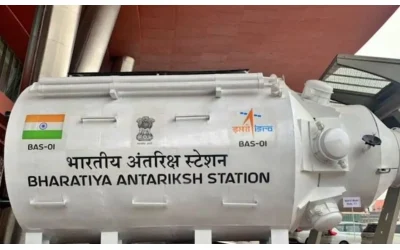
Artemis, new ISS, and 3I-ATLAS: Preparing Humanity for the Next Cosmic Shock, and why Space Stations, the Moon, and 3I/ATLAS Belong in the Same Conversation.
Sixty-six million years ago, an asteroid impact on Earth led to the extinction of the dinosaurs and caused severe damage to life across the planet. It is reasonable to assume that had Homo sapiens existed at the time, our species might not have survived that cosmic event either.
When physicist Stephen Hawking was asked about contact with extraterrestrial civilizations, he issued a stark warning. Advanced civilizations, he suggested, might be societies that were expelled from their original habitats and are now searching for a new “anchoring point” — for natural reasons or otherwise. Hawking compared such encounters to Columbus’s arrival in the Americas, cautioning that contact could pose an existential threat. Silence, he argued, may at times be a survival strategy — perhaps one explanation for the apparent quiet of the universe.
This week, Tel Aviv University hosted the Ilan Ramon International Space Conference, where discussions focused on next-generation space stations, lunar landings, and the construction of a permanent surface station on the Moon. Senior figures from leading commercial space companies — including Vast, Axiom Space, and Voyager Technologies — participated alongside representatives from space agencies, academia, and industry. The discussions addressed the future of exploration, innovation, and human presence in space, as well as Israel’s role as an active and influential player in the global arena. One notable absence was Blue Origin, which is also competing in the race to succeed the International Space Station.
The formal discussions focused largely on operational aspects and NASA’s upcoming decision on which companies will lead the next phase. Yet hovering over the global debate is the elephant in the room — a subject that went largely unmentioned at the conference:the interstellar object known as 3I/ATLAS, discovered roughly seven months ago.
Comets and asteroids constantly pass through the solar system, but until recently we lacked the technological capability to detect small, fast-moving objects traveling at tens of kilometers per second. That has now changed. The Vera C. Rubin Observatory in Chile, advanced space telescopes such as the James Webb Space Telescope, and a growing fleet of spacecraft operating around Mars, Jupiter, and beyond enable us to detect and track objects entering the solar system from interstellar space.
The implication is clear: over the coming decade, we are likely to detect many more “Atlases.” These discoveries will force scientists, policymakers, and the public to rethink what is happening beyond our planetary neighborhood — and, more importantly, how humanity can ensure its long-term survival in a volatile and dynamic cosmic environment.
A central question inevitably arises: is humanity’s survival dependent on finding and settling an Earth-like planet? In theory, such a planet may exist. In practice, discovering one could take centuries or millennia, and reaching it far longer still. This makes planetary relocation an unrealistic response to near-term cosmic threats. Moreover, even if we detect fast-moving hazardous objects entering the solar system, their immense velocities may leave us with little or no ability to intercept them.
The logical conclusion is that alongside improving detection systems, developing advanced planetary-defense capabilities, and strengthening global cooperation, humanity must also adopt a broader framework for temporary survival — a strategy of “riding out the storm.”
Crucially, many of the technologies required for such a framework already exist in operational form. With additional research, development, and sustained investment, they could provide an added layer of resilience for life on Earth.
This survival envelope would rest on four core components:
-The establishment of permanent lunar surface stations, as a natural continuation of NASA’s Artemis program.
-The deployment of small, large, and modular space stations, similar to those proposed by companies competing in NASA’s post-ISS program.
-The creation of mobile logistical storage hubs supplying oxygen, nitrogen, water, food, and essential materials, operating in low Earth orbit to support extended station endurance.
-The establishment of parallel logistical storage facilities on the Moon itself.
Such an integrated system could allow humanity to endure a prolonged cosmic disruption lasting years — or longer — and to survive periods of extreme instability. If we invest in this resilience architecture in time, we may be able to provide a practical, near-term response to an extinction-level event comparable to the one that ended the age of the dinosaurs — or to a scenario in which an interstellar object like one of the future “Atlases” collides with Earth, by accident or otherwise.
Related Topics
Related Posts