
Founder & Principal, Line of State
Article 5 Has a Map. Turkey Does Not Get to Redraw It.
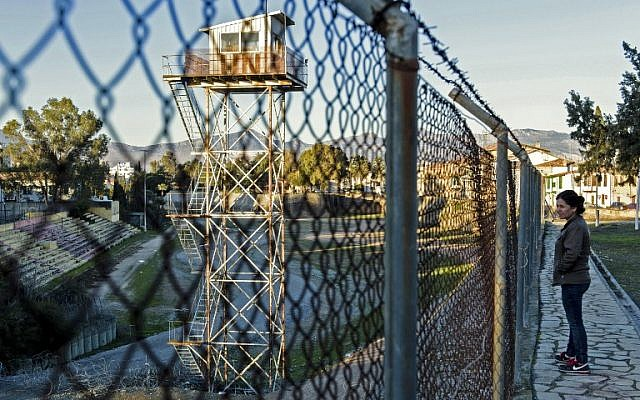
A woman walks along the Turkish side of Nicosia’s Green Line, the UN controlled buffer zone dividing the Cypriot capital, January 13, 2017. A ceasefire can freeze a map. It cannot rewrite sovereignty - or decide which treaty governs the next crisis. (AFP/Iakovos Hatzistavrou)
An Israel–Turkey clash would be extraordinarily costly to both. But the decisive variables are not platform counts: who is attacked, where, which legal basis is activated, and who is obliged – or chooses – to enter. Cyprus sits at the centre of that equation.
Escalation in the Eastern Mediterranean is no longer a purely theoretical possibility. This does not mean that war is inevitable. It does, however, mean that deterrence requires preparation, and that Greece, Cyprus and Israel are already adapting their strategies to an environment of heightened risk.
The presence of Greek F-16s and a Greek frigate in Cyprus, operations by Greek aircraft from Cyprus under bilateral defense agreements, and the visit to Cyprus by the Chief of the Hellenic National Defense General Staff, Greece’s senior military officer, following his contacts in Israel, do not in themselves indicate that war is imminent.
They do, however, indicate that Athens is taking seriously a possibility that, until recently, could more readily have been treated as theoretical.
The region is more tense today than it was a year ago. In such circumstances, a serious incident may not remain contained. The risk of escalation into a broader military crisis is greater.
At its core lies the Turkish military presence in occupied northern Cyprus.
Turkey has maintained substantial military forces and infrastructure in the northern part of the island for 52 years. That presence is one of the givens of Cypriot security and, at the same time, a factor that cannot be ignored in any future planning.
The critical question is what would happen if, amid a dramatic shift in the regional balance, Ankara decided to use that military presence against Israel, the Republic of Cyprus or Greece.
A potential Israel–Turkey confrontation would not unfold in a geopolitical vacuum. Greece is adjacent to the theatre of operations, has close defence ties with Israel and, at the same time, constitutes the other principal pole of the Greek–Turkish confrontation.
From Greece’s perspective, therefore, the crisis cannot be treated as a matter concerning Ankara and Jerusalem alone. A serious Turkish military move in the region could directly affect Greek security.
At this point, a myth that resurfaces whenever Greece and Turkey are in tension must be dispelled. The fact that both countries are NATO members does not mean that every Turkish military action would automatically enjoy Alliance protection.
Article 4 provides for consultations among the Allies when a member considers itself threatened. It does not entail automatic military intervention.
Article 5 is different. It concerns the principle of collective defence in the event of an armed attack against a member state. Even then, however, it does not mean that every NATO member automatically enters a war. The Alliance takes a political decision, and each country determines the form of its contribution.
Geography is also critical. Article 6 defines the geographical scope of collective defence. Put simply, the presence of Turkish troops in Syria, in occupied northern Cyprus or in Somalia does not turn those areas into NATO territory.
The same applies to the Turkish–Libyan memorandum. It confers no independent right on Turkey to invoke the Alliance’s collective defence.
For Greece, this is particularly important. No automatic mechanism would compel Athens to join a regional war precipitated by Turkey.
For Cyprus, there is a different and particularly important instrument: Article 42(7) of the Treaty on European Union, the EU’s mutual assistance clause.
The Republic of Cyprus is an EU member state, and under EU law the entire island is regarded as territory of the Republic. In the areas where the Republic does not exercise effective control, the EU acquis — the body of EU law — is suspended.
The European mutual assistance clause provides that, if a member state is the victim of armed aggression on its territory, the other member states are obliged to provide it with aid and assistance using the means at their disposal.
That obligation derives from the European treaties, not from a country’s membership of the North Atlantic Alliance.
If, therefore, the Republic of Cyprus or Greece were subjected to an armed attack on their territory and invoked this provision, the issue would automatically acquire a European dimension. That would significantly alter the strategic environment.
A Crisis in Cyprus Would Not Stay in Cyprus
A serious military conflict in Cyprus would not simply constitute another episode in the history of the Cyprus problem. It could become a crisis of far greater dimensions, involving Israel, Greece and the Republic of Cyprus directly or indirectly and, depending on developments, European and NATO institutions.
In a hypothetical scenario such as the one described as “Poseidon’s Wrath”, Greece, the Republic of Cyprus and Israel could find themselves engaged in varying degrees of military coordination.
If Turkey simultaneously extended its military action onto Greek or Cypriot territory, the crisis would also acquire a European dimension.
Ankara would then face not merely a bilateral confrontation with Athens or Nicosia, but a far broader political and legal environment.
This does not mean that the European Union would automatically become an alliance at war. It means that the cost of military escalation would become far greater and far more complex.
In an extreme scenario, the objective could not simply be another ceasefire that left the existing situation in Cyprus essentially untouched.
If the conflict reached the point of military confrontation around Cyprus, the question of the day after would inevitably arise, and the ultimate objective should be the restoration of the sovereignty of the Republic of Cyprus over the entire island.
That, however, is very different from crisis management.
Crisis management seeks to stop hostilities.
Changing the status quo seeks to change the very reality that created the crisis. The latter is infinitely harder and more dangerous.
Israel Can Strike Turkey. The Question Is Whether It Will.
A direct conflict between Israel and Turkey would be extraordinarily costly to both sides. It would, however, be a mistake to assume that Israel lacks the operational capability to engage targets far from its own territory.
The recent experience of operations against Iran demonstrated that Israel can conduct sustained long-range operations and maintain operational continuity even under conditions of intense hostile pressure.
The real question, therefore, is not whether Israel can strike Turkish targets, but whether it would decide to do so. And that is primarily a political and legal question.
Who would have started the conflict? Which territory would have been attacked? What would be the position of Greece and Cyprus? How would Washington respond? How would NATO position itself? And how far would Europe’s mutual assistance obligation extend?
Those are the questions that would determine the course of a crisis far more than a simple comparison of numbers and weapons systems.
The conclusion is that the Eastern Mediterranean has entered a period in which a serious incident can have consequences far greater than in the past.
For Greece, the critical question is not merely how many aircraft Turkey possesses or how many capabilities Israel has.
It is who would be regarded as having been attacked, on what territory the attack occurs, which legal basis is activated, and which allies would be obliged – or choose – to become involved.
That is the real strategic game, and Cyprus stands at its centre. Greece therefore cannot assume that a potential conflict between Turkey and Israel would necessarily remain between those two countries.
The history of the Eastern Mediterranean has shown that crises rarely unfold exactly as planned. That is why deterrence does not begin when the first bomb falls.
It begins much earlier – with preparation, alliances, clear red lines and, above all, an adversary convinced that the cost of attack will exceed any possible gain.
–
This article was first published in Greek by Reporter.gr on 28 August 2026 under the title «Η Κύπρος στο επίκεντρο μιας νέας στρατηγικής κρίσης» (“Cyprus at the Centre of a New Strategic Crisis”). This is the author’s full English version.
–
Related by the same author:
- “Northern Cyprus Is Also an Israeli Problem”, Israel Hayom, July 29, 2025.
- “For Turkey, Article 5 Is Dead”, Kathimerini, September 29, 2025.
- “Operational Unbundling: How Regional Agreements Are Dismantling the Logic of Occupation”, SigmaLive English, January 5, 2026.
- “The Fourth Power Doctrine: France Completes the Eastern Mediterranean Centre. Poseidon’s Wrath Enters Ankara’s War Calculus”, RIEAS, July 18, 2026.
- “Turkey’s Next War Could Undo 1974”, The Times of Israel, August 22, 2026.
Related Topics