
The views expressed herein are solely mine.
How El-Sayed Normalizes Erasing Israel’s Character
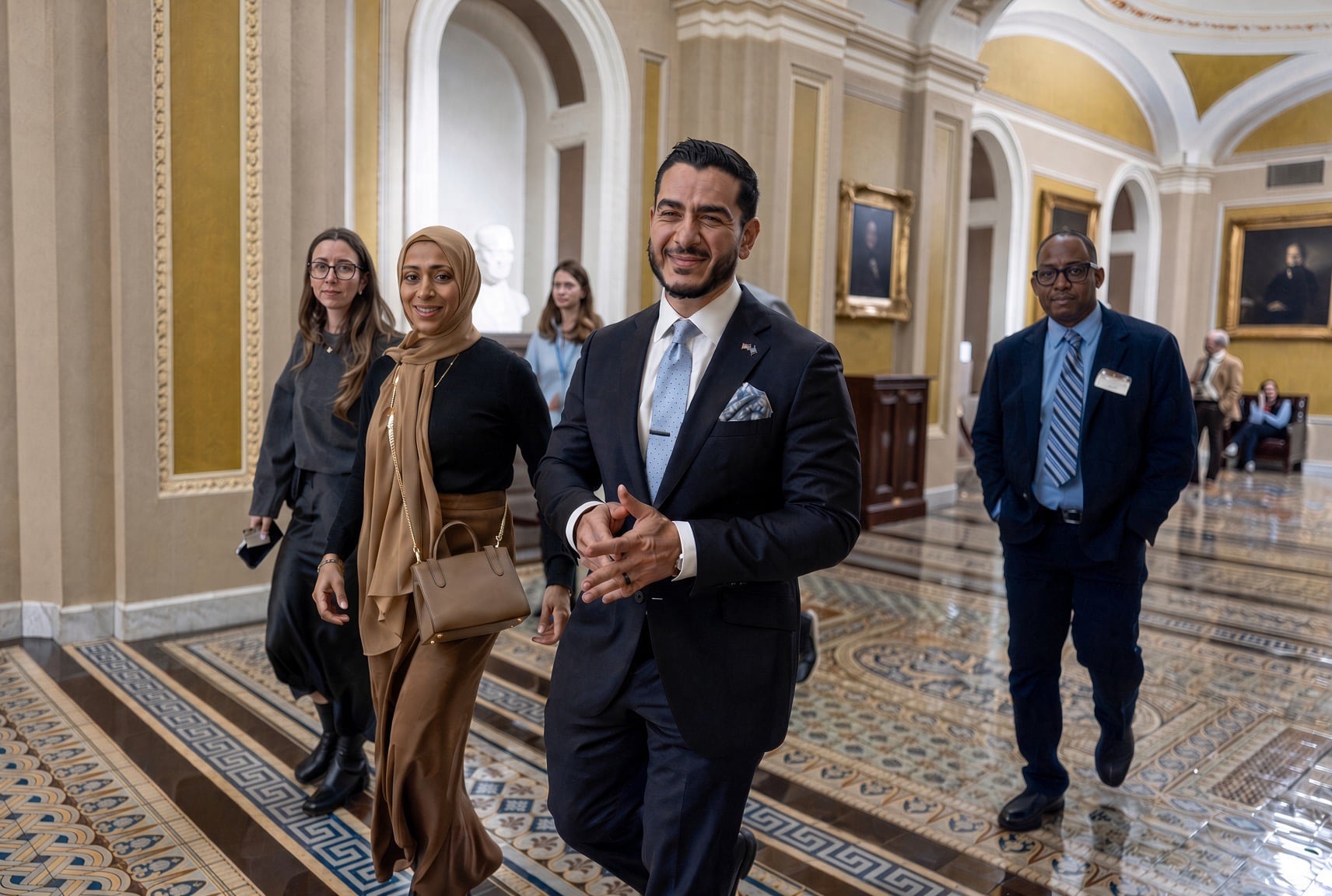
Sen.-elect Abdul El-Sayed, Democrst of Michigan, and his wife Sarah Jukaku, left, walk to a gathering at the Capitol as Congress returns to work following the sweeping victory by Democrats in the midterm elections, at the Capitol in Washington, November 9, 2026. (AP Photo/J. Scott Applewhite).
Senator-elect Abdul El-Sayed of Michigan, the first Muslim elected to the U.S. Senate, has begun defining Israel as “a country that must abandon any identification with Jewish culture or faith” and instead “rest on equal citizenship alone.” Notably, El-Sayed never levels that demand at the world’s 53 Muslim-majority countries—or the 22 member states of the Arab League—reserving the erasure of national-religious identity exclusively for the sole Jewish state. In a November 2026 Atlantic Summit interview, he stated that Israel “ought to be a country that upholds equal rights for all of its citizens, does not identify itself with a culture or a faith.” Refusing to endorse a two-state outcome, he declared himself open to one state, two states, or “25 states,” provided only that Palestinians and Jewish Israelis negotiate on “equal footing.” That formulation aims to translate the hollow “From the River to the Sea” chants of American leftist radicals and demonize the Jewish national character of the State of Israel. Worse, El-Sayed’s November victory removes the electoral restraint that once moderated such rhetoric, giving it a Senate platform from which to harden into the Democratic Party’s post-October 7 orthodoxy.
Western institutions compressed three successive charges against Israel in just thirty-six months. First, Amnesty International’s February 2022 report labeled Israel as an “apartheid state”; after the October 7, 2023 butchery that killed 1,200 Israelis, those same institutional and academic networks rebranded it as a “genocidal state.” Polling followed suit. Early 2026 Gallup data showed American sympathy for Palestinians at 41 percent versus 36 percent for Israelis—the first Palestinian numerical edge in a quarter-century—while NBC and Gallup placed Democratic sympathy for Palestinians between 65 and 67 percent, versus just the mid-teens for Israelis. El-Sayed’s binational framing arrives as the logical next step already visible in progressive caucus statements and campus resolutions that treat Israel’s Jewish character as an open question rather than a settled fact of self-determination. Left-leaning academia already adopts this framing because it lets professors and administrators openly attack the Jewish state without triggering the “racist” or “antisemitic” labels that still carry residual cost. With European surveys registering similar declines in support for Israel’s national character, the concept now spreads across transatlantic campuses and media as a “fresh” alternative to the exhausted two-state formula.
Beneath this rhetoric lies a structural irony that unites progressive anti-Zionists, Islamists, and the extreme right around the denial of legitimate Jewish sovereignty. Islamist organizations and parties that have long rejected any Jewish statehood now pivot to the exact same one-state formula, ironically seeking the demographic erasure of Israel that extreme-right Israeli nationalists seek in reverse. Hamas and allied movements have never accepted a Jewish state; the post-October 7 rhetorical shift simply supplies them with palatable Western vocabulary. Simultaneously, the extreme right advances parallel historical distortions to argue against Israel’s existence—claiming, for example, that Jews already possess a homeland in Russia’s Jewish Autonomous Oblast. As usual, they omit that Joseph Stalin established that remote Siberian territory along the Chinese and Mongolian borders in 1928 specifically to clear minorities out of major Soviet cities and corral them into isolated ethnic regions under Kremlin control. Equally false is the extreme-right trope that Nazi Germany benevolently helped Jews relocate their wealth to the Land of Israel before the Holocaust. Germany never controlled Mandate Palestine; rather, the 1933 Haavara Agreement was a desperate rescue mechanism negotiated by Zionist leaders that forced fleeing German Jews to forfeit steep exit taxes and liquidate their savings into exported German goods just to salvage a fraction of their property from Nazi confiscation.
Concurrently, demographic shifts are reshaping the domestic politics behind these narratives. Muslim population concentrations continue to expand in the very states yielding progressive foreign-policy voices. The 2020 U.S. Religion Census recorded roughly 242,000 Muslims in Michigan, 115,000 in Minnesota, 313,000 in Texas, 127,000 in Florida, and 724,000 in New York—figures that understate subsequent growth in Dearborn, Minneapolis, and major New York and Texas metros. El-Sayed’s victory proves that a candidate who treats Israel as “not an ally,” accuses it of genocide, and questions its Jewish character can win a competitive statewide race.
Bizarrely, 50% of Michigan Jews support El-Sayed, repeating an exact and unsparing historical parallel. In 1921, Berlin lawyer and World War I veteran Max Naumann founded the Association of German National Jews (Verband nationaldeutscher Juden). Naumann and his several thousand members—many of them decorated officers and assimilated professionals—insisted that absolute German loyalty and the rejection of Zionism would protect them. They greeted Hitler’s January 1933 appointment as chancellor and, as late as 1935, sent congratulatory messages even as the regime stripped away Jewish rights. That November, the Nazis banned the organization and arrested Naumann, forcing its members to discover that the loyalty test had never been genuinely available. Contemporary Jewish support for El-Sayed’s vision repeats that identical calculation: the belief that public distance from Jewish sovereignty will purchase safety. Just as it failed in Germany, nothing in the present record of Islamist political growth or progressive rhetoric indicates a different outcome.
Interrupting this trajectory requires two concrete measures. First, the United States Congress should enact a National Continuity Recognition Act that conditions all U.S. security assistance and diplomatic engagement on explicit partner recognition that the Jewish people have the exact same right to a sovereign national homeland granted to the French, Japanese, Armenians, and dozens of other peoples. Under the statute, proposals for a binational or one-state dissolution of Israel must trigger an automatic review of aid and alliance status, functionally equivalent to calling for the dissolution of any other UN member state. By resting on established reciprocity principles, the law forces academic and political advocates to defend why they single out only the Jewish state for erasure, disqualifies federally funded programs that present dissolution frameworks as legitimate alternatives, and creates a standing judicial review mechanism for violations of national continuity.
Second, the executive branch and congressional committees should launch a Civic Resilience Pact partnering the United States Department of State, the National Endowment for Democracy, and private foundations with American and European Jewish groups, Arab liberal networks, and ex-Muslim intellectuals. The initiative would fund data-driven counter-programming—from historical studies of one-state collapses in Lebanon, Yugoslavia, and Syria to quantitative tracking of Islamist political networks in key swing and metro states—to preempt the binational narrative before it consolidates. Its statutory authorization should also require annual public disclosure of foreign funding behind campus and nonprofit dissolution advocacy, while freezing or redirecting U.S. funds away from foreign entities that endorse erasing Israel’s national character and into local civic education.
Waking up now matters because the rhetorical compression from apartheid to genocide to dissolution took place only within three years. Any further delay allows El-Sayed’s formulation to harden into Democratic orthodoxy, after which reversal becomes exponentially harder. The Naumann precedent proves that loyalty rituals and self-erasure never purchase safety; they only accelerate the moment of reckoning when the other side reveals it never accepted the bargain. Ultimately, Israel’s Jewish national reality either remains a settled pillar of American foreign policy or it does not—and the choice is still pending.
Related Topics
- American Jewry
- Anti-Zionism
- Antisemitism
- Antizionism
- Ashkenazic Jews
- Europe
- European Jewry
- Germany
- Great Britain
- Hamas
- Islam
- Israel: Jewish and Democratic
- Jewish Assimilation
- Jewish history
- Jewish-Muslim Relations
- Middle East
- October 7 anniversary
- Palestinian Statehood
- Palestinians
- Russia
- Soviet Jewry
- The Arab World
- US Midterm Elections
- US Politics
- Zionism
Related Posts