


From Kibbutz to the global stage
Artificial Island off Gaza Could Rebuild the Strip’s Economy
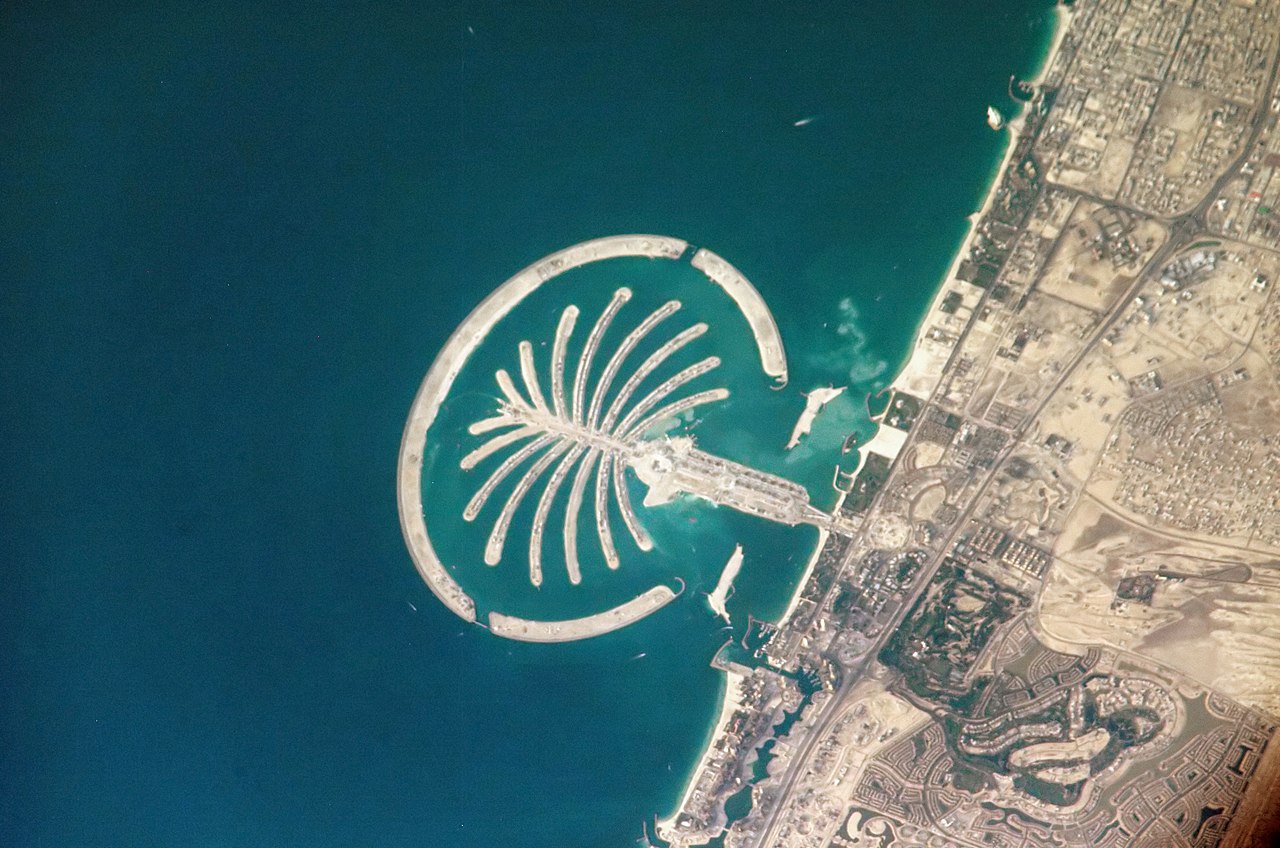
Image: Palm Jumeirah, Dubai — Commander Leroy Chiao, public domain
Artificial Island off Gaza Could Rebuild the Strip’s Economy
As Israel, its neighbors, and international donors discuss long-term solutions for Gaza’s reconstruction, one visionary idea is resurfacing — the creation of an artificial island off Gaza’s coast.
The proposal to build an artificial island off the coast of Gaza could provide a practical solution for recycling tens of millions of tons of rubble accumulated during two years of war—while creating new space for infrastructure, housing, and economic growth.
A 35-square-kilometer island would expand Gaza’s territory by about 10 percent, and its central location would ensure accessibility for residents and businesses alike.
This concept is not entirely new: between 2017 and 2018, then-Minister of Transportation Israel Katz (today Israel’s Minister of Defense) promoted a plan he called “Separation Island”—a name chosen to emphasize Israel’s desire for a physical and political separation from Gaza.
At the time, Prime Minister Benjamin Netanyahu did not advance the idea, despite Katz’s pressure. Discussions took place in 2018 but never progressed beyond the conceptual stage.
As Minister for Regional Cooperation, Tzachi Hanegbi told Ynet (Feb 5, 2018):
“We are waiting to see whether the international community is willing to fund it. Donor states have urged Mahmoud Abbas to take responsibility for Gaza’s reconstruction rather than fight Hamas over every minor issue.”
Hanegbi also warned that “the longer the situation persists, the more complex the challenges—especially in energy, employment, and health infrastructure—and the higher the risk of escalation.”
He further noted that most of the funds transferred from Qatar to Hamas had been invested in military buildup, weapons production, and training, rather than in reconstruction.
Interestingly, after Hanegbi was appointed National Security Adviser in November 2022, one might wonder whether the same intelligence he shared in 2018 was already known to the prime minister and cabinet. If not, this raises further questions about the chain of responsibility—a matter that strengthens the case for a state inquiry into the October 7, 2023 events.
Why the Previous Plan Failed
Experts who reviewed Katz’s proposal pointed to serious economic and physical feasibility concerns, as well as high engineering risks.
The idea included building a deep-water port for large container ships—despite little need for such capacity compared with nearby ports. The proposed site, 4.5 km offshore and in over 30 meters of water, was justified as a “security measure” that would allow Israel to cut the island off from Gaza if necessary.
However, this depth would require massive land reclamation, dramatically increasing costs and project duration. It also remained unclear where the necessary fill material would come from.
A 4.5-km access bridge would further complicate logistics, increase costs, and reduce safety.
Katz’s original cost estimate of $5 billion was widely dismissed as unrealistic, given the engineering complexity and physical risks involved.
A Different Context Today
In contrast, the current situation in Gaza—with tens of millions of tons of debris and an urgent need for reconstruction—may justify revisiting the island concept from a sustainability and economic recovery perspective.
The project could serve as both a debris management solution and a multi-purpose development platform, boosting the devastated local economy and easing Gaza’s extreme population density.
Engineering, Environmental, and Regional Considerations
Any such initiative would require comprehensive feasibility studies, assessing impacts on geology, coastal morphology, and regional demography, as well as maintenance challenges to prevent erosion and subsidence.
Global experience—especially from the United Arab Emirates’ “Palm Islands” project in Dubai—offers valuable lessons.
The Palm Islands project, designed under the vision of Sheikh Mohammed bin Rashid Al Maktoum, sought to extend Dubai’s coastline and promote tourism through the creation of three artificial islands: Palm Jumeirah, Palm Jebel Ali, and Deira Islands.
Only Palm Jumeirah was completed—a 17-frond island with luxury residences, hotels, and attractions such as the Atlantis Hotel and water park. It is connected to the mainland via road and monorail.
While Dubai’s islands became an iconic success story, urban planners and environmental experts from the organization City Beautiful highlight important cautionary lessons.
Land reclamation can destroy natural coastal ecosystems, increasing vulnerability to flooding and coastal retreat. In response, some newer projects have been built at higher elevations—but studies show this can shift flood risks to other low-lying areas.
Even more critically, artificial land often subsides over time. For example, Incheon Airport in South Korea sinks by about 25 cm per year, while Shanghai’s Pudong Airport sinks at about 10 cm per year. Constant infill operations are required to maintain stability, creating huge economic and environmental costs.
As a result, some countries—such as China—have restricted artificial land expansion and banned sand exports to Singapore, after several small Asian islands literally disappeared from the map due to over-extraction.
Conclusion
An artificial island off Gaza would be a bold, ambitious, and complex project. Its potential contribution to Gaza’s reconstruction and regional stability is clear, but success would require expert planning, international cooperation, ongoing maintenance, and sustainable funding.
If executed wisely—with lessons drawn from global experience—it could transform destruction into renewal and serve as a regional model for post-conflict recovery.
Image: Palm Jumeirah, Dubai — Commander Leroy Chiao, public domain
About the Author
Rafi Glick is a writer, lecturer, farmer, and business executive with decades of experience at the intersection of academia, technology, agriculture, and international trade.
• He has served as a Senior Teaching Associate at Ben-Gurion University of the Negev, Ono Academic College, Ariel University, Ruppin Academic Center, and as a guest lecturer at Sofia University’s Faculty of Economics and Business Administration (FEBA). At Ben-Gurion University he also advised the BGU–NHSA Accelerator in the Faculty of Science.
• In business, Rafi was CEO of Bidsnet Ltd., a pioneer in deploying fiber-optic cables through unconventional infrastructure (in partnership with CableRunner), delivering high-speed connectivity to homes, enterprises, institutions, and cellular networks. Earlier he held senior roles at ECI Telecom and served on the board of RLF Venture Capital, working with partners such as Intel, Teva, and the Jerusalem Development Authority.
• He contributed extensively to Israel’s trade and investment ecosystem: he directed industrial and agricultural technology divisions at the Israel Export Institute, founded Israel’s AGRITECH as international exhibition, and served on the board of the Israeli Investment Center at the Ministry of Industry and Trade.
• In his early career, Rafi established and served as the first director of the Cargo and Aircraft Supply Security Department in the Security Division at Ben-Gurion Airport (1972–1976). He lived in Kibbutz Parod until 1974.
• Rafi has also been recognized for his writing: in 2008 he was named Best Economic Blogger by TheMarker, Israel’s leading business daily.
• Today he continues to publish essays and commentary—with a special passion for astrophysics, space exploration, technology, economics, and social issues.
From Kibbutz Parod to the global stage, Rafi Glick’s career reflects a lifelong commitment to building connections—between people, industries, and ideas.
Email: rafi.glick@gmail.com
Related Topics
Related Posts


Rafi Glick