Published author, Jewish educator and scholar
‘As a Jew…’: What Jews Today Can Learn from Moses
ChatGPT
It is very rare for Jews today to begin a sentence with the phrase, “As a Jew…” when defending Jewish self-defense, expressing solidarity with Israel, or advocating for Jews under threat. Instead, the phrase is typically employed in situations where their Jewish identity is invoked to stake out a moral position in contested spaces. This is especially true in discussions surrounding Israel, Gaza, or the Palestinians. In such contexts, “As a Jew…” often functions as a preemptive disclaimer: a way to signal distance from mainstream Jewish or Israeli perspectives, and to claim special moral authority when critiquing Jewish power.
Commonly, the phrasing takes forms like: “As a Jew, I believe Israel is…” or “As a Jew, I cannot support Zionism…” Here, Jewish identity is not expressed as solidarity or belonging, but as the foundation for a privileged ethical stance. Implicitly, it says: “I am a safe Jew; you may trust my critique; my Jewishness should reassure you.” This pattern is particularly prevalent on university campuses, in op-eds, on social media, and within activist circles. Often, it signals that the speaker believes their Jewish identity obliges them to reject claims such as Jewish peoplehood, land, or sovereignty, and that Zionism is inconsistent with Jewish ethics and history.
Those who speak this way are typically secular or culturally Jewish diaspora Jews, highly educated, familiar with progressive discourse, and often embedded in academic, media, or NGO networks where moral authority is prized. They tend toward universalist ethics over communal loyalty, frequently left-leaning or progressive in outlook.
This stands in sharp contrast to Moses, as described in this week’s parasha.
Moses was raised in Pharaoh’s household, likely as a prince. He would have been educated in Egyptian language, religion, customs, and political norms. He enjoyed the privileges of elite life: wealth, status, comfort, and access to power. Socially and culturally, he was fully integrated into Egyptian royal society, seeing the world through the lens of hierarchy, authority, and the values of the ruling class.
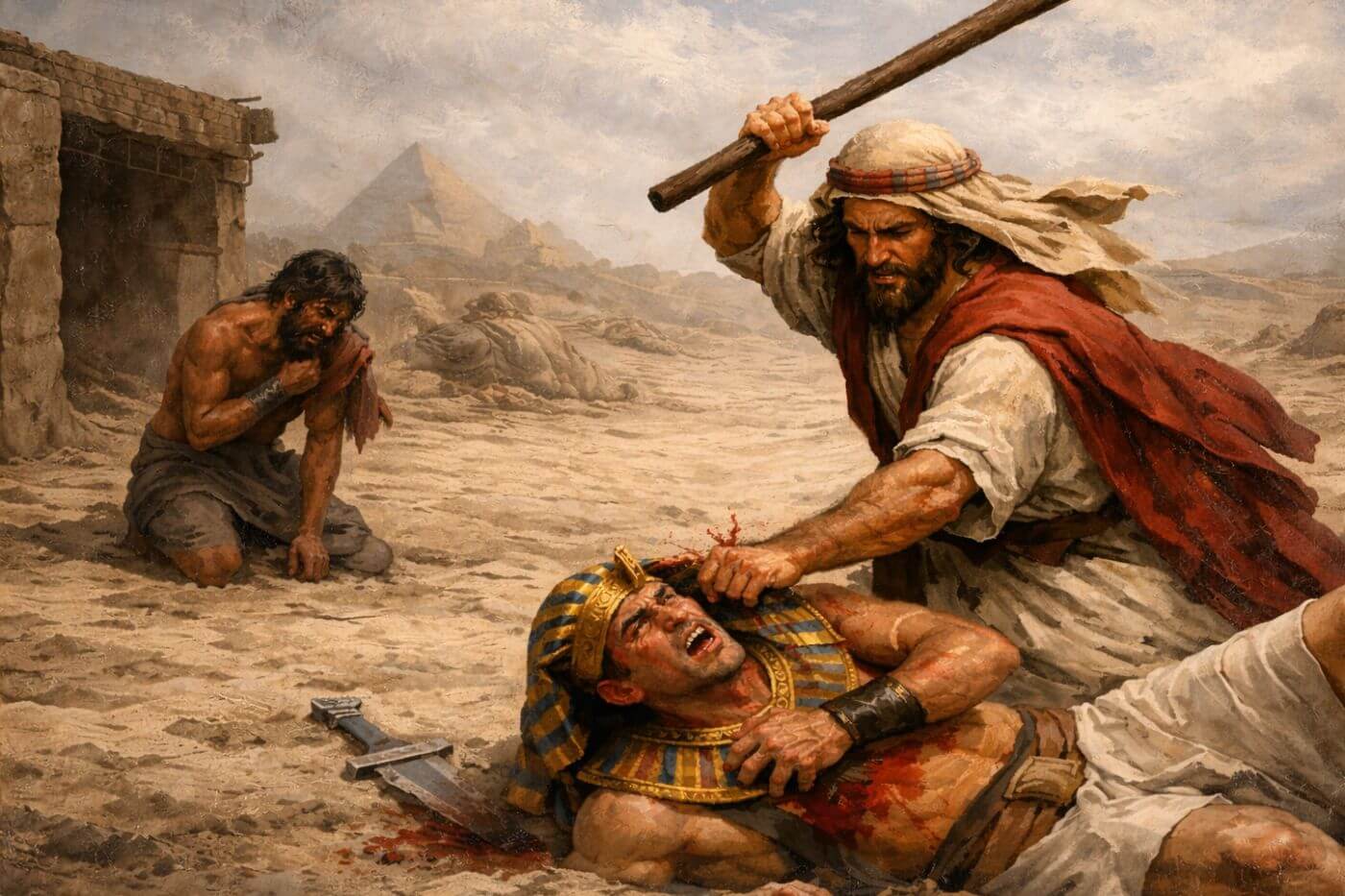
Yet, the Torah tells us that as a young adult, Moses “went out to his kinsfolk and saw their suffering” (Exod. 2:11). The phrase “went out” suggests he left the safety, comfort, and privilege of Pharaoh’s house. More importantly, he went to his kinsfolk—to his people—showing that his Jewish identity was not abstract but familial, collective, and embodied. The Torah emphasizes that he saw their suffering, bearing their pain as his own. Only after this identification does the Torah recount: “He struck down the Egyptian.” Moses’ intervention was on behalf of his people, against the oppressor, at personal risk, without pretense or detachment.
Notice what Moses does not say:
- “As a Hebrew raised among Egyptians, I must critique Hebrew violence.”
- “As a moral universalist, I reject tribal loyalties.”
- “As someone with access to power, I must distance myself from my people.”
Instead, Moses does the opposite. He claims his people first, and from that rooted loyalty, acts morally in the world. Unlike the modern usage of “As a Jew…” as a shield for moral authority while remaining detached from the Jewish community, Moses’ ethic flowed from deep connection: loyalty enabled action, and particular commitment enabled universal morality.
In short, Moses teaches that ethical universality does not emerge from detachment—it emerges from dedication to one’s people. Commitment to one’s community does not contradict universal morality; it often makes it possible.
For Jews today, the greatest teacher of Jewish ethics, Moshe Rabbeinu—Moses our Teacher—remains a model. His life reminds us that to be moral, one must first belong.
Shabbat Shalom.
________________________________________
For more articles on the parasha and current events, or to sign up for my newsletter, visit my website: https://davidharbater.com/
Follow me on Facebook: https://www.facebook.com/Rabbi.Dr.David.Harbater
Visit my YouTube channel: https://www.youtube.com/@rabbidrdavidharbater
To invite me to speak at your synagogue or community: davidharbater.com/contact
Related Topics
Related Posts