
As Long as There Is Another Inning
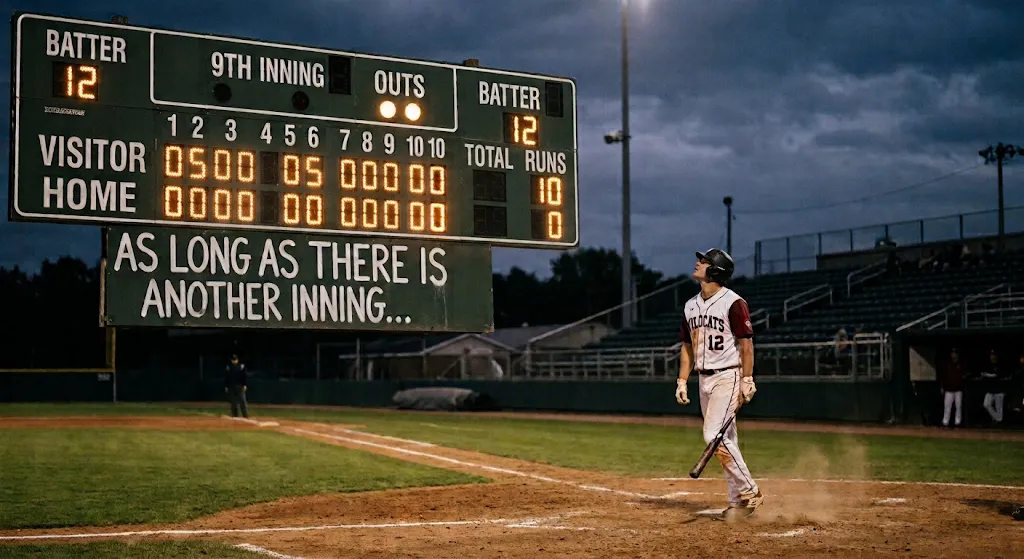
One of the reasons I love baseball is that it doesn’t believe in clocks.
In basketball, football, and soccer, the clock is king. You can be mounting a furious comeback, finding your rhythm, feeling momentum shift in your favor—and then the buzzer sounds. Game over. Time has spoken, regardless of how you played during the last few minutes.
Baseball is different. Theoretically, a game could go on forever. If it’s tied after nine innings, you keep playing. Ten innings, eleven, twelve, as long as it takes.
And even when things look utterly hopeless, baseball leaves a door open.
Picture a team trailing 10–0 in the bottom of the ninth with two outs. Most of us would turn off the TV. But technically, the game isn’t over. There is still one more batter, one more pitch, one more swing. A walk, a base hit, a double into the gap—suddenly runners are moving. Is a ten-run comeback likely? Absolutely not. But unlikely doesn’t mean impossible.
That might be baseball’s greatest lesson for the rest of us: Never confuse the two.
Life has a funny way of surprising us just when we think the final score is set. We look at our own personal scoreboards and may decide it’s time to pack it up. A career path stalls, a relationship breaks down, a health diagnosis catches us off guard, or we make a mistake we’re convinced we can never fix. Or maybe we just reach a certain birthday and start quietly telling ourselves that our best days are in the rearview mirror.
We forget a basic truth: there are still innings left to play.
Baseball doesn’t ask a batter to clear a ten-run deficit with a single swing. You just try to get on base. You let the next person step up. You take it one at-bat at a time.
When life feels overwhelming, we often paralyze ourselves by staring at the whole mountain instead of taking the next step. We want guaranteed outcomes before we move. But you don’t need to know how the whole game ends to step up to the plate today. Make the phone call. Offer the apology. Submit the application. Reach out to the old friend. Take the class. Swing the bat.
In baseball, a hitter can strike out three times and still drive in the winning run in the ninth. The scoreboard keeps track of what happened, but it doesn’t control what happens next. We are shaped by our past, but we aren’t prisoners of it.
And then there is what might be the most beautiful baseball metaphor of all.
Sometimes you are not the person at the plate.
Sometimes you’re in the dugout. Sometimes you are waiting your turn. Sometimes your job is to cheer for someone else. Sometimes the person who changes the game is a teammate you never expected to be the star.
That, too, is life.
We are not always the heroes of the story. Sometimes our most important contribution is encouraging someone else, opening a door for them, making a phone call on their behalf, or simply telling them, “Don’t give up.”
Because we might know something they may have forgotten:
The game isn’t over.
There is one more inning. One more chance. One more possibility.
Of course, there are limits to this metaphor. Life is not literally infinite. Unlike a baseball game, we do not get an unlimited number of innings. That makes our time even more precious.
But perhaps that is precisely the point.
We don’t know exactly how many innings we have left.
What we do know is that we are still in the game.
There’s also a distinctly Jewish weight to this way of looking at this idea.
The Talmud tells a story about King Hezekiah lying gravely ill. The prophet Isaiah visits with devastating news: the decree is set, and Hezekiah is going to die. But Hezekiah refuses to accept that the story is finished. He turns to the wall and prays. From this, the Sages derive a stunning principle: “Even if a sharp sword rests upon a person’s neck, a person should not refrain from praying for mercy” (Berakhot 10a).
Picture that image. The sword is literally touching a person’s neck. You couldn’t ask for a more hopeless situation. Yet the Talmud says: Don’t write the ending early. Don’t walk off the field while you’re still at bat.
This isn’t naive optimism. Judaism doesn’t promise that every prayer gets answered the way we want, just as baseball doesn’t promise a miracle comeback every time you’re down late in the game. It’s something subtler and deeper: the refusal to surrender hope prematurely.
It’s why our tradition places so much weight on teshuvah—the idea that no matter how far down a wrong road we’ve walked, we can turn around. The past is real, but it isn’t the final score.
In Pirkei Avot, Hillel famously warns, “Do not say, ‘When I have leisure I will study,’ for perhaps you will not have leisure.” His message is urgent: use the opportunity right in front of you today.
Pair Hillel’s wisdom with Hezekiah’s story, and you get the ultimate playbook: Act now with what you have, and when things look bleak, never assume the door is closed.
That sounds a lot like baseball.
Step up to the plate. Watch the pitch. Do what you can right now. You don’t need absolute certainty that you’re going to get a hit or win the game—you just need to believe the game isn’t over yet.
Perhaps that is what faith means as well.
Not the certainty that everything will turn out exactly as we wish, but the refusal to surrender hope before the final pitch.
As long as there is another inning, there is another possibility.
And perhaps, in life, that is sometimes the most important thing we can believe.